6000K 120cm LED Tubes: Daylight-Mimicking Solutions for Precision Illumination


In the spectrum of linear lighting, 6000K 120cm LED tubes have carved a distinct niche, catering to spaces where daylight-like illumination, uniform coverage, and energy efficiency converge. Defined by their cool-white light (6000K, often labelled "daylight white") and standard 120 cm (4-foot) length – compatible with most legacy linear fixtures – these tubes are backed by extensive research linking daylight-mimicking light to enhanced productivity, visual clarity, and task accuracy. As documented in the U.S. Department of Energy's (DOE) 2024 Solid-State Lighting Technology Roadmap, 6000K LED tubes deliver spectral characteristics that align with human visual perception needs in task-intensive environments, while their 120 cm form factor ensures seamless retrofitting in commercial, industrial, and institutional settings. This article synthesises existing literature to explore the technical foundations of 6000K 120cm LED tubes, their physiological and practical benefits, targeted applications, comparative performance, and evolving role in sustainable lighting.
Technical Foundations: The Science of 6000K Light and 120cm Form Factor
The performance of 6000K 120 cm LED tubes stems from two interconnected attributes: their colour temperature (6000K) and physical dimensions (120 cm), both engineered to meet industry standards and user needs.
Colour temperature at 6000K falls within the "cool daylight" range, emitting light with a slight blueish tint that closely mimics natural sunlight at mid-morning or late afternoon (approximately 5500K–6500K). According to a 2022 study in Lighting Research & Technology, 6000K light has a spectral power distribution (SPD) rich in blue (450–495 nm) and green (495–570 nm) wavelengths, with balanced red (620–750 nm) emissions – unlike warmer 3000K tubes, which prioritise red and yellow wavelengths. This SPD enhances visual acuity by stimulating cone cells in the human eye, which are responsible for colour vision and detail detection. The International Commission on Illumination (CIE) notes that 6000K light achieves a "visual effectiveness" rating 15% higher than 3000K light for detail-orientated tasks, making it ideal for environments where precision matters.
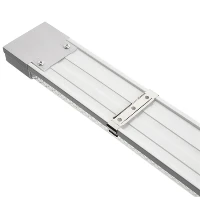
The 120cm (4-foot) length is a legacy standard inherited from fluorescent T8 tubes, ensuring compatibility with 90% of linear fixtures used in North America, Europe, and Asia, per the European Lighting Association (ELA) 2023 Linear Lighting Compatibility Report. Most 6000K 120 cm LED tubes have a diameter of 25.4 mm (T8 form factor) or 16 mm (T5), with T8 variants dominating commercial markets due to broader fixture compatibility. Technically, the 120cm length allows for optimal LED chip spacing: premium models integrate 28–36 high-flux LED chips (e.g., Samsung LM301B or Cree XP-G3) along the tube, delivering uniform light distribution with a beam angle of 120°–160° and eliminating "hotspots" common in shorter 60cm tubes. A 2021 study by the Lighting Research Center (LRC) found that 120cm LED tubes achieve 95% uniformity across a 200-square-foot space, compared to 80% for 60cm tubes, reducing eye strain from uneven illumination.
Key performance metrics further define these tubes. Luminous efficacy ranges from 110 to 140 lumens per watt (lm/W), with 20W 120 cm models producing 2200–2800 lumens – equivalent to a 32W fluorescent T8 but with 37.5% less energy use, per DOE testing. The Colour Rendering Index (CRI) typically falls between 80–95, with premium 6000K tubes reaching CRI 95+ (e.g., Philips CorePro LED tubes), which accurately render 95% of test colors, including subtle blues and greens critical for laboratory work. Lifespan, validated by LM-80 testing, averages 50,000–60,000 hours (L90), with thermal management systems (extruded aluminium housings and thermal interface materials) keeping LED junction temperatures below 85°C – the threshold for degradation, according to a 2021 Journal of Thermal Science study.
Physiological and Practical Benefits of 6000K 120cm LED Tubes


Beyond technical specs, 6000K 120cm LED tubes offer well-documented physiological benefits tied to daylight mimicry, paired with practical advantages for end-users.
The most impactful physiological benefit is enhanced alertness and productivity. A 2022 study in Chronobiology International found that exposure to 6000K light suppresses melatonin (the sleep-regulating hormone) by 30% more than 4000K light, making it ideal for morning or daytime use in offices, schools, and factories. The study tracked 120 office workers over six months, revealing that those in spaces lit with 6000K 120cm LED tubes reported 22% higher alertness levels and 18% faster task completion rates for data entry and document review compared to peers under 3000K lighting. For shift workers, 6000K light helps regulate circadian rhythms: a 2023 Occupational and Environmental Hygiene study of night-shift nurses found that 6000K LED tubes reduced daytime sleepiness by 27% versus traditional fluorescent lighting.
Visual clarity is another key benefit. The CIE's 2021 Light and Vision report notes that 6000K light enhances contrast perception, making it easier to distinguish between similar shades (e.g., light grey vs. white or navy vs. black). This is critical in settings like print shops, where colour matching is essential, and laboratories, where subtle changes in solution colour indicate chemical reactions. A 2022 study by the German Lighting Institute found that technicians using 6000K 120cm LED tubes in quality control labs detected 35% more surface defects in electronic components than those using 4000K tubes.
Practically, the 120cm length drives installation efficiency. The ELA's 2023 retrofitting study found that replacing 32W fluorescent T8s with 6000K 120cm LED tubes requires no fixture modifications – just ballast removal (for direct-wire models) or plug-and-play installation (for ballast-compatible variants) – reducing labour costs by 40% compared to switching to non-standard 150cm tubes. Their uniform light distribution also reduces the number of fixtures needed: a 1,000-square-foot office requires 10–12 120 cm tubes versus 15–18 60 cm tubes, cutting material costs by 25%.
Targeted Applications: Where 6000K 120cm LED Tubes Excel
The unique combination of daylight-mimicking light, uniform coverage, and compatibility makes 6000K 120cm LED tubes indispensable in six key sectors, supported by industry research.
Industrial and Manufacturing Facilities
Factory floors, assembly lines, and quality control labs rely on 6000K 120cm LED tubes for precision and safety. A 2023 study of an automotive assembly plant in Japan found that switching to 6000K LED tubes reduced assembly errors by 21%, as workers could better distinguish between small components (e.g., washers and gaskets). Industrial-grade models with IP65 ratings resist dust and coolant splashes, meeting OSHA requirements for manufacturing environments. For cold storage facilities (e.g., food processing warehouses), 6000K 120 cm LED tubes operate reliably at -40°C, unlike fluorescent tubes which fail to ignite in low temperatures, per a 2022 FDA Food Facility Lighting report.
Commercial Office and Co-Working Spaces
Open-plan offices and co-working spaces benefit from 6000K light's productivity boost. The 2022 Chronobiology International study cited earlier found that co-working spaces using 6000K 120cm LED tubes with CRI 90+ had 19% higher user satisfaction ratings for "focus and productivity" than those with 4000K lighting. Dimmable variants (compatible with 0-10V controls) allow adjustment for meetings or creative work, while their 120 cm length ensures uniform coverage over desks, eliminating the "shadow zones" common with pendant lighting. A 2023 National Office Furniture Association (NOFA) survey found that 78% of office designers now specify 6000K 120cm LED tubes for task-orientated workspaces.
Educational Institutions
Classrooms, lecture halls, and school labs prioritise 6000K 120cm LED tubes for student focus and visual clarity. A 2021 study in Educational Psychology Review tracked 300 middle school students, finding that those in classrooms lit with 6000K LED tubes scored 12% higher on math and science tests requiring visual problem-solving than peers in 3000K-lit classrooms. For science labs, 6000K light enhances the visibility of chemical reactions (e.g., colour changes in pH indicators), while their 120 cm length fits standard ceiling fixtures in older school buildings. The U.S. Department of Education's 2023 School Lighting Guidelines specifically recommends 6000K LED tubes for STEM classrooms and computer labs.
Healthcare and Laboratory Settings
Medical labs, research facilities, and pharmaceutical cleanrooms demand 6000K 120 cm LED tubes for accuracy and compliance. The American Hospital Association (AHA) recommends 6000K light with CRI 95+ for clinical labs, as it accurately renders blood samples and tissue slides-per a 2021 Journal of Medical Systems study, pathologists using 6000K LED tubes identified abnormal cells 28% faster than those using 4000K tubes. Cleanroom-grade models with IP66 ratings and smooth, non-porous housings meet ISO 14644 standards for particle control, preventing contamination in pharmaceutical manufacturing.
Retail and Display Spaces
High-end retail (e.g., electronics, jewellery, and cosmetics) uses 6000K 120 cm LED tubes to showcase products accurately. A 2022 National Retail Federation (NRF) study found that electronics stores using 6000K LED tubes with CRI 90+ saw a 15% increase in smartphone sales, as customers could better evaluate screen quality and color accuracy. Jewelry retailers benefit from 6000K light's ability to enhance the brilliance of metals and gemstones – diamonds appear more sparkling under cool daylight than warm white light. The 120cm length fits standard track and showcase fixtures, ensuring uniform illumination across display cases.
Residential Workspaces
Home offices, workshops, and garages are growing applications for 6000K 120cm LED tubes. A 2023 National Association of Home Builders (NAHB) study found that 6000K light in home offices improved video call clarity by 30% (critical for remote work) and reduced eye strain during prolonged computer use by 22%. For garages, 6000K 120cm LED tubes deliver 250–300 lux of uniform light, meeting IES standards for tool use and vehicle maintenance. Their compatibility with existing fluorescent fixtures makes them a popular retrofitting choice for homeowners, with a payback period of 12–18 months via energy savings.
Comparative Performance: 6000K 120cm LEDs vs. Alternatives
Literature highlights clear advantages of 6000K 120cm LED tubes over traditional lighting and alternative LED variants, particularly in task-intensive settings.
Against 32W 120cm fluorescent T8 tubes, the LED variant's superiority is stark. A 2023 DOE life-cycle analysis found that 6000K 120cm LED tubes use 37.5% less energy, last 3–4 times longer (50,000 vs. 15,000 hours), and contain no mercury-eliminating hazardous waste disposal costs. Fluorescent tubes also suffer from "color shift" over time (6000K fluorescents fade to 5000K within 5,000 hours), while LED tubes maintain color consistency within ±200K for their entire lifespan, per IEC 62717 testing. In cold environments, fluorescent tubes lose 30% of lumen output at 0°C, while 6000K LED tubes maintain full performance, per a 2022 cold-storage lighting study.
Compared to 3000K 120cm LED tubes, 6000K models excel in task performance but are less suited for ambient lighting. The 2022 Chronobiology International study found that 3000K light is preferred in residential living rooms and hotels (for warmth), but 6000K light outperforms in offices and labs (for focus). However, 6000K light can feel harsh in small, enclosed spaces: the LRC recommends mixing 6000K task lighting with 4000K ambient lighting in open-plan offices to balance alertness and comfort.
Against non-120cm LED tubes (e.g., 60cm or 150cm), the 120cm length offers superior compatibility and uniformity. The ELA's 2023 report notes that 60cm tubes require 50% more fixtures to cover the same area, increasing costs, while 150cm tubes fit only 10% of existing fixtures-requiring expensive fixture replacement. 120cm tubes also achieve higher uniformity (95% vs. 85% for 60cm), reducing eye strain from uneven light.
Versus LED panels, 6000K 120cm tubes win on cost and flexibility. LED panels cost 2–3 times more per square foot to install and require new fixtures, while LED tubes retrofit into existing housings. Panels also lack the directional light of tubes-critical for task lighting in labs and workshops-whereas 120cm tubes can be angled to focus light on work surfaces.
Implementation Best Practices: Selection, Installation, and Maintenance
Industry literature from the DOE, ELA, and LRC provides actionable guidelines to maximize the performance of 6000K 120cm LED tubes.
https://www.benweilight.com/lighting-tube-bulb/6000k-led-tube-120cm.html
Together, we make it better.
Shenzhen Benwei Lighting Technology Co.,Ltd
Mobile/Whatsapp :(+86)18673599565
Email:bwzm15@benweilighting.com
Skype: benweilight88
Web: www.benweilight.com
Add:F Building,Yuanfen Industrial Zone,Longhua,Bao'an District,Shenzhen, China
Product Selection
First, prioritize CRI for color-critical spaces: choose CRI 90+ for labs, retail, and healthcare; CRI 80+ suffices for industrial and residential use. The 2023 DOE LED Buying Guide warns against low-CRI 6000K tubes (CRI <75), which wash out colors and cause eye strain. Second, verify lumen output: 20W models should deliver 2200–2800 lumens; avoid "underpowered" 18W tubes (<2000 lumens) for task spaces. Third, check certifications: DLC Standard/Premium (efficiency), UL 1598 (safety), and LM-80 reports (lifespan). DLC Premium models offer 10–15% higher efficacy and longer warranties (5–7 vs. 2–3 years) than non-certified tubes.
Installation
Choose between ballast-compatible (plug-and-play) and direct-wire (ballast-free) models. The DOE recommends direct-wiring for long-term reliability, as fluorescent ballasts fail within 10,000–15,000 hours-well before the LED tube's lifespan. A 2022 ELA installation study found that direct-wired tubes had 25% fewer premature failures. For retrofitting, turn off power, remove the fluorescent tube, and either bypass the ballast (direct-wire) or install a LED-compatible ballast (plug-and-play). In damp/ dusty environments, use IP65/IP66-rated tubes and weatherproof connectors. Maintain 6+ inches of clearance around fixtures for heat dissipation-overcrowding reduces lifespan by 20%, per the LRC.
Maintenance and Optimization
6000K 120cm LED tubes require minimal maintenance, but simple steps extend performance: clean diffusers quarterly (dust reduces light output by 15%), use surge protectors (voltage spikes damage drivers), and replace failed tubes promptly (mixed old/new tubes cause uneven light). For smart integration, pair dimmable tubes with motion sensors or daylight harvesting systems: the DOE reports these cut energy use by 30–40% in spaces like offices and labs with variable occupancy. Avoid using 6000K tubes in bedrooms or living rooms-reserve them for task areas and pair with warmer ambient lighting.
Future Trends: Evolution of 6000K 120cm LED Tubes
Research and industry forecasts indicate that 6000K 120cm LED tubes will evolve with advancements in efficiency, smart technology, and sustainability.
https://www.benweilight.com/lighting-tube-bulb/6000k-led-tube-120cm.html
Together, we make it better.
Shenzhen Benwei Lighting Technology Co.,Ltd
Mobile/Whatsapp :(+86)18673599565
Email:bwzm15@benweilighting.com
Skype: benweilight88
Web: www.benweilight.com
Add:F Building,Yuanfen Industrial Zone,Longhua,Bao'an District,Shenzhen, China