A Buyer's Guide to Selecting High-Quality LED Chips for Superior Lighting Solutions

In the rapidly evolving lighting industry, the core of any superior LED product is its LED chip. Understanding the key performance parameters of LED chips is crucial for manufacturers, exporters, and buyers aiming to deliver or procure reliable, efficient, and high-quality lighting solutions. This guide breaks down the essential characteristics to consider, empowering you to make informed decisions and avoid the pitfalls of substandard components.
1. Luminous Efficacy and Efficiency: The Core of Energy Savings
Luminous efficacy, measured in lumens per watt (lm/W), is a fundamental metric indicating how efficiently an LED converts electrical power into visible light. Higher efficacy means more light output for less energy consumption, leading to significant operational cost savings.
Data Point: Early white LED chips from the study had an efficacy of approximately 1.6 lm/W for small chips, while larger power chips (1 mm × 1 mm) reached 18 lm/W [1]. Modern high-quality chips from leading manufacturers now far exceed these figures, with many standard chips achieving 130–150 lm/W and high-end versions reaching over 200 lm/W.
Application: For large-scale commercial or industrial lighting projects where energy costs are a major concern, prioritizing high-efficacy LED chips is paramount.
2. Color Quality: Consistency is Key
The color performance of an LED is defined by two main parameters: chromaticity (color consistency) and color rendering index (CRI).
Chromaticity & Color Temperature (CCT): LEDs from the same batch must have consistent color coordinates and correlated color temperature (CCT, measured in Kelvin). Inconsistencies lead to visible color differences in the final fixture, creating an unprofessional appearance.
Guideline: For a uniform lighting effect, the peak wavelength of LEDs in a batch should be within a 3-5 nm range. For critical applications like museum or retail lighting, an even tighter binning is required [1].
Color Rendering Index (CRI): CRI (Ra) measures how accurately a light source reveals the true colors of objects compared to natural light. A higher Ra indicates better color fidelity.
Standard: For most indoor applications, a CRI of Ra≥80 is standard. For settings where color discrimination is critical (e.g., galleries, retail stores, hospitals), a CRI of Ra≥90 is highly recommended [1].

3. Thermal Management: The Decider of Lifespan
An LED's performance and longevity are critically dependent on its operating temperature. Excessive heat (high junction temperature, Tj) accelerates light output degradation and shortens lifespan.
Impact of Heat: The study notes that for every 10°C increase in junction temperature, the LED's peak wavelength shifts by about 1 nm towards longer wavelengths, and its luminous intensity can decrease by approximately 1% [1].
L70 Lifetime: The industry standard for LED lifespan is the L70 rating-the time it takes for lumen output to depreciate to 70% of its initial value. High-quality LEDs with effective thermal management can achieve an L70 lifetime of 50,000 hours or more. Poor thermal design can cause premature failure and rapid light decay [1].
4. Key Selection Criteria for Reliable Sourcing
When sourcing LEDs, moving beyond basic specifications is essential to ensure long-term reliability.
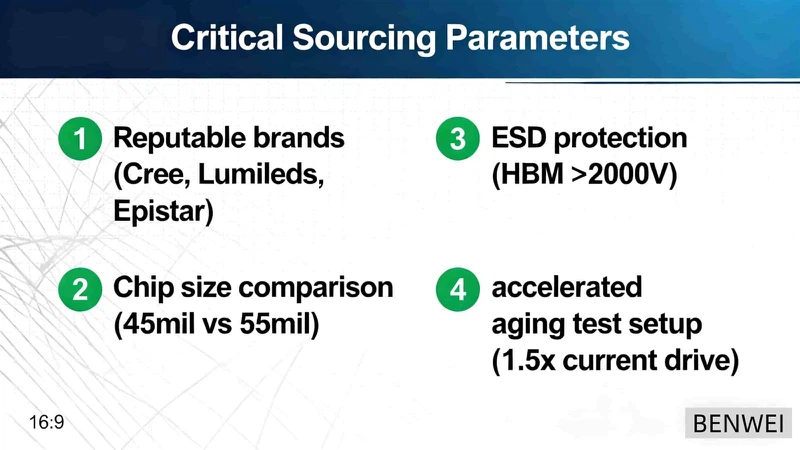
Chip Brand and Size: The brand and physical size of the semiconductor chip are primary indicators of quality and performance. Reputable international brands (e.g., Cree, Lumileds) and leading Taiwanese/Chinese manufacturers (e.g., Epistar, San'an) offer proven reliability. Larger chip sizes (e.g., 45 mil, 55 mil) generally offer better stability and higher brightness for power LEDs compared to smaller, cheaper alternatives [1].
ESD Protection: LEDs are sensitive to electrostatic discharge (ESD). Ensure the LEDs have a high ESD resistance, typically with a Human Body Model (HBM) rating of over 2,000V, to prevent failure during handling and assembly [1].
Aging Tests: Require suppliers to provide evidence of rigorous aging tests. Accelerated life tests, where LEDs are driven at higher currents (e.g., 1.5x the rated current) under controlled thermal conditions, can quickly identify products with poor longevity and high initial light decay [1].
Partner with a Manufacturer That Masters the Fundamentals
For global buyers, the complexity of LED technology makes it vital to partner with a lighting manufacturer that has deep expertise in LED chip selection and integration.
Benwei Lighting, a professional LED solutions provider based in Shenzhen, China, builds its products on this foundational knowledge. We ensure superior product quality by:
Strategic Chip Sourcing: We use high-efficacy chips from reputable suppliers, carefully binned for color consistency and performance.
Robust Thermal Design: Our fixtures are engineered with advanced heat sinks and thermal management systems to keep junction temperatures low, ensuring long life and stable performance.
Rigorous Quality Control: Every batch of LEDs undergoes strict electrical and photometric testing, including aging tests, to guarantee they meet our high standards before being integrated into your order.
By focusing on the core science of LEDs, Benwei Lighting delivers lighting solutions that are not only bright and efficient but also reliable and consistent over their entire lifespan.

Reference
[1] Du, B., Shi, J., Wang, L., & Wan, C. LED Assembly Technology and Soldering Process. China National Electric Apparatus Research Institute.
Source High-Performance LED Products with Confidence:
Company: Shenzhen Benwei Lighting Co., Ltd.
Contact Email: bwzm15@benweilighting.com
Website: http://www.benweilight.com/
https://www.benweilight.com/industrial-lighting/lamp-bead.html
FAQs
Q1. How Can I Get These Samples?
A1: Hi, easy for this. Give me your address and tell me which item you need; we will arrange for it to be sent to you by DHL or FedEx.
Q2: How About Your Quality?
A2: All raw material is top quality to ensure high luminosity and enough brightness.
Q3: What About The Lead Time?
A3: The sample needs 3-5 days; mass production time needs 25-40 days after receiving the deposit