A Comprehensive Analysis of LED Temporary Construction Lighting Fixtures
By Kevin Rao November 26,2025
In the underground construction site of a commercial complex in Munich, Project Manager Thomas was inspecting the quality of concrete pouring. When he activated the newly procured LED temporary construction lighting system, uniform light instantly filled every corner, revealing even the details of rebar tying nodes. "This is 40% more efficient than the halogen lamps we used last year," he recorded in the project log. "More importantly, workers report significantly reduced visual fatigue."
Such scenes are unfolding at construction sites worldwide. According to the U.S. Department of Energy's 2023 whitepaper on building lighting, the penetration rate of LED technology in the temporary lighting sector has increased from 35% five years ago to 72% today. This shift stems not only from energy conservation considerations but also from a redefinition of work efficiency and safety standards.
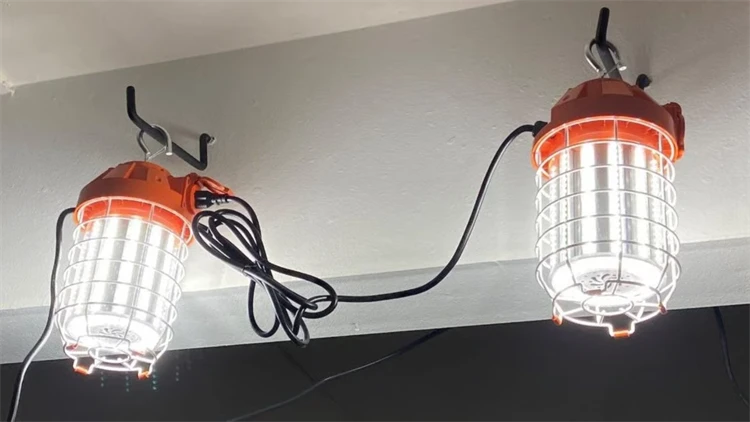
I. Technical Analysis: Core Technical Parameters of LED Temporary Lighting
1. Optical Performance Index System
Luminous Flux Output: Measured in lumens (lm), directly determining the illumination area. Professional-grade LED temporary construction lights need to achieve 8,000-20,000 lm, equivalent to three times the output of traditional 500W halogen lamps.
Beam Angle Control: Utilizing secondary optical design, narrow beams (30°) are suitable for high-point task lighting, while wide beams (120°) are ideal for area floodlighting.
Color Rendering Index (CRI): Construction work requires CRI ≥ 80, with areas for detailed tasks like electrical wiring needing CRI ≥ 90.
2. Mechanical Structure Protection Standards
IP Protection System: IP65 rating provides dust and water resistance, IP67 allows for temporary immersion, and IP68 is suitable for extreme environments like tunnel construction.
Impact Resistance Rating: IK08 protection can withstand 5 joules of impact energy, equivalent to a 1kg object falling from a height of 0.5m.
Thermal Management Design: Utilizing aluminum alloy heat sinks with thermal silicone ensures the chip junction temperature remains below 85°C.
3. Power Adaptation Characteristics
Wide Voltage Input: AC100-240V self-adaptive design handles grid fluctuations.
Power Factor Correction: High-quality fixtures require PF ≥ 0.9 to reduce reactive power loss.
Harmonic Control: THD < 20% complies with IEEE519 standard.
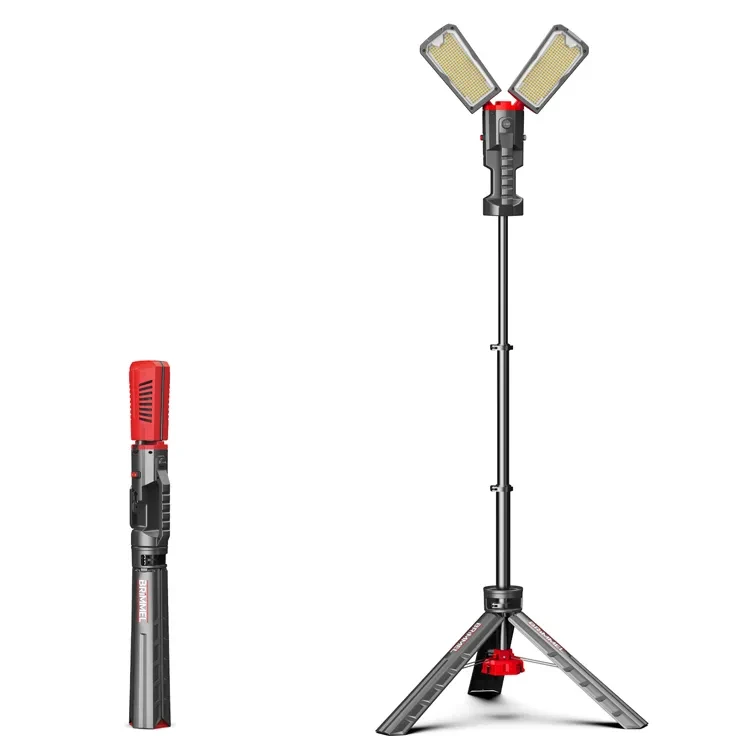
II. Application Scenarios and Equipment Selection Matrix
| Scenario Type | Recommended Fixture Type | Technical Parameter Requirements | Configuration Density Standard | Typical Case Study |
|---|---|---|---|---|
| Underground Structure Construction | Explosion-proof LED Floodlight | IP67, IK10, 15000lm | 4 nodes per 100㎡ | Stockholm Metro Extension Project |
| Steel Structure Installation | Magnetic LED Work Light | 5000lm, 360° adjustable | 2-3 sets per work area | Burj Al Arab Maintenance Project |
| Finishing & Decoration Phase | Track-mounted Dimmable Lights | CRI>90, Adjustable Color Temperature | Configure per work team | Paris Opera Restoration Project |
| Emergency Rescue Operations | Portable Generator-integrated Light | 8h runtime, 2m drop resistance | 4 sets standard for advance teams | Japan 3/11 Post-disaster Reconstruction |
| Road & Bridge Construction | High-Pole Tripod System | 20000lm, 10m pole | Deploy every 50m spacing | Hong Kong-Zhuhai-Macao Bridge Project |
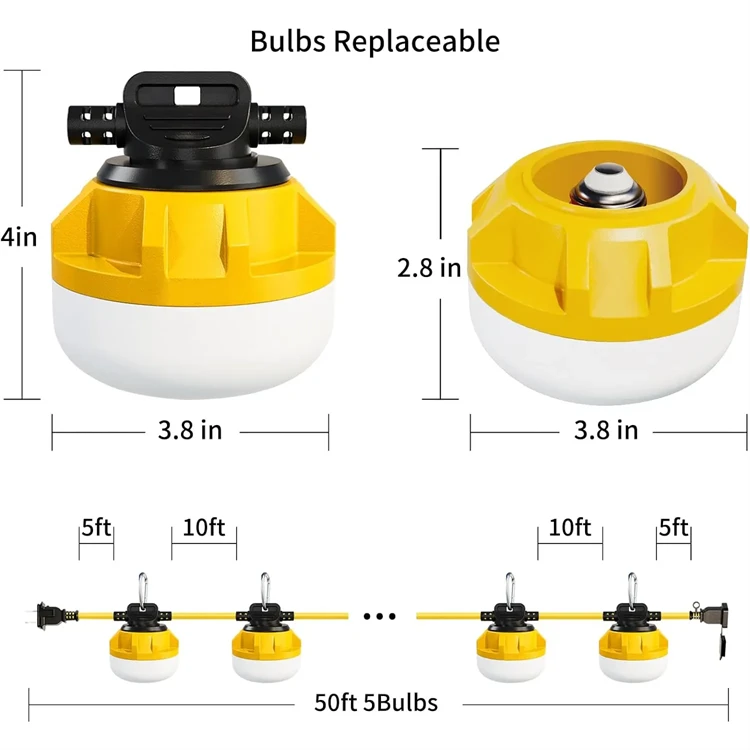
III. Professional Selection Evaluation System
1. Optical Requirements Analysis
Basic work areas should maintain 50-100 lux
Precision installation areas require 200-500 lux
Color discrimination tasks require illumination uniformity U0 ≥ 0.7
2. Environmental Adaptability Assessment
Low-temperature environments: -40℃ requires preheating devices
High-temperature environments: Above 55℃ requires enhanced heat dissipation design
Corrosive environments: Coastal areas require C5-M anti-corrosion rating
3. Operational Cost Model
math
TCO = \frac{Procurement\ Cost + (Annual\ Energy\ Cost × Service\ Life)}{Usage\ Efficiency}
Case Analysis: A project using 300W LED lights to replace 1000W metal halide lamps saves 2100 kWh per lamp annually, with a payback period < 1.2 years.
IV. Technological Innovation Trends
1. Intelligent Control Systems
Zigbee-based group control enables automatic illumination adjustment
Motion sensors trigger energy-saving modes, automatically reducing power by 50% when unoccupied
Remote monitoring platforms collect real-time status of each fixture
2. Energy Architecture Optimization
Integrated solar-storage-LED systems break grid limitations
DC power supply architecture efficiency increases to 94%
Modular battery packs support hot-swappable replacement
3. Human Factors Engineering Applications
Circadian rhythm algorithms dynamically adjust color temperature (2700K-5700K)
Anti-glare micro-prism technology controls UGR value below 16
Gradual dimming design avoids light adaptation issues
V. Standards and Regulations Interpretation
According to OSHA 29 CFR 1926.56 standards, illumination requirements vary significantly across construction phases:
Excavation and shoring phase: Minimum 10 lux, Recommended 50 lux
Structural construction phase: Minimum 30 lux, Recommended 100 lux
Equipment installation phase: Minimum 50 lux, Recommended 200 lux
Simultaneously, compliance with ANSI/IESNA RP-7-20 standards for temporary lighting installation is required:
Fixture mounting height should be greater than 2.4m
Emergency lighting must maintain 10% of normal illumination
Distribution circuit insulation resistance ≥ 1MΩ

VI. Frequently Asked Questions
Q1: How to adjust lighting schemes according to construction phases?
A1: Recommended three-phase lighting strategy:
Earthwork phase: Deploy IP68 rated floodlights, spaced 15-20m apart
Main structure phase: Adopt hybrid lighting system, 6:4 ratio of flood to task lighting
Finishing phase: Configure track-mounted dimmable lights, unified 4000K color temperature
Q2: What are the key considerations for selecting explosion-proof fixtures?
A2: Three dimensions must be considered simultaneously:
Explosive atmosphere classification (Class I hazardous locations)
Temperature class requirements (T4 level and above)
Protective material selection (copper alloy explosion-proof housing)
Q3: How to verify actual performance indicators of lighting fixtures?
A3: Recommended on-site testing of three key parameters:
Use illuminance meter to measure work surface uniformity
Use power quality analyzer to detect THD value
Observe heat distribution via thermal imager
Q4: How to integrate temporary lighting systems with BIM technology?
A4: Recommended four-step integration process:
Preset lighting points in BIM model
Perform illumination simulation analysis
Generate equipment list and wiring plan
Output installation positioning drawings
VII. Conclusion
LED temporary construction lighting has evolved from simple illumination tools to essential components of smart construction sites. In the Hamburg Elbphilharmonie project, deploying intelligent LED temporary lighting systems not only reduced energy consumption by 32% but also controlled construction accuracy errors to millimeter levels. As former International Commission on Illumination President Werner Jorg stated: "Quality lighting is the invisible cornerstone of engineering quality."
When we switch on the first light in darkness, we illuminate not just the work area, but the path to engineering excellence. Choosing scientific temporary lighting solutions is essentially insuring project quality.
References:
U.S. Department of Energy. (2023). Solid-State Lighting R&D Plan
OSHA Standard 29 CFR 1926.56 (2024 Edition)
IESNA. (2023). Lighting Handbook: Reference & Application
IEEE Standard 519-2022 for Harmonic Control in Electrical Power Systems