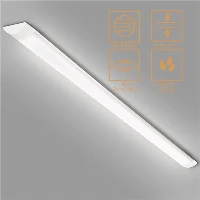
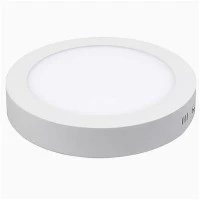
Let's define each of the main parts of an LED panel: an aluminum frame, LED chips, a light guide plate, a diffusion board, reflective paper, a rear cover, and a driver.
LED panel lights are ceiling fixtures that can be square, rectangular, or circular, and they can produce impressive brightness efficiently because of the integrated LED chips in their construction!
1.An aluminum frame, which can have a different IP rating and is frequently made of rust-resistant materials to ensure durability and longevity, serves as the primary channel for the LED chips to disperse heat and support the entire fitting.
2.The light source of the LED panel is the LED chips, which are solid-state semiconductors that directly transform energy into light.
3.This part, the light guide plate, controls the quality of an LED panel by refracting light through the dots and exporting it uniformly from the front.
4.Diffusion board: uniformly distributes the brightness from the light guide plate and helps the LED panel blur the individual LED chips.
5.In order to increase the efficiency of the fitting, reflective paper reflects the leftover light onto the rear of the LED panel.
6.Rear cover: it protects the LED panel and assists with light dispersion.
7.An LED panel's driver is its power supply; without it, the fixture cannot work.
Benefits of LED Panel Lights
Why are LED panels necessary for your space? How much does it improve the illumination you have now? LED panel lights are more economical, long-lasting, environmentally friendly, and energy-efficient than traditional lighting fixtures. They provide advantages that incandescent lamps and fluorescent tubes cannot match. Here is a detailed explanation of each benefit!
Energy Efficiency
LED chips are used in the creation of LED panels. About 95% of the electricity used by this technology can be converted into light, with only 5% going to waste (heat). This incredibly high electricity-to-light conversion allows LED panels to operate with little energy usage while producing unmatched brightness!
Longevity
The typical lifespan of an incandescent lightbulb is 1,000 hours. A fluorescent bulb, on the other hand, has a lifespan of around 7,000 to 15,000 hours. If you think those numbers are amazing, you'll be amazed at how long an LED panel can endure!
LED panels typically have an average lifespan of 25,000 to 30,000 hours. Years will pass before a replacement needs to be bought and installed again! But hold on, things get better! Similar to other LED fixtures, LED panels experience a phenomenon known as lumen degradation. This implies that the light will gradually fade rather than abruptly go off when it reaches 25,000 or 30,000 hours.
Thus, you may continue to use your panels until they are too dark to be useful!
Light Quality and Distribution
Switching to LED panel lights is a great option if you value attention to detail in your environment. The diffuser distributes light evenly, and the premium LED chips guarantee a high CRI rating.
Design and Aesthetics
Because of its slender construction and dazzling white finish, LED panel lights can adapt to any home design. Choose between a circle, square, or rectangle and choose the correct color temperature to suit your tastes!
Eco-Friendly Features
LED panel lights don't contain any dangerous chemicals. They will not jeopardize your health and harm the environment. In fact, utilizing LED panels can minimize your carbon footprint and lessen the garbage discarded at disposal sites.
Types of LED Panels
If you were unaware that there are other varieties of LED panels, here are few that you shouldn't overlook!
Surface-Mounted LED Panels
A surface-mounted panel light hangs immediately above the ceiling. It's excellent if you rent the space since attaching and removing is straightforward. Surface-mounted LED panels are widespread in offices, stores, garages, storage spaces, libraries, and more!
Recessed LED Panels
Recessed panel lights are one of the most common forms of LED panels and are commonly seen in offices and commercial businesses. They are flush installed against the ceiling and blend in smoothly with the surface, giving it a polished and clean appearance.
Suspended LED Panels
Using a particular kind of mounting kit, you can hang LED panel lights by attaching the wires to your ceiling so the panel hangs. This is ideal for more artistic applications and modern spaces. If you want to add some color and vibrancy to your business setup, think about using a suspended panel.

https://www.benweilight.com/ceiling-lighting/flat-led-panel/led-flat-led-panel-receesed-lgiht.html