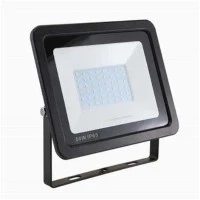
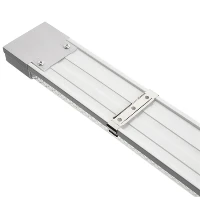
The Impact of Supplemental Red LED Lighting on the Growth of Nursery Pigs: A Scientific Approach to Modern Pig Farming

In modern pig production, optimizing environmental conditions is crucial for maximizing growth performance and overall herd health. Among various environmental factors, lighting has gained increasing attention for its influence on animal physiology and behavior. This article explores the effects of supplemental red LED lighting on nursery pigs, supported by scientific research, and introduces Shenzhen Benwei Lighting as a leading provider of agricultural lighting solutions.
The Importance of Lighting in Pig Farming
Light is a key environmental factor that affects animal growth, reproduction, and well-being. In intensive pig farming, especially in enclosed housing systems, natural light is often insufficient. Inadequate lighting can lead to reduced growth rates, lower immunity, and impaired reproductive performance. For instance, one study reported that only 40.3% of gilts showed estrus under low-light conditions, far below the normal rate of over 90% (Gao et al., 2019).
Traditional lighting systems, such as incandescent and fluorescent lamps, have been widely used. However, LED technology offers significant advantages, including higher energy efficiency, longer lifespan, and the ability to emit specific wavelengths of light that can positively influence animal biology.
Scientific Study: Red LED Light and Nursery Pigs
A recent study conducted by Song Zhongxu et al. (2022) investigated the effects of supplemental red LED light on the growth performance of nursery pigs. The experiment was carried out at the Hubei Academy of Agricultural Sciences from January 15 to February 9, 2021.
Experimental Design
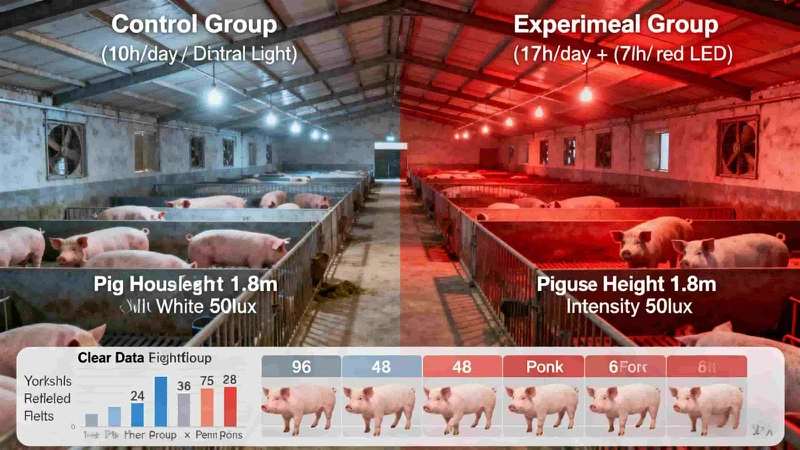
A total of 96 healthy weaned Yorkshire piglets were divided into two groups: a control group and an experimental group. Each group contained 48 pigs, further divided into 6 pens with 8 pigs each. The control group received only natural light (approximately 10 hours per day), while the experimental group was exposed to supplemental red LED light for 7 hours daily (5:00–8:00 and 18:00–22:00), totaling 17 hours of light per day.
The red LED bulbs used were 3W, suspended 1.8 meters above the floor, and equipped with waterproof and dustproof covers to ensure uniform illumination. The light intensity at pig eye level was approximately 60 lux, which falls within the recommended range for nursery pigs (Gao Yan, 2015).

Key Findings
The results were statistically significant and demonstrated clear benefits of red LED supplementation:
Increased Daily Weight Gain: The experimental group showed an average daily weight gain of 391 g, compared to 325 g in the control group-an increase of 66 g per day.
Improved Feed Conversion Ratio (FCR): The FCR in the experimental group was 1.61, compared to 1.67 in the control group-a 3.59% improvement.
Consistent Growth Enhancement: All pens in the experimental group showed higher weight gain, with some differences being highly significant (P < 0.01).
These findings indicate that red LED light not only promotes growth but also enhances feed efficiency, making it a cost-effective intervention for pig producers.
Why Red Light?

Pigs have two types of cone cells in their eyes, with peak sensitivity at 439 nm (blue) and 556 nm (green). However, they show reduced sensitivity to wavelengths above 650 nm-the red light spectrum (Yao et al., 2019). This means red light is less likely to cause stress or behavioral disturbances.
Historical and international studies support the use of red light in pig farming:
In the 1990s, Hungarian researchers found that red light increased daily gain and feed efficiency, while blue light caused restlessness and higher mortality (Wang Changqing, 1993).
Red light in the range of 600–1000 nm can penetrate the skull and increase intracranial temperature, promoting activity and growth through photothermal effects (Zhang Ying, 2019).
How Light Influences Pig Physiology

Light influences pigs through the retina-hypothalamus-pineal gland axis. Light signals received by the retina are transmitted to the suprachiasmatic nucleus (SCN), which regulates melatonin secretion from the pineal gland. This, in turn, affects circadian rhythms and the release of various hormones that influence growth, immunity, and stress response (Niekamp et al., 2007).
LED lights, with their high luminous efficacy (50–200 lm/W) and long lifespan (up to 100,000 hours), are particularly effective in delivering consistent and biologically beneficial light spectra.
Recommendation: Shenzhen Benwei Lighting Company
For pig producers looking to implement scientifically backed lighting systems, Shenzhen Benwei Lighting offers a range of high-quality, energy-efficient LED solutions tailored for agricultural use.
Why Choose Benwei Lighting?
Specialized Agricultural LED Products: Benwei provides red LED bulbs and fixtures designed specifically for livestock farming, ensuring the right wavelength and intensity for optimal animal response.
Energy Efficiency and Durability: Benwei's LEDs consume less power and have a long operational life, reducing both energy and replacement costs.
Customizable Solutions: Whether for nursery, growing, or breeding phases, Benwei offers customizable lighting systems to meet specific farm requirements.
Expertise and Support: With years of experience in industrial and agricultural lighting, Benwei provides professional guidance and after-sales support to ensure successful implementation.
By integrating Benwei's red LED lighting systems, pig farms can replicate the experimental conditions described in the study and achieve similar improvements in growth performance and feed efficiency.
Conclusion

The study by Song et al. (2022) clearly demonstrates that supplementing nursery pigs with 60 lux of red LED light for 7 hours daily (total 17 hours) significantly enhances daily weight gain and improves feed conversion. These findings highlight the importance of light management in modern pig production and offer a practical strategy for boosting productivity.
With advanced LED technology from companies like Shenzhen Benwei Lighting, pig farmers can now easily and effectively implement scientific lighting regimens to maximize growth, health, and profitability.
References
Gao Wanglong, Xie Shuihua, Huang Zhen, et al. (2019). Pig Farming. (2): 87–88.
Gao Yan (2015). Animal Husbandry and Feed Science. 32(12): 42–43.
Niekamp S.R., Sutherland M.A., Dahl G.E., et al. (2007). Journal of Animal Science. 85(1): 93–100.
Song Zhongxu, Li Lianghua, Zhao Haizhong, Peng Guangwen, Sun Hua, Mei Shuqi (2022). Swine Production. (2): 44–46.
Wang Changqing (1993). Livestock and Poultry Industry. (3): 28.
Yao Chunyan, Li Qin, Wang Qiangjun, et al. (2019). Animal Husbandry and Feed Science. 51(9): 113–118.
Zhang Ying (2019). Modern Animal Husbandry Science and Technology. 55(7): 11–12.
FAQ
Any question or wanna send an inquiry!
Q1. How soon is the lead time?
A: For sample order, 7-17 days if no stock. For bulk order, 15-30 days.
Q2. Can your products' label, packaging, design be customized?
A: Yes, we offer customization service on these.
Q3. How can we guarantee quality?
A: Always a pre-production sample before mass production; Always final Inspection before shipment.
Q4. How do you ship the goods and how long does it take to arrive?
A: We usually ship by DHL, UPS, FedEx or TNT. It usually takes 3-5 days to arrive. Airline and sea shipping also optional.
Q5. What is your payment way?
A: Paypal / Visa / Western Union / online transfer / apply pay / T/T all works for us for payment.
Shenzhen Benwei Lighting Technology Co.,Ltd
Telephone: +86 0755 27186329
Mobile(+86)18673599565
Whatsapp :19113306783
Email:bwzm15@benweilighting.com
Skype: benweilight88
Web: www.benweilight.com