Advantages and applications of LED breeding lights in poultry farming
The energy-efficient narrow-band emission of LED light sources makes lighting technology of great value in life science applications. In this article, the three-proof light manufacturer will introduce the advantages and applications of LED breeding lights in poultry farming, and hope to help everyone!
The advantage of LEDs is that they can provide a customizable tunable spectrum. The spectral sensitivity of animals is different from that of humans, as are the spectral requirements. By optimizing the spectrum, radiation, and modulation in the barn, farmers can create a good lighting environment for their animals, which will keep them happy, thereby promoting their growth while reducing energy and feed expenditures.
LED Breeding Light
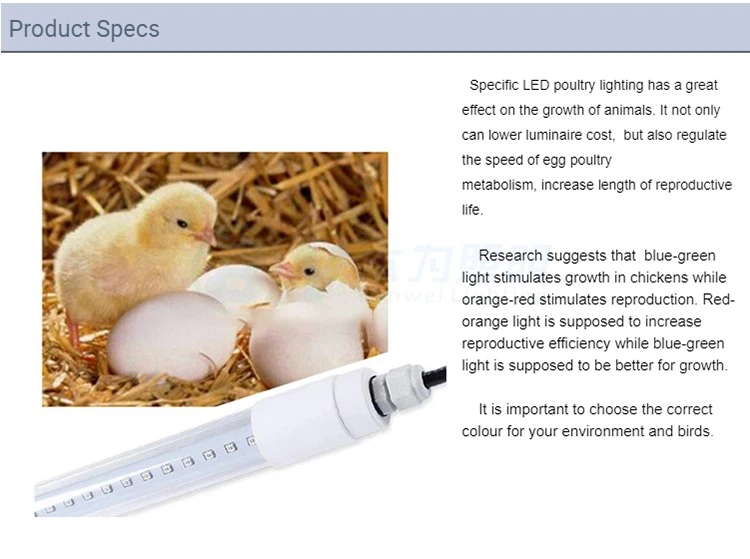
Poultry are four-colored. Like humans, poultry has a peak sensitivity to green at 550 nm. But they are also highly sensitive to red, blue and ultraviolet (UV). But perhaps the most striking difference between humans and poultry is the ability of poultry to visually sense ultraviolet light (peaking at 385nm).
Each color has a distinct effect on the physiology of poultry. For example, the proliferation of skeletal muscle satellite cells can be enhanced by green light, increasing growth rate at an early stage. Blue light increases growth at later ages by raising plasma androgens. Narrow-band blue light reduces motion and also reduces the rate of cannibalism. Green and blue light work together to promote the growth of muscle fibers. Overall, blue light has been shown to improve feed conversion by 4%, reducing cost per pound by 3% and increasing overall live weight by 5%.
At the beginning of the rearing period, red light can increase the growth rate of chickens and increase the amount of exercise of chickens, thereby reducing leg diseases. Red light also reduced feed consumption per egg lay, while the eggs produced did not differ in size, weight, shell thickness, yolk and albumin weight. Overall, red lights have been shown to prolong peak production, increasing production by 38 eggs per hen and potentially reducing consumption by 20%.
The above is an introduction to the advantages and applications of LED breeding lights in poultry farming, I hope it can help everyone. In addition, if you want to know more information, you can pay more attention to our website dynamics!