Garages and workshops are spaces where many people struggle to choose the right lighting solution; while the areas may not be large, the demands for brightness and durability are high-especially in workshops where precision tasks like vehicle repair or woodworking take place. LED batten lights (linear LED fixtures) are frequently recommended for these settings, but their suitability depends on the specific usage scenario. This article explores this topic.
Specific Lighting Needs for Garages and Workshops
Garages and workshops differ from standard living spaces; they often feature limited ceiling heights and elongated layouts, and are frequently exposed to harsh environmental factors like dust, grease, and moisture. Furthermore, because tasks often require seeing fine details-such as in auto repair, woodworking, or appliance maintenance-the requirements for overall illuminance and color rendering are significantly higher than in living rooms or bedrooms. When selecting fixtures, one must balance brightness, protection ratings, and ease of installation.
Brightness Performance of LED Batten Lights
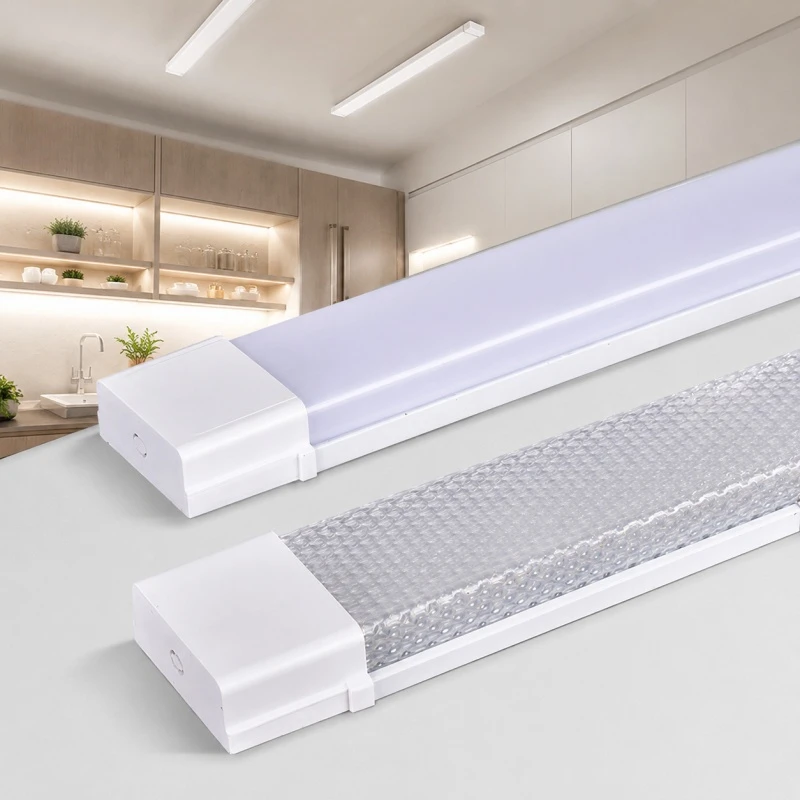
A major advantage of LED batten lights is the uniform illumination provided by their linear structure. Unlike the point-source lighting of traditional downlights or flush-mount ceiling lights, batten lights cast a linear band of light that minimizes shadows and dark spots. This is highly practical for garages, where good visibility is needed across workbenches and around vehicle bodies. For a standard residential garage, a single batten light with a power output of 20–40W generally meets daily lighting needs. In two-car garages or larger workshops, overall brightness can be increased by installing multiple fixtures in a row, eliminating the need to switch to higher-wattage units.
Suitability of Protection Ratings for Garage Environments
This depends on the specific conditions. Standard indoor batten lights typically have an IP20 rating, making them suitable only for dry, dust-free environments. If the garage is subject to wet activities like car washing or floor mopping, or if the workshop generates significant dust (such as a woodworking shop), you should choose batten lights with an IP65 rating or higher. These fixtures feature better housing seals that effectively prevent moisture and dust from entering and compromising the light's lifespan. Therefore, strictly speaking, not all batten lights are suitable for garages; when selecting a model, you must check the ingress protection (IP) rating rather than simply installing a standard indoor light fixture.
Installation flexibility suited to the space
Garage and workshop ceilings are usually not very high, making the surface-mounted design of batten lights ideal for these settings; unlike high-output high-bay lights, they do not consume excessive vertical space. Furthermore, the ability to daisy-chain batten lights is highly convenient for the long, narrow layout of a garage-multiple units can be installed in a continuous row along the length of the space, providing far more uniform illumination than a few scattered, high-output ceiling lights. This is a key reason why many homeowners prioritize batten lights when renovating their garages.
Long-term cost comparison
Compared to traditional fluorescent tubes, LED batten lights generally offer a lifespan exceeding 30,000 to 50,000 hours. Combined with low power consumption, they are perfect for garages-spaces that require stable, long-term operation but do not see continuous daily use-eliminating the hassle of frequent tube replacements. Although the initial purchase price is slightly higher than standard fluorescent fixtures, LED batten lights prove more cost-effective in the long run when factoring in electricity bills and maintenance costs; this cost advantage is even more pronounced in high-usage environments, such as commercial repair workshops.
Scenarios where they are less suitable
Not every garage or workshop scenario is suitable for standard batten lights. For instance, if the garage stores flammable liquids (such as paint or gasoline) or if the workspace involves spray painting-creating a risk of dust explosions-explosion-proof fixtures are required instead of standard batten lights; such specialized environments fall outside the scope of conventional batten lights. Additionally, in spaces with high ceilings (such as a workshop converted from a high-ceilinged warehouse), the beam angle and coverage of batten lights may be less effective than high-bay lights, necessitating a re-evaluation of the fixture type based on the actual ceiling height.
Conclusion
Overall, LED batten lights are well-suited for most residential garages and standard workshops, offering advantages such as uniform illumination, flexible installation, and low long-term operating costs. However, it is essential to select the appropriate ingress protection (IP) rating based on factors like humidity and dust levels; specialized environments-such as those with flammable or explosive hazards or exceptionally high ceilings-may require different types of lighting fixtures.
If you are selecting a lighting solution for your garage or workshop but are unsure about the required wattage or IP rating, please feel free to share your space dimensions and intended use with us. We can recommend suitable product models and welcome your inquiries at any time.