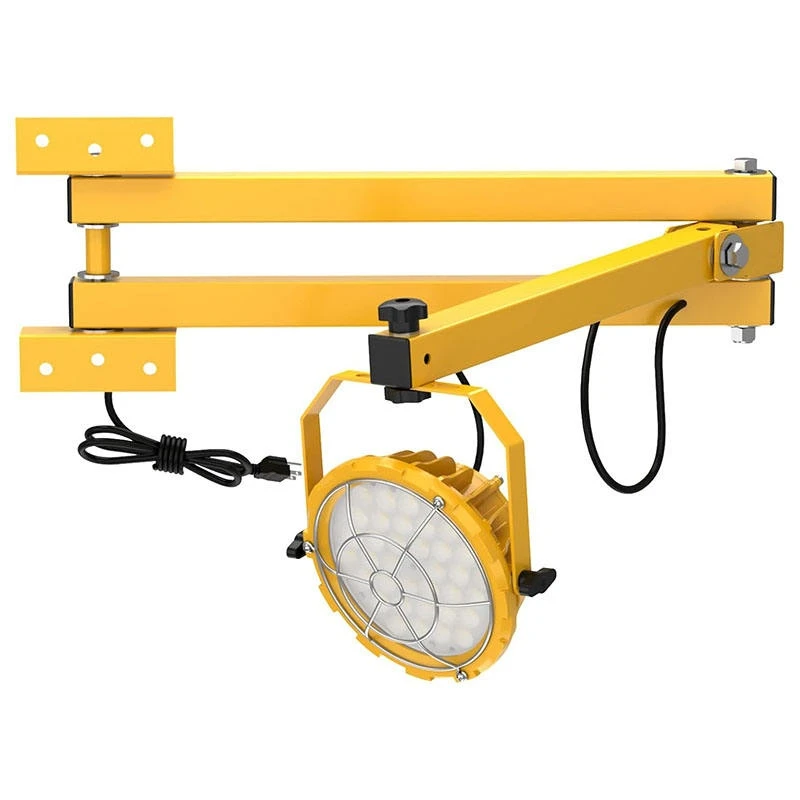
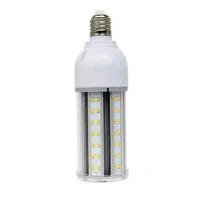
If you are selecting lighting for warehouse loading docks, loading zones, or freight bays, you have likely encountered this question: given that halogen lights have been the standard for years, are LED dock lights truly more energy-efficient? Is it worth making the switch? Dock lights are typically installed beside loading platforms to illuminate the interiors of truck trailers; they operate for long periods daily, with some warehouses running around the clock. While the wattage of a single light may seem low, the cumulative cost of electricity becomes significant when multiplied by the number of units and hours of operation. Below, we break down the differences between LED and halogen lights across several practical dimensions.
Power and Brightness: The Difference in Energy Consumption for the Same Light Output
Common halogen dock lights range from 50W to 150W, with some older models consuming even more power. In contrast, LED dock lights that deliver comparable illumination typically require only 15W to 40W.
In other words, to illuminate the same truck trailer, an LED light consumes only 20% to 40% of the power used by a halogen light. This is the primary source of energy savings.
Luminous Efficacy Comparison: Lumens Produced per Watt
Luminous efficacy refers to the amount of luminous flux (measured in lumens) produced per watt of electrical energy consumed (lm/W). Halogen lights have an efficacy of approximately 15–25 lm/W; a large portion of the electrical energy is converted into heat rather than light.
LED dock lights typically achieve an efficacy of 100–150 lm/W, with some high-quality products performing even better. This means that for every watt of electricity, an LED light produces 5 to 8 times more light than a halogen light.
It is also worth noting that halogen light disperses in all directions, requiring a reflector to focus the beam-a process that entails energy loss. LED light sources, however, are inherently more directional, resulting in more effective light actually reaching the interior of the trailer.
Heat Generation: The Overlooked "Hidden Electricity Cost"
Halogen lights generate high surface temperatures during operation; it is no exaggeration to say that the area near the lamp head becomes hot enough to burn the touch. This leads to two issues:
Heat represents wasted electrical energy.
In loading dock areas served by air conditioning or cold storage, the heat emitted by the lights increases the cooling load, indirectly driving up electricity costs.
LEDs generate far less heat, offer better control over fixture temperature, and have a minimal impact on the surrounding environment and cargo. This is a particularly important consideration if your loading dock connects to a cold-chain warehouse.
Service Life and Maintenance Costs
Halogen bulbs typically last between 2,000 and 4,000 hours; for a loading dock operating over a dozen hours a day, this means replacing bulbs every few months.
LED dock lights usually have a rated lifespan of 30,000 to 50,000 hours-meaning they can last seven or eight years based on 12 hours of daily use.
While not strictly "electricity consumption," bulb replacement involves labor, working at heights, and sometimes pausing loading/unloading operations; when these costs are factored in, they often rival the cost of electricity itself. Saving on energy and saving on maintenance are essentially two sides of the same coin.
Switching and Startup Characteristics
Halogen lights require a warm-up period to reach full brightness, and frequent switching significantly shortens bulb life. Consequently, many warehouses simply leave them on, resulting in additional wasted electricity.
LEDs turn on instantly, and the frequency of switching has little impact on their lifespan. When paired with sensors or timers, they can be set to turn on when a vehicle arrives and off when it leaves, further reducing unnecessary energy consumption.
Shock Resistance and Durability
Loading docks are "rough" environments: truck traffic, forklift collisions, and the opening and closing of doors all generate vibration. The tungsten filaments in halogen bulbs are fragile and prone to snapping from vibration; once a bulb fails, it must be replaced-often after having wasted electricity for a period prior to failure.
LEDs are solid-state light sources with no filaments, offering far superior shock resistance. Stable operation ensures that energy-saving performance is maintained over the long term, rather than diminishing as the light is used.
Conclusion
Returning to the initial question: Are LED dock lights more energy-efficient than halogen lights? The answer is a definite yes, and the difference is significant.
Power consumption: For the same brightness, LEDs require only about 20%–40% of the power used by halogen lights.
Luminous efficacy: LEDs are 5 to 8 times more efficient than halogen lights.
Heat generation: LEDs generate much less heat, reducing the burden on cooling systems.
Lifespan: LEDs can last tens of thousands of hours, drastically lowering maintenance costs.
Total cost: Although the initial investment is higher, the cost is typically recouped within 1 to 2 years.
We specialize in industrial dock lighting and offer LED dock lights with various power ratings, arm lengths, and mounting options; we also provide customized solutions tailored to your loading dock dimensions and specific operational needs. If you are planning a warehouse lighting retrofit, require bulk purchasing, or would like to request a quote or samples, please leave a message or send an inquiry-our team will get in touch with you shortly.
https://www.benweilight.com/lighting-tube-bulb/led-panel-light-600x600.html