Are Ordinary DC LED Tubes Suitable for Railway Vehicles?
In railway rolling stock applications, one of the core challenges electronic devices face is the fluctuation and momentary interruption of the power supply system. The EN 50155 standard, as the general specification for electronic equipment used on rolling stock, imposes clear and mandatory requirements regarding input voltage variations, interruptions, and switching. When applying standard DC12-48V low-voltage LED tubes in such an environment, a thorough technical analysis and adaptive design are necessary.
Two key scenarios:
Voltage interruption requirement (10ms hold-up time): The standard stipulates that equipment should continue to operate as specified (S2 level requirement) if a voltage interruption does not exceed 10ms. This requirement simulates the extreme case where the system exhibits a "low impedance" (short circuit) state after an overload or fault on the power supply bus is cleared. It is worth noting that at the moment of recovery from such an interruption, the load may generate a reverse negative peak surge current, impacting the drive circuit.
Power supply switching requirement (0.6 Un for 100ms): The standard also specifies a voltage descent requirement-the equipment must be able to continue operating normally for at least 100ms when the input voltage drops to 60% of the nominal value (0.6 × Un), without interruption. This simulates the voltage drop scenario when a train switches between different power supply sections or experiences a sudden load change.
Deploying standard DC12-48V LED tubes directly into a railway environment presents several technical bottlenecks:
| Challenge Dimension | Specific Problem Analysis | Technical Consequence |
|---|---|---|
| Insufficient Hold-up Time | Ordinary LED drivers typically lack energy storage design. A 10ms interruption would cause the light to extinguish instantly. | Violates EN 50155 S2 class performance (must maintain functionality without interruption). |
| Low Voltage Input Adaptability | For a 48V system, operation at 0.6 × Un (28.8V) for 100ms requires sophisticated driver design. | Standard driver ICs may shut down below their undervoltage lockout (UVLO) threshold. |
| Reverse Inrush Current Surge | The negative peak inrush current during recovery from interruption can damage LED chips or the driver MOSFET. | Reduces product lifespan and increases failure rates. |
| Wide Voltage Range Compatibility | Must cover 12V to 48V and potentially higher (including transient overvoltages). Standard constant current sources operate inefficiently. | Excessive heat generation, accelerated lumen depreciation. |
To meet the aforementioned requirements, DC12-48V LED tubes intended for railway applications need targeted design enhancements at the following levels:
Incorporate Hold-up Circuitry: To prevent the light from extinguishing during a 10ms interruption, energy storage must be added at the power input. The most common method is paralleling electrolytic capacitors for energy storage. The required capacitance value must be calculated based on the minimum input voltage, output power, and the 10ms duration. For example, in a 24V system, meeting a 10ms hold-up time might require several thousand microfarads of capacitance.
Optimize Driver Topology: To satisfy the requirement of operating at 0.6 × Un (e.g., 28.8V in a 48V system) for 100ms, the driver IC must feature wide input voltage capability and a low undervoltage lockout (UVLO) point. It is advisable to select drivers supporting boost or buck-boost topologies. These ensure the output current remains constant even when the input voltage dips, preventing flicker or extinction.
Implement Surge Suppression and Protection: To counter the reverse inrush current upon recovery, protection measures should be added at the input. This includes a reverse polarity protection diode and an inrush current limiting circuit (e.g., an NTC thermistor or a power resistor bypassed by a diode) to prevent large current surges from damaging components.
Electromagnetic Compatibility (EMC) Design: Compliance with the EN 50121 standard is necessary, requiring the device to possess robust electromagnetic immunity against disturbances like surges and electrical fast transients (EFT).
Summary and Recommendations
Standard DC12-48V LED tubes cannot directly meet the EN 50155 requirements concerning voltage interruption (10ms) and voltage dip (0.6Un/100ms). To enable railway applications, the driver circuitry must undergo specialized hold-up circuit design and wide-voltage input optimization.
Technical Recommendation: Select or customize LED drivers featuring "power-off hold-up" functionality. These drivers integrate internal storage capacitors or active hold-up circuits to ensure uninterrupted output during the 10ms interruption. Crucially, verify that the driver itself holds certifications for EN 50155, EN 50121 (EMC), and EN 61373 (vibration and shock). If employing an external capacitor bank for hold-up, pay close attention to the capacitors' voltage rating (must account for 1.4 times the transient overvoltage) and inrush current suppression. Only through such meticulous design can the reliable operation of low-voltage LED tubes be guaranteed within the complex power supply environment of modern trains.
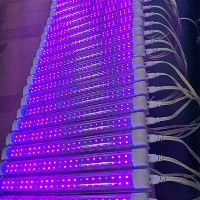
T8 Tube DC Input


Related product links:https://www.benweilight.com/search/DC%20T8.html
Tel/Whatsapp:+8619972563753
Email:bwzm12@benweilighting.com