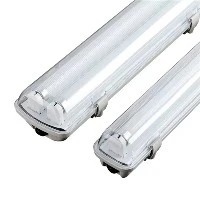
Those involved in livestock and poultry farming are likely familiar with this scenario: after less than a year, the lights in a chicken coop show yellowed covers, corroded (green-tinted) terminals, and flickering or failing LED strips. The cost and labor required for replacements often exceed the price of the lights themselves. The root cause usually lies in the environment. Chicken coops and livestock facilities with high ammonia levels are characterized by high humidity, heavy dust, and elevated ammonia concentrations-compounded by frequent high-pressure washdowns. Standard lighting fixtures simply cannot withstand such conditions for long.
So, can "tri-proof" (waterproof, dustproof, and corrosion-resistant) T8 LED fixtures truly be relied upon in these environments? This article examines the actual operating conditions of farms and breaks down the critical factors you need to know.
The Real-World Challenge: Chicken Coops and High-Ammonia Livestock Facilities
The fermentation of poultry manure continuously releases ammonia. In poorly ventilated buildings, ammonia concentrations often reach high levels. When ammonia reacts with moisture, it creates a corrosive, alkaline environment that gradually degrades metal components, circuit board solder joints, and plastic parts. Add to this the accumulation of feathers and feed dust, along with high-pressure washdowns between production cycles, and it becomes clear that lighting fixtures must endure a fourfold assault: corrosion, humidity, dust, and water exposure. Standard T8 tubes-designed for office environments-typically last only a few months under these conditions.
Understanding "Tri-Proof" Protection Ratings: Is IP65 Sufficient?
To determine whether a lighting fixture is suitable for a farm, start by checking its ingress protection (IP) rating.
IP65: Offers complete protection against dust and can withstand low-pressure water jets from any direction; suitable for environments with high humidity and routine, low-pressure cleaning.
IP66 / IP67: Designed to withstand powerful water jets or even temporary immersion. If your facility utilizes high-pressure water jets for close-range cleaning, these ratings are highly recommended.
It is important to note that an IP rating measures dust and water resistance, but it does not account for corrosion resistance. Therefore, looking solely at an "IP65" rating is not enough; the following point is the most critical factor for environments with high ammonia levels.
Resistance to Ammonia Corrosion: Material Selection Is Key
In an environment containing ammonia, the lifespan of a light fixture primarily depends on the materials used for the following components:
Diffuser and Housing: Opt for PC (polycarbonate) or corrosion-resistant PP (polypropylene). Avoid standard PVC or low-quality plastics, which are prone to becoming brittle, yellowing, and cracking.
Metal Components: Clips, screws, and end-cap connectors should ideally be made of stainless steel or materials treated for corrosion resistance; standard galvanized parts will rust quickly.
PCB and LEDs: It is recommended to use fixtures with a conformal coating (protective lacquer) or full encapsulation (potting) to isolate the circuitry from ammonia gas.
Terminals: Copper components are susceptible to ammonia-induced corrosion (turning green); therefore, tin-plated terminals or those with sealed, protective housings are a safer choice.
This aspect is the primary differentiator between high-quality products and cheap alternatives-it is a key point to raise when requesting quotes from suppliers.
Water Resistance and Wash-Down: Sealing and Connection Details
Water ingress in light fixtures rarely occurs through the center of the diffuser; it almost always happens at the ends or connection points.
Check whether the end caps feature silicone gaskets and if they are tightly secured.
Ensure that cable entry points are equipped with waterproof glands and that the wire exit points are properly sealed.
Consider whether the diffuser and base are integrated (molded as one piece) or assembled from multiple parts; more seams mean a higher risk of leaks.
During wash-down, avoid directing high-pressure water jets closely at the connection points; even the best seals cannot withstand prolonged, direct high-pressure spraying.
Dust and Heat Dissipation: Often-Overlooked Risks
Poultry houses are typically very dusty. Dust accumulation on the surface of a light fixture hinders heat dissipation, causing the temperature of the LEDs to rise, which accelerates light degradation (lumen depreciation). Choosing products with effective thermal management-such as those using aluminum-core PCBs or aluminum alloy bases-and wiping down the fixtures during the "empty barn" period between flocks can significantly extend their service life. Additionally, fixtures with smooth surfaces and no hard-to-reach crevices are easier to clean and less prone to dust accumulation.
Impact on the Flock: Light Quality and Flicker-Free Performance
The safety of lighting equipment extends beyond the hardware itself; it also encompasses the well-being of the animals. Chickens are far more sensitive to light flicker than humans; flicker caused by low-quality LED drivers can agitate the flock and lead to increased feather-pecking.
Therefore, it is advisable to choose flicker-free or low-flicker light fixtures. You should also select appropriate color temperatures and brightness levels for each stage of the birds' life cycle (brooding, rearing, and laying), while utilizing a dimming system to manage both the duration and intensity of the lighting.
Conclusion
Can T8 "tri-proof" (waterproof, dustproof, and corrosion-resistant) light fixtures be used safely in poultry houses or livestock facilities with high ammonia levels? The answer is yes-provided you choose the right product. Look for five key features: an ingress protection (IP) rating of at least IP65 (IP66 or higher is recommended if frequent wash-downs occur); a design that protects the housing and metal components from ammonia corrosion; effective sealing at both ends and waterproof cable entry points; an efficient heat-dissipation structure; and a reliable LED driver with comprehensive electrical protection and flicker-free performance. When these criteria are met, tri-proof fixtures offer significantly greater stability and a longer service life in agricultural environments compared to standard light tubes, ultimately proving more cost-effective in the long run.
Looking for a customized T8 tri-proof lighting solution for your poultry house or farm?
Please reach out to us! Let us know the dimensions of your facility, your cleaning methods, and the ammonia levels in your environment. We will recommend the ideal protection rating and configuration for your needs, and provide samples and a price quote. Share your requirements with us, and we will get back to you promptly.