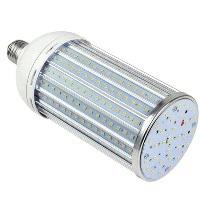
When a light keeps flickering, the issue often lies not with the product itself, but with a mismatch between the lamp and the control equipment it is connected to. Below, we explain the causes of flickering across three common scenarios-dimmers, sensors, and legacy ballasts-to help you avoid pitfalls when selecting products.
Understanding how "corn" LED lamp drivers work
Corn-style LED lamps use DC-powered LED chips, while mains electricity is AC. Inside the lamp base, a small driver circuit rectifies the AC power, steps down the voltage, and stabilizes the current. The quality of this driver's design determines how "picky" the lamp is regarding the external electrical circuit.
Most standard corn-style LED lamps are designed for low cost and compact size; their simple circuitry lacks specific compatibility features for upstream control equipment. Consequently, if the incoming power is not a clean, stable sine wave, the driver may struggle to maintain a steady output, resulting in visible flickering. The three scenarios discussed below are essentially different manifestations of this underlying issue.
Causes of flickering when used with dimmers
The lamp does not support dimming. This is the most common scenario. Standard corn-style LED lamps lack a dimming interface; when a dimmer "chops" parts of the AC waveform, the driver cannot interpret the signal correctly, causing the light to fluctuate in brightness.
Incompatible dimmer type. Many legacy dimmers were designed for incandescent bulbs. Depending on the phase-cutting method used (leading-edge or trailing-edge), compatibility with LEDs can vary significantly. Leading-edge dimmers, when paired with capacitive LED drivers, can trigger inrush currents that lead to flickering or instability.
Insufficient minimum load. Dimmers typically require a minimum power load to operate reliably. A single 12W corn-style LED lamp often falls well below the minimum load threshold (which can be tens of watts for traditional dimmers), causing the dimmer itself to become unstable and, in turn, causing the lamp to flicker.
Low-end of the dimming range. Even with dimmable corn-style LED lamps, setting the brightness to a very low level can reduce the driver's ability to maintain a stable current, potentially resulting in slight flickering or "jitter."
Multiple lamps in parallel. When the number of lamps on a single circuit changes, the total load shifts; a setup that previously functioned correctly may begin to flicker.
Reasons for flickering when used with sensors
Leakage current. Many sensors-especially two-wire infrared, microwave, or light-controlled switches-allow a tiny amount of current to flow through the load even when in the "off" state, in order to power themselves. While incandescent bulbs are unaffected by this, the capacitors within an LED driver can gradually charge up; once the voltage reaches a certain threshold, the driver briefly activates, causing the light to flash before turning off again-a cycle that repeats continuously.
Sensor switching mechanism. Some sensors utilize thyristors (SCRs) for switching. With a small load, a thyristor may fail to conduct fully, resulting in intermittent power output.
False triggering by light sensors. If a sensor with a built-in light detector is installed too close to the lamp it controls, it may detect the light emitted by the bulb, interpret it as "daylight," and switch the lamp off. Once the lamp turns off, the sensor then perceives it as "darkness" and switches the lamp back on, creating a flickering loop. This is an installation issue, not a defect in the lamp itself.
Interference with microwave sensors. Microwave sensors can be continuously triggered by nearby moving objects, reflections from metal surfaces, or even swaying leaves, leading to frequent switching that appears as flickering.
Reasons for flickering when used with legacy ballasts
This refers to scenarios where "corn-style" LED lamps are installed directly into fixtures originally designed for fluorescent, metal-halide, or high-pressure sodium lamps, without removing the existing ballast.
Inductive (magnetic) ballasts do not provide a stable mains-voltage output. Their function is to limit current and deliver a high-voltage pulse during startup; their output voltage and frequency characteristics differ significantly from the input requirements of an LED driver.
Conflict with starters. In fluorescent lighting circuits, a starter repeatedly makes and breaks the circuit to preheat the lamp filaments. Since LEDs lack filaments, the starter may remain in a continuous state of operation, causing the LED to flicker incessantly.
High-frequency output from electronic ballasts. Electronic ballasts output high-frequency electricity (in the tens of kilohertz), which LED drivers-typically designed for 50/60Hz-may not be able to process correctly.
Ballast aging. Even if a setup seems to work initially, the aging of internal components within the ballast can lead to increasingly unstable output, eventually causing problems to surface.
Power mismatch is another issue. Ballasts are designed for the wattage of the original lamps; using a "corn" LED bulb with a significantly lower wattage causes the operating point to shift outside the intended range.
In such scenarios, the safest approach is to bypass the ballast entirely and connect the corn LED bulb directly to the mains (line voltage). If the fixture is labeled as "Type B" compatible-meaning it is designed for direct mains connection-this is not a concern.
Selection and Troubleshooting
Selection Phase:
For applications requiring dimming, explicitly choose corn LED bulbs labeled "Dimmable" and confirm with the supplier which types and models of dimmers are compatible.
When using sensors, prioritize three-wire sensors (those with a dedicated neutral wire) to avoid issues related to leakage current.
When retrofitting older fixtures, ensure the ballast has been removed and verify the fixture's wiring configuration.
Troubleshooting Phase:
First, test the bulb in a socket controlled by a standard, simple switch to verify that the bulb itself is functioning correctly.
If it works, gradually reintroduce components-such as dimmers, sensors, or ballasts-one by one to identify which part is causing the issue.
For problems involving sensor leakage current, connecting a bypass load (such as a bleeder resistor) in parallel with the bulb may provide a solution.
If components remain incompatible, replacing the bulb or the control device is generally more time-efficient than repeated, unsuccessful troubleshooting.
Summary
In the vast majority of cases, flickering in corn LED bulbs does not mean the bulb is "broken"; rather, it indicates a mismatch between the LED's driver circuitry and the upstream control equipment. With dimmers, you must consider whether the bulb supports dimming, the specific dimming method, and the minimum load requirements. Sensor-related issues often stem from leakage current or false triggering, while old-style ballasts are fundamentally incompatible with the output requirements of LED drivers. Identifying the root cause provides a clear path toward a solution. Clarifying the intended use case at the time of purchase is far more efficient than troubleshooting problems after installation.
Need a corn light solution?
If your project involves dimming, sensor-based control, or retrofitting existing fixtures that use ballasts, please let us know the specific application scenario, the model of your control equipment, and the type of light fixture. Our engineering team can recommend suitable dimmable corn lights and provide samples for testing, ensuring full compatibility before you place a bulk order.