Calculating PPFD Requirements for Hydroponic LED Lights: Leafy vs. Fruiting Crops
Introduction
PPFD (Photosynthetic Photon Flux Density) is the cornerstone metric for evaluating grow light performance in hydroponic systems. Measured in μmol/m²/s, it quantifies the number of photosynthetically active photons (400-700nm) reaching plant surfaces per second. This article provides a step-by-step methodology for calculating PPFD needs and analyzes the significant differences between leafy greens and fruiting vegetables.
Part 1: Calculating PPFD Requirements
Step 1: Determine Crop-Specific DLI
Daily Light Integral (DLI) represents the total photons delivered daily (mol/m²/day). Reference values:
Leafy greens (lettuce/kale): 12-17 mol/m²/day
Fruiting crops (tomatoes/peppers): 20-30 mol/m²/day
Step 2: Convert DLI to Target PPFD
Use the formula:
PPFD = DLI ÷ (Light Hours × 0.0036)
Example:
Lettuce at 14 DLI with 16h photoperiod:
14 ÷ (16 × 0.0036) = 243 μmol/m²/s
Tomato at 25 DLI with 18h photoperiod:
25 ÷ (18 × 0.0036) = 386 μmol/m²/s
Step 3: Adjust for System Efficiency
Factor in:
Reflectivity losses (10-20% in vertical farms)
Canopy penetration (30-50% reduction for lower leaves)
Practical Tip: Multiply calculated PPFD by 1.3x as a safety margin.
Part 2: Key Differences Between Leafy & Fruiting Crops
1. Intensity Requirements
| Parameter | Leafy Vegetables | Fruiting Vegetables |
|---|---|---|
| Optimal PPFD | 200-300 μmol/m²/s | 400-600 μmol/m²/s |
| Peak PPFD | Up to 400 (red-leaf varieties) | Up to 800 (e.g., greenhouse tomatoes) |
Technical Insight: Fruiting crops require 2-3x higher PPFD during flowering/fruiting stages due to:
Higher carbohydrate demand for fruit development
Thicker mesophyll layers reducing light penetration
2. Spectral Sensitivity
Leafy Greens:
Prefer blue-rich spectra (20-30% blue, 450nm) for compact morphology
Example: Butterhead lettuce shows 15% faster growth under 450+660nm vs. full spectrum
Fruiting Crops:
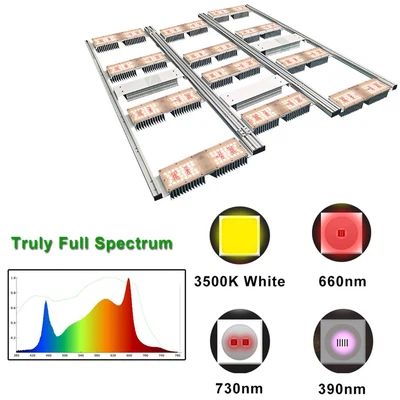
Require far-red (730nm) to trigger shade avoidance responses
Data: Adding 15% 730nm increases tomato yield by 22% (HortScience, 2021)
3. Photoperiod Interactions
Leafy Greens:
Linear yield increase up to 18h light (DLI=14 at 216 μmol/m²/s)
Fruiting Crops:
Require dark periods for ethylene regulation
Optimal cycle: 12h @ 600 μmol/m²/s (DLI=26) for peppers
Part 3: Implementation Strategies
For Leafy Greens (NFT Systems)
Light Setup:
120-150W LED bars per m²
Height: 30-50cm above canopy
Spectrum: 450nm (20%) + 660nm (80%)
Economic Benefit:
Reducing PPFD from 300 to 200 μmol/m²/s saves 33% energy with only 8% yield reduction
For Fruiting Crops (DWC Systems)
Light Setup:
300-400W LED panels per m²
Height: 40-60cm (adjustable)
Spectrum: 450nm (15%) + 660nm (70%) + 730nm (15%)
Tech Note:
Use movable lights to maintain uniform PPFD across vertical fruiting zones
Conclusion
Precise PPFD calculation requires crop-specific DLI targets and system-specific adjustments. While leafy greens thrive at 200-300 μmol/m²/s, fruiting vegetables demand 400-600 μmol/m²/s with supplemental far-red. Modern LED systems should incorporate:
Dynamic spectrum control
Real-time PPFD monitoring sensors
Photoperiod-programmable controllers