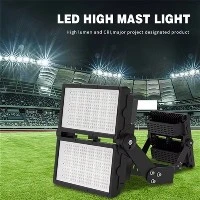
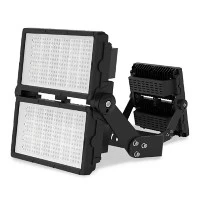
Professional Sports Lighting Guide: How 1000W LED Floodlights Are Redefining Large Venue Standards
For large outdoor venues such as football pitches, rugby fields, and athletics tracks, lighting is far more than just "visibility." It directly impacts athlete safety, spectator experience, broadcast quality, and operational costs. In recent years, 1000W-class LED floodlights have rapidly replaced traditional 1000W–2000W metal halide lamps as the preferred choice for professional stadiums. This article breaks down five core technical aspects you must evaluate when selecting high-power LED sports lighting.
1. Real Luminous Efficacy & Uniformity – Don't Judge by Wattage Alone
Many buyers still equate "wattage" with brightness. In the LED era, the key metrics are total lumens (lm) and illuminance uniformity.
- Traditional metal halide (1000W): Delivers about 80,000–100,000 lumens initially, but suffers from rapid lumen depreciation and reflector losses.
- High-quality 1000W LED: Achieves 130–150 lm/W, meaning 130,000–150,000 total lumens – 30–50% brighter than metal halide, with better directional control.
Uniformity requirements: FIFA and other governing bodies require a main camera uniformity (U1) ≥0.5 and (U2) ≥0.7. Quality LED fixtures use secondary optical lenses (narrow beam, medium beam, asymmetric distribution) to deliver even coverage without "zebra stripes" or dark zones.

2. Glare & Spill Light Control – Critical for Athletes and Neighbors
Sports venues are often near residential areas. Spill light and glare are the top two sources of complaints.
- Glare rating (GR): Professional outdoor sports lighting should specify GR ≤50 (max 55).
- Solutions: Precision visors, louvers, or reflectors that strictly confine light to the playing field. Some advanced fixtures also accept external anti-glare shields to further reduce environmental light pollution.
3. Thermal Management & Reliability – The Lifeline of 1000W LEDs
High-power LEDs are vulnerable to heat. For every 10°C increase in junction temperature, lifespan halves and lumen depreciation accelerates. Therefore, heat sink design is a critical quality differentiator.
- Quality approach: Independent heat pipes + die-cast aluminum fins + temperature-controlled fans (smart on/off). Passive cooling (fins only) is not sufficient for 1000W – active cooling is required.
- Verifiable metrics: Request thermal imaging reports and LM-80 (LED lumen maintenance) reports. High-quality fixtures can operate continuously at 50°C ambient temperature, with L70 life ≥50,000 hours (i.e., still delivering ≥70% of initial lumens after 50,000 hours).

4. Ingress Protection & Impact Resistance – Survival in Outdoor Venues
Football field lights are exposed to wind, rain, thunderstorms, extreme temperature swings, and even ball strikes.
- IP rating: Minimum IP65 (dust-tight and protected against low-pressure water jets). For coastal or high-humidity areas, choose IP66.
- Impact rating (IK): IK08 or IK10 (withstands 5–20 joules – equivalent to a 1.7kg object dropped from 1 meter). This is often overlooked but directly affects fixture lifespan and insurance claims.
5. Smart Control & Emergency Response – Standard for Modern Venues
Major events require multiple lighting scenes (match, training, cleaning, emergency). Traditional systems need complex wiring. Modern LED systems use DMX512, RDM, or wireless control to deliver:
- 0–100% flicker-free dimming (compatible with super-slow-motion cameras)
- Instant hot restrike (metal halide lamps require 10 minutes of cooling before restarting – LEDs have no such limit)
- Emergency mode: Integrates with fire/security systems for instant 100% emergency illumination.
Economic Analysis: Why 1000W LED Pays Back in Under 3 Years
| Comparison (per fixture) | 1000W Metal Halide | 1000W LED Floodlight |
| Actual power (incl. ballast) | ~1150W | ~1050W |
| Annual energy cost (6h/day, $0.12/kWh) | ~$302 | ~$276 |
| Lamp replacement interval | Every 1 year (~2000h) | None (50,000h life) |
| Annual maintenance (labor + lamp) | ~$80 | ~$5 (cleaning) |
| 5-year total cost | ~$2,100 | ~$1,450 |
Note: Estimates vary with local electricity rates and labor costs.
Just from electricity and lamp replacements, each fixture saves about $100–130 per year. A standard 5-a-side football pitch typically uses 12–16 x 1000W LEDs – that's over $1,500 saved annually. Payback period: 2–3 years.

Procurement Checklist – 6 Questions to Ask Every Supplier
When evaluating 1000W LED sports lighting, always request:
- IES or LDT files – for professional lighting simulation (Dialux/Relux).
- Third-party LM-79 test report – verifies true lumens, efficacy, CCT (typically 5000K–5700K), and CRI (Ra≥80; for broadcast, Ra≥90).
- TM-21 lifetime projection – calculates L70 life from real measured data.
- IP and IK certification – preferably from TÜV, SGS, or similar.
- Measured glare data (GR value) – ensure it meets your league's requirements.
- Warranty terms – industry leaders offer 5–7 years; reputable manufacturers offer 3–5 years.
Summary – Invest in Quality Light for the Next Decade
Upgrading to 1000W LED floodlights is not just about saving energy – it's a strategic decision that enhances match quality, reduces long-term operational risks, and improves the broadcast experience. Good lighting reduces athlete injury rates, attracts more spectators and sponsors, and makes HD broadcasts look professional.
Next steps for you:
- Request IES files to run professional simulations of your venue.
- Ask for free samples for on-site testing (especially thermal and glare performance).
- Compare warranties and failure compensation terms from at least three suppliers.
If you are looking for reliable high-power LED sports lighting, prioritize manufacturers that provide complete optical reports, thermal management data, and internationally recognized certifications. Verify thoroughly before investing – it will save you years of high maintenance and energy costs.