Can a 1200W High-Power LED Stadium Light Really Replace Three Traditional Metal Halide Lights?
Have you ever wondered, while watching a live broadcast of an international football match at night, what makes the entire stadium as bright as daylight – even flicker-free during slow‑motion replays? When you work at night in a stadium, a large square, or a port loading area, what is that giant light high above that illuminates the entire area?
The answer is – high‑power LED stadium lights.
In recent years, from the eight stadiums of the 2022 FIFA World Cup in Qatar to the Chengdu Phoenix Mountain Sports Park, and from community football fields to international competition venues, 1200W‑class LED stadium lights are replacing traditional 2000W, 3000W, and even 4000W metal halide lamps at an unprecedented speed. So, how can a 1200W LED light "beat three" traditional lights? What do its core parameters mean? How should you choose the right model for your project?

1. Technical Principle of 1200W High‑Power LED Stadium Lights: A Dual Revolution of Efficiency and Optics
To understand the value of a 1200W LED stadium light, you first need to grasp a basic concept: Luminous Efficacy – the amount of luminous flux (in lumens) emitted per watt of electrical power consumed, expressed in lm/W. Traditional high‑power metal halide lamps have an efficacy of about 70–90 lm/W, meaning a significant portion of the electricity is converted into heat rather than visible light. In contrast, a 1200W LED stadium light can achieve an efficacy of 150 lm/W or even higher – nearly twice as much light per watt.
Take the Meanwell 1200W outdoor LED stadium light as an example; its core parameters are as follows:
| Parameter | Specification |
|---|---|
| Rated Power | 1200W |
| Total Luminous Flux | 180,000 LM |
| Luminous Efficacy | 150 LM/W |
| Color Rendering Index (CRI) | Ra ≥ 80 |
| Color Temperature Range | 2700–6500K (adjustable) |
| Power Factor (PF) | ≥ 0.95 |
| LED Chip | Lumileds 5050 SMD, 520 pcs |
| Driver | Meanwell ELG series constant current |
| Ingress Protection (IP) | IP65 (dust‑tight, protected against water jets) |
| Impact Resistance | IK08 |
| Operating Temperature | -30°C to +50°C |
| Beam Angles | 25° / 45° / 60° (10° optional with CREE chips) |
| Rated Lifetime | 50,000 hours |
| Warranty | 5 years |
| Net Weight | 31.6 KG |
Key points to understand:
① What does 150 lm/W efficacy mean?
A total luminous flux of 180,000 lm means that just one 1200W LED light can replace a traditional 2000W or even 3000W metal halide lamp. One Huaxia Beidou Star 1200W LED stadium light directly replaces a 2000W metal halide lamp, saving nearly half the energy. Some high‑end products can replace up to 4000W metal halide lamps, achieving energy savings of over 85%.
② Why is CRI ≥ 80 important?
The Color Rendering Index (Ra) measures how accurately a light source reveals the true colors of objects. Common metal halide lamps have a CRI of about 60–70, while LED stadium lights achieve Ra ≥ 80, and premium versions can reach Ra > 90. For high‑definition television broadcasts, CRI ≥ 80 is just the entry ticket. Philips and other brands have introduced stadium lights specifically for HDTV broadcasting that are flicker‑free and can handle high‑speed photography and slow‑motion replays. Every 10‑point increase in Ra dramatically improves how athletes and spectators perceive the grass color, jersey colors, and skin tones.
③ The value of Power Factor ≥ 0.95
The closer the power factor (PF) is to 1, the higher the electrical efficiency and the lower the transmission and distribution losses. LEDs with PF ≥ 0.95 convert electricity into light very efficiently, whereas metal halide lamps with ballasts typically have a PF of only 0.5–0.6, causing huge reactive power losses. In a large stadium with hundreds of lights, this difference translates into hundreds of thousands of dollars in electricity bills each year.
④ 50,000‑hour lifetime + 5‑year warranty
50,000 hours – at 8 hours of daily use (matches + training) – means more than 17 years of service. Traditional metal halide lamps last only 8,000–15,000 hours and experience significant lumen depreciation over time. This means that over the entire lifecycle of an LED light, your maintenance cost is nearly zero.
2. LED Stadium Light vs. Traditional Metal Halide Light: Full Comparison
To make the replacement advantage clearer, we compare mainstream metal halide lamps (2000W/3000W) with a 1200W high‑efficacy LED stadium light. Data are based on actual measurements and publicly available industry information.
| Comparison Aspect | Traditional High‑Power Metal Halide (2000–3000W) | 1200W LED Stadium Light (e.g., Benwei) |
|---|---|---|
| Rated Power | 2000–3000W | 1200W |
| Actual Power Consumption (including ballast loss) | 2600–3900W | 1320W |
| Luminous Efficacy | 70–90 lm/W | 150 lm/W |
| Total Luminous Flux | 140,000–270,000 lm | 180,000 lm |
| Color Rendering Index (CRI) | Ra 60–70 | Ra ≥ 80 |
| Power Factor (PF) | 0.5–0.6 | ≥ 0.95 |
| Start‑up Time | 5–10 minutes warm‑up | Instant full brightness (<1 sec) |
| Re‑strike Time | 15–20 minutes cool‑down required | Instant re‑strike |
| Flicker | Present (100Hz mains flicker) | Flicker‑free (HDTV compliant) |
| UV/IR Radiation | Strong UV/IR | No UV, no IR |
| Hazardous Substances | Contains mercury | Zero mercury, environmentally friendly |
| Rated Lifetime | 8,000–15,000 hours | 50,000 hours |
| Warranty | Typically 1 year | 5 years |
| Ingress Protection | Usually IP54 | IP65 + IK08 |
| Low‑Temperature Start | Warm‑up required | Instant start at -30°C |
| Dimming Control | Difficult, needs special dimming ballast | 0–10V / DMX / DALI programmable dimming |
Key differences explained:
- Actual power consumption: The rated power of a metal halide lamp is only the lamp itself; the ballast adds extra losses. A 3000W metal halide lamp can actually consume up to 3900W. This is a critical, often overlooked detail.
- Instant start: Metal halide lamps need 5–10 minutes to warm up to full brightness. If the power is interrupted, they require 15–20 minutes to cool down before re‑striking. LED lights reach full brightness in <1 second – no warm‑up, no cool‑down wait. This is invaluable for live broadcasts, emergency lighting, and temporary light shows.
- Dimming capability: Dimming metal halide lamps is difficult and expensive. LED stadium lights can be continuously dimmed from 0–100% via 0–10V, DMX512, or DALI protocols. With an intelligent lighting control system, a single football stadium can preset over 20 different scene modes – from professional matches, HDTV broadcasts, recreational training, to pre‑match light shows – all switchable at the touch of a button.
3. Application Scenarios for 1200W LED Stadium Lights
High‑power LED stadium lights are no longer limited to professional sports venues; their applications are expanding rapidly. Below are typical use cases based on industry standards and real projects.
| Application Scenario | Typical Number of Fixtures | Recommended Power | Key Requirements |
|---|---|---|---|
| Professional Football/Track & Field Stadium | 150–400 | 800–1500W | HDTV broadcast, flicker‑free, high illuminance, UGR ≤ 22 |
| Multi‑purpose Gymnasium (Basketball/Badminton) | 60–120 | 400–800W | Uniformity, anti‑glare, multi‑scene switching |
| Large Squares / Transportation Hubs | 20–50 | 800–1200W | Wide‑area uniform lighting, IP65+ protection |
| Ports / Container Yards | 30–100 | 1000–1500W | Vibration resistance, wind resistance, corrosion resistance, long life & maintenance‑free |
| Golf Courses / Driving Ranges | 50–200 | 400–1200W | Precise light distribution, long‑distance projection, spill‑light control |
| Large Temporary Events / Concerts | Variable | 500–1200W | DMX512 control, fast installation/dismantling, programmable light shows |
Industry standard reference: Some parameters above refer to Level III professional competition standards in the "Sports Venue Lighting Design and Testing Standard" (JGJ 153‑2016). Those standards require average illuminance ≥ 500 Lux for training and ≥ 2000 Lux for professional matches, uniformity ≥ 0.7, and glare rating UGR ≤ 22. 1200W high‑efficacy LED stadium lights can fully meet or exceed these standards.
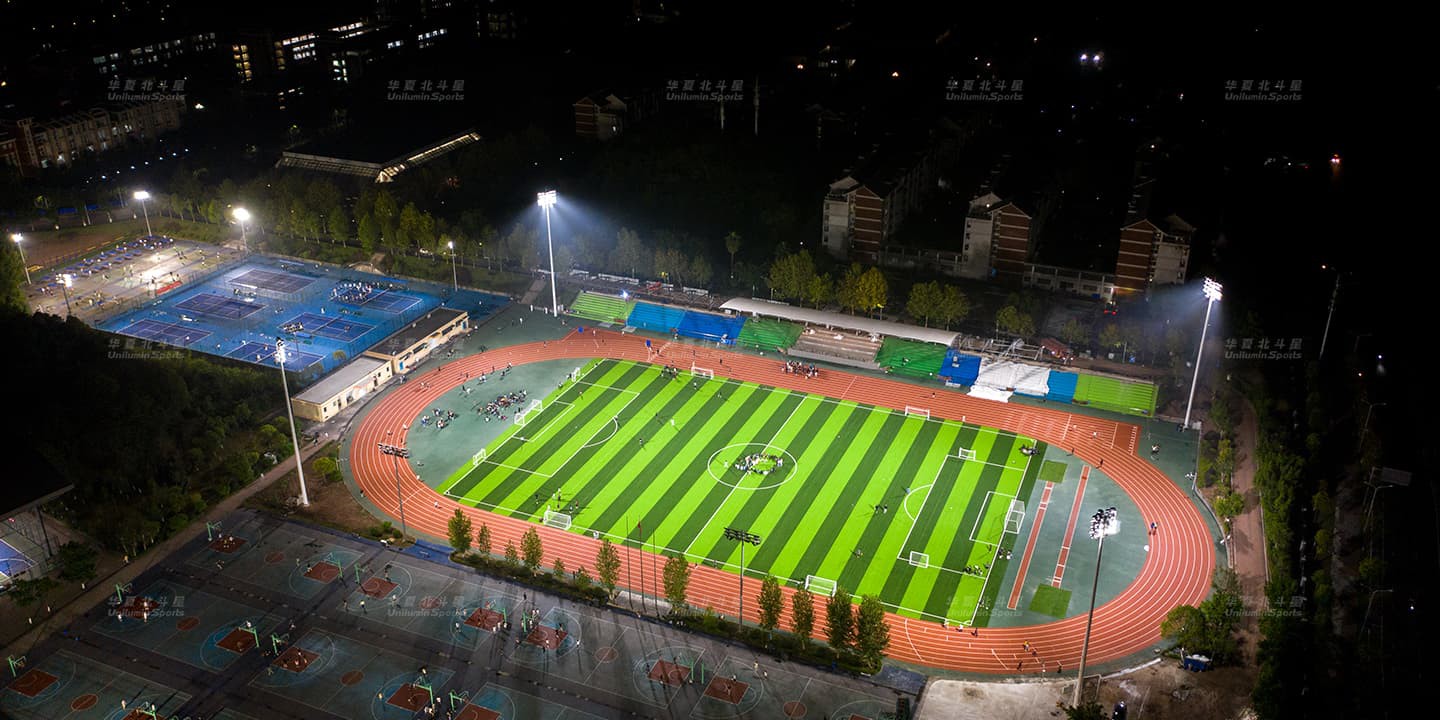
4. The "Achilles' Heel" of High‑Power LEDs: Thermal Management
The biggest technical difference between high‑power LED stadium lights and ordinary LED lights is heat dissipation.
A power density of 1200W means enormous thermal load. The electro‑optical conversion efficiency of LED chips is only 30%–40%; the remaining 60%–70% of electrical energy is converted into heat. If heat is not efficiently conducted away, the junction temperature rises, leading to reduced efficacy, accelerated lumen depreciation, spectral shift, and shortened lifespan. Studies show that when the chip junction temperature rises from 25°C to 85°C, luminous efficacy can drop significantly.
In the industry, there is a vivid saying: "A high‑power LED light with poor thermal management is a star on the field for the first three months, but becomes a 'shoddy project' by the fourth month."
To ensure stable thermal performance, 1200W LED stadium lights typically use a combination of the following technologies:
- High‑purity aluminum integrated die‑cast heatsink (ADC12) – monolithic design that minimizes the thermal conduction path;
- Micro‑groove composite phase‑change heat dissipation technology – achieves extremely high heat transfer coefficients with minimal temperature difference, solving the core thermal challenge of high‑power‑density LED fixtures;
- Sealed driver compartment – physically isolates the power supply and other sensitive electronics from the chip heat zone while preventing dust ingress.
Thanks to these synergistic thermal solutions, a 1200W LED stadium light can maintain stable light output and reliability over its rated 50,000‑hour lifetime.
5. What Are the Most Critical Technical Specifications When Choosing an LED Stadium Light?
When faced with many brands of LED stadium lights, focus on these five core dimensions. Each directly impacts real‑world performance and total cost of ownership.
Dimension 1: Luminous Efficacy & Luminous Flux
- Acceptable level: ≥ 120 lm/W (commercial grade)
- Recommended level: ≥ 150 lm/W (professional grade)
- Verification method: Request third‑party IES test reports. Verify the ratio of total luminous flux (lm) to input power (W) – do not rely on theoretical chip data.
An efficacy of 150 lm/W means more light at the same power, or fewer fixtures to achieve the target illuminance – directly lowering both procurement cost and electricity bills.
Dimension 2: Color Rendering Index (CRI)
- General training / recreational venues: Ra ≥ 80
- Professional matches / HDTV broadcasts: Ra ≥ 90, R9 (red saturation) ≥ 0
- Verification method: Check the measured CRI value in the product datasheet; request test reports.
Dimension 3: Beam Angle & Photometric Distribution
1200W LED stadium lights typically offer multiple beam angle options such as 25°, 45°, and 60°. Some high‑end models also offer a 10° ultra‑narrow beam for long‑distance precision projection (e.g., flagpoles, tall towers).
- Narrow beam (10°–25°): Suitable for high‑mast lighting, long‑distance projection (e.g., from the top of the stands to the center of the field). High central intensity but small coverage area.
- Medium beam (30°–45°): Suitable for medium‑distance lighting, balancing brightness and coverage.
- Wide beam (60° and above): Suitable for large‑area uniform illumination, such as squares and spectator stands.
Many stadium lights also support asymmetric photometric designs (e.g., 30°×70°) to achieve ideal lighting coverage from fixtures mounted at the edge of the field.
Dimension 4: Ingress Protection (IP) & Impact Protection (IK)
- IP65: Dust‑tight, protected against low‑pressure water jets from any direction. This is the minimum recommended rating for outdoor stadium lights.
- IP66/IP67: Further protection against powerful water jets or temporary immersion for extreme environments.
- IK08: Impact resistance of 5 joules – equivalent to withstanding a 1.7 kg weight dropped from 0.3 meters. Critical for outdoor light poles that may be accidentally struck.
Dimension 5: Driver Quality & Certifications
The driver is the "heart" of an LED light; its quality directly determines stability, dimming performance, and lifetime. Choose drivers from top international brands (e.g., Meanwell, Philips, Inventronics). For example, the Meanwell ELG series used in the 1200W LED stadium light features high constant‑current accuracy, high conversion efficiency, and low heat generation, ensuring 50,000 hours of stable operation. Also verify that the product has passed certifications such as UL, CE, RoHS, FCC, and ISO9001.

6. Global LED Sports Lighting Market Trends
LED stadium lights are not a temporary "technology fad" but a structural industry transformation. According to TrendForce and multiple market research firms:
- The global sports stadium lighting market was approximately USD 619 million in 2024 and is expected to reach USD 853 million by 2030, with a compound annual growth rate (CAGR) of 5.5%.
- The LED segment within this market is growing even faster, with a CAGR of about 6.3%, and is expected to capture over 80% of the market share (approx. USD 681 million) by 2030.
- Other market reports project the global LED sports lighting market to reach USD 1.0–1.4 billion by 2030, with a steady CAGR of 6.5%–7.2%.
From a longer‑term perspective, the CAGR of the global LED lighting electronics market is expected to reach 6.4% (2025–2035), far exceeding the growth of traditional lighting. In the Chinese market, the "14th Five‑Year Plan" period, with its smart renovation of sports venues and the vigorous development of the nighttime economy, is becoming one of the strongest drivers for high‑power LED stadium lights.
7. summary: 1200W LED Stadium Light – A Smart Choice for Sports Venue Lighting
Can a 1200W LED stadium light really replace three traditional metal halide lamps? The answer is yes – but scientific selection is essential.
The core advantages of LED stadium lights over traditional metal halide lamps are:
- Significant energy savings: ≥50% lower power consumption for the same brightness, drastically reducing electricity bills.
- Ultra‑long lifetime: 50,000 hours = 17 years of maintenance‑free operation; labor and replacement costs are nearly zero.
- Superior light quality: CRI ≥ 80, flicker‑free, no UV/IR radiation – meets HDTV broadcast standards.
- Smart controllability: Supports 0–10V, DMX512, DALI multi‑protocol dimming, allowing one‑touch switching between 20+ scenes.
- Eco‑friendly and safe: Zero mercury, no explosion risk, green and recyclable.
When selecting, always focus on the five core metrics: Luminous efficacy (≥150 lm/W), CRI (≥80, ≥90 for broadcast), Beam angle (choose scientifically based on mounting height and projection distance), Ingress/impact protection (IP65 + IK08 or higher), and Driver quality & certifications.
Lighting is the lifeline of sports stadiums and large outdoor spaces. High‑power 1200W LED stadium lights, for the first time, allow facility managers to simultaneously achieve four seemingly contradictory goals: energy efficiency, HD broadcast‑grade quality, intelligent control, and low maintenance. They are not only the most cost‑effective energy‑saving investment but also a strategic choice for meeting international competition standards, enhancing user experience, and reducing long‑term operating costs.
✨Contact✨
🙋♀️Harriet
📫Email: bwzm88@benweilighting.com
📞Whatsapp: +8613007285242