Do You Really Understand RGB T8 LED Tubes? It's Far More Than Just Colored Lights
When most people think of RGB T8 LED tubes, what comes to mind are the swirling neon colors in bars or the ever-changing background lights in live streaming rooms. But if you only see it as a "color-changing decorative light," you haven't truly understood it.
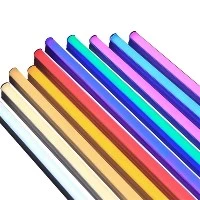
From a lighting technology perspective, the RGB T8 LED tube is fundamentally a precision optical device based on the additive color method of three primary colors. It encapsulates three independent LED chips - red, green, and blue - inside a single tube. By precisely controlling the output ratio of these three light sources, it can theoretically produce over 16 million colors. More notably, it is replacing traditional fluorescent tubes at an astonishing rate, becoming the mainstream choice in commercial, industrial, and even residential lighting. So, how exactly does an RGB T8 LED tube work? What do its key performance parameters mean? And what tangible value can it bring to your space?

1. Core Technology Principle of RGB T8 Tubes: The RGB Additive Color Method
Before diving into product specifications, you need to understand a basic but crucial concept - the RGB additive color method.
RGB stands for Red, Green, and Blue - the three primary colors perceived by the human eye. Inside an RGB LED tube, three sub-LED chips emitting red, green, and blue light are packaged together. By independently adjusting the brightness ratio of each channel, any color can be mixed. For example, mixing red and green light at a 1:1 ratio produces yellow; mixing red and blue equally produces magenta; and combining red, green, and blue at full intensity produces white light.
RGB color mixing is fundamentally different from traditional filtering methods: the former directly controls the emitted light color with no energy loss, while the latter "blocks" unwanted spectra through filters, resulting in lower efficiency. In an 8‑bit RGB LED system, each of the three channels has 256 brightness levels, combining to 256 × 256 × 256 = 16,777,216 colors - a range far beyond any traditional single‑color source.
It is worth noting the advanced version of the RGB T8 tube - the RGBW LED T8 tube. This adds an independent white LED chip alongside the red, green, and blue chips. This brings two key improvements: (1) white light is produced directly by a dedicated white chip instead of being mixed from the three colors, thus achieving higher purity and brightness; (2) the Color Rendering Index (CRI) jumps from 75–85 (standard RGB) to 90–95, significantly enhancing color accuracy. For spaces like clothing stores, supermarket fresh‑food sections, or exhibition halls where precise color reproduction is critical, RGBW is the better choice. If creating atmosphere and mood lighting is the main goal, standard RGB is sufficient.
2. Core Parameter Analysis and Comparison of RGB T8 LED Tubes
A good RGB T8 LED tube is not just about "many colors." Below we analyze the key parameters that determine quality, using a mainstream 18W RGB T8 tube (approx. 1.2m standard length) as an example. Comparisons are made with a traditional fluorescent tube (36W T8 daylight) and a low‑end generic RGB LED tube.
Core Parameter Comparison Table
| Parameter | Traditional Fluorescent (36W T8) | Low‑end Generic RGB LED Tube | Mainstream Quality RGB T8 LED Tube (e.g., Benwei 18W) |
|---|---|---|---|
| Rated Power | 36W | 18W | 18W |
| Luminous Efficacy | ~60–70 lm/W | ~60–70 lm/W | 90–100 lm/W |
| Total Luminous Flux | ~2160–2520 lm | ~1080–1260 lm | ~1620–1800 lm |
| Color Rendering Index (CRI) | Ra 60–70 | Ra < 70 | Ra >70 / ≥80 optional |
| Color Temperature Range | Fixed single CCT (e.g., 6500K) | RGB mixed color | Full RGB + tunable white 2700–6500K |
| Power Factor (PF) | 0.5–0.6 (with inductive ballast) | <0.5 | ≥0.95 (high PF version) |
| Rated Lifetime | 8,000–15,000 hrs | 10,000–20,000 hrs | 50,000 hrs |
| UV/IR Radiation | Contains UV | Some contain UV | No UV, No IR |
| Low‑Temperature Start | Fogging, low brightness | Unstable | Instant full brightness at -20°C |
| Mercury Content | Contains mercury | Some contain mercury | Zero mercury, recyclable |
| Certifications | - | None | UL / FCC / RoHS / CE / TUV |
| Installation Compatibility | Requires ballast | Requires rewiring | Type A+B (plug‑and‑play or ballast bypass) |
Data sources:
- Fluorescent tube parameters: Typical 36W T8 fluorescent tubes have efficacy of ~60–70 lm/W, total flux ~2,160–2,520 lm, lifetime 8,000–15,000 hours, and contain mercury.
- High‑quality RGB T8 LED parameters: Taking Benwei 18W RGB T8 tube as an example, efficacy reaches 90–100 lm/W, total flux ~1,620–1,800 lm, fully replacing a 36W fluorescent tube while saving over 55% energy. PF ≥0.95, lifetime 50,000 hours, and certified with UL, FCC, RoHS, etc.
- CRI reference: Low‑end RGB LEDs typically have CRI below 70; quality RGB tubes can provide ≥80, and RGBW versions reach ≥90 for true color reproduction.
Key Interpretation
① Power and Efficacy: An 18W quality RGB T8 tube can replace a 36W fluorescent tube because its efficacy has nearly doubled (90–100 lm/W vs. 60–70 lm/W). In other words, half the electricity consumption for the same or even higher brightness.
② Color Rendering Index (CRI): Lower CRI means distorted object colors - a red garment looks grayish, fresh fruit looks dull. Quality RGB tubes achieve Ra ≥80 to meet the demanding color accuracy requirements of commercial display environments.
③ Power Factor: PF ≥0.95 means that nearly 95% of the electrical energy is converted into light, with only about 5% lost as heat or other forms. For large spaces with dozens or hundreds of tubes, the energy savings from a high power factor are significant.
④ Lifetime: 50,000 hours means more than 17 years of use at 8 hours per day. In contrast, fluorescent tubes need replacement once or twice a year. The maintenance cost difference for large facilities is enormous.
⑤ Cold Start Performance: Ordinary fluorescent tubes suffer from fogging, low brightness, or failure to start in low temperatures. Quality RGB T8 tubes instantly reach full brightness even at -20°C.
3. Application Scenario Selection Guide
RGB T8 LED tubes are used for much more than just "looking good." Based on industry standards and real‑world cases, here are selection recommendations for different scenarios.
| Application Scenario | Recommended Tube Type | Recommended CRI | Recommended Color Temperature/Strategy | Key Considerations |
|---|---|---|---|---|
| Clothing Stores/Boutiques | RGBW T8 | Ra ≥ 90 | 3000–4000K adjustable | True fabric color rendering, day/night CCT switching |
| Supermarket Fresh Food Sections | RGBW T8 | Ra ≥ 85 | 4000–5000K + high brightness | High CRI makes meat & produce "look fresh" |
| Restaurants/Cafés | RGB T8 | Ra ≥ 80 | 2700–3000K warm + party mode | Warm ambiance daily, color‑changing mode for events |
| Bars/Nightclubs/KTV | RGB T8 | Ra ≥ 70 | Full RGB dynamic color change | Color variety first, DMX512 controller for light shows |
| Office Spaces | RGBW T8 | Ra ≥ 80 | 4000–5000K neutral white | Flicker‑free, low glare, reduced visual fatigue |
| Parking Lots/Garages | RGB T8 | Ra ≥ 70 | 5000–6500K cool white | Low‑temp start, long life, maintenance‑free |
| Exhibitions/Weddings/Stages | RGBW T8 + DMX control | On demand | Full‑color programmable | Flexible scene programming and wireless control |
| Home/Children's Rooms | RGB T8 | Ra ≥ 80 | RGB + tunable white | Balanced daily lighting and ambiance creation |
Industry standard reference: The recommended illuminance and CCT values in the table are based on CIE International Commission on Illumination and China's GB50034 lighting standards for commercial lighting, adapted for the tunable nature of RGB T8 tubes.

4. Installation and Compatibility of RGB T8 LED Tubes
For customers upgrading from traditional fluorescent tubes, installation compatibility is often the biggest concern. Quality RGB T8 tubes on the market typically feature Type A+B dual‑mode compatibility, offering two installation options:
- Option A: Type A (Plug‑and‑Play) – Insert the LED tube directly into the existing fluorescent ballast. No rewiring, no electrician needed – upgrade in 5 seconds. Ideal for those who want to minimize modification cost and time.
- Option B: Type B (Ballast Bypass) – Remove the existing ballast and wire the tube directly to the mains (220V AC). This completely eliminates failure risks from aging ballasts, provides higher energy efficiency, and extends tube life – suitable for long‑term fixed installations.
Both options can be used flexibly at different stages – use plug‑and‑play today, and later bypass the ballast if it fails, without changing the tubes.
5. Market Trends of RGB T8 LED Tubes
RGB T8 LED tubes are not a niche "atmosphere lighting" product but a rapidly growing, large‑scale market. According to the latest industry report from QYResearch, the global LED three‑primary‑color light source market (including RGB T8 tubes, RGB strips, and other mainstream product forms) reached approximately USD 120 million in 2025, with annual sales of about 20 million units, an average unit price of about USD 6, and an industry average gross margin of about 20%. The market is expected to grow to USD 154–158 million by 2032, with a compound annual growth rate (CAGR) of approximately 3.4%–3.5% from 2026 to 2032. From a broader perspective, the global LED lighting electronics market CAGR is expected to reach 6.4% (2025–2035), indicating that the entire LED lighting industry is on a continuous growth trajectory.
Key drivers include government policies promoting high‑efficiency lighting, the growing demand for "immersive experiences" and "differentiated atmospheres" in commercial spaces, and the continuously falling cost of LED technology, which improves cost‑effectiveness.
6. Summary: How to Choose an RGB T8 LED Tube Scientifically
Based on the analysis above, customers should focus on the following aspects when selecting an RGB T8 LED tube:
- Look at specifications, not just price – Check efficacy (≥90 lm/W), CRI (≥80), PF (≥0.9).
- Confirm the application scenario – Need accurate color reproduction? Choose RGBW. Just ambiance? Standard RGB is sufficient.
- Check installation compatibility – Does it support Type A+B dual mode? Does it have UL, CE, RoHS certifications?
- Calculate long‑term cost – What does 50,000 hours lifetime mean? The hourly lighting cost is far lower than fluorescent tubes.
- Choose a reliable supplier – Verify whether the manufacturer has independent R&D and production capabilities, and offers comprehensive after‑sales support.
Lighting is the soul of a space, and RGB T8 LED tubes have, for the first time, given managers the technical ability to "customize the soul of a space at will." Don't just think of it as a colored light – it may be your best investment to enhance commercial competitiveness, reduce long‑term operating costs, and create a unique spatial experience.