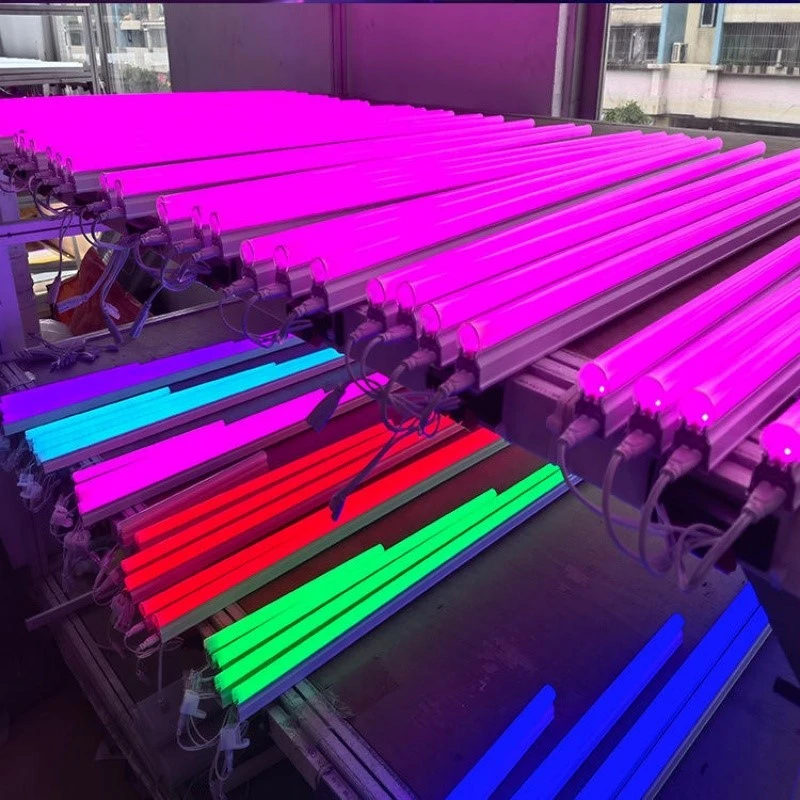
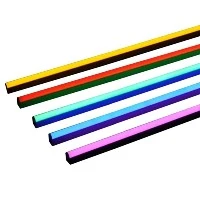
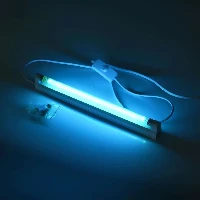
When renovating the lighting for shops, showrooms, or bars, many people face the same question: since they already have a row of T8 fluorescent fixtures, can they simply swap the existing tubes for RGBW T8 tubes to add color to the space? The answer is yes-but it depends on the type of fixture and your intended use. Below, we break down the key aspects you'll encounter during such a retrofit.
What is an RGBW T8 tube?
An RGBW T8 tube retains the standard T8 outer diameter (26mm) and G13 bi-pin base, but it houses red, green, blue, and white LED chips. The red, green, and blue chips combine to create colored light, while the dedicated white chips provide clean, functional illumination for everyday use.
The primary difference between these and standard white LED T8 tubes is the addition of a "control" layer. The tubes do not change color on their own; they require an external controller, remote, or DMX signal to switch between colors and lighting modes.
Key differences from standard fluorescent tubes
Light generation: Fluorescent tubes rely on gas discharge to excite a phosphor coating, whereas RGBW T8 tubes use LED chips that emit light directly-meaning they turn on instantly without any flickering or warm-up period.
Power consumption: For a standard 1.2-meter (4-foot) tube, fluorescent versions typically consume 18–36W, while RGBW T8 tubes generally use 12–20W, making them more energy-efficient.
Light color: Fluorescent tubes have a fixed color temperature, while RGBW tubes offer adjustable colors and the option to emit pure white light.
Lifespan: Fluorescent tubes typically last 8,000–15,000 hours, whereas LED tubes often exceed 30,000 hours, significantly reducing the frequency of replacements.
Control: Fluorescent tubes are limited to simple on/off operation, while RGBW tubes require additional control signals.
Which fixtures are suitable for a direct swap?
If a fixture uses an electronic ballast, the ballast must be removed or bypassed before installing an RGBW T8 tube; it is not a simple "plug-and-play" replacement. This is the most common misconception. There are two relatively straightforward scenarios:
Fixtures with traditional inductive ballasts and starters: Simply remove the starter and rewire according to the instructions provided with the new tubes-a fairly simple process.
Empty T8 fixture housings (containing no ballast): Simply install the tubes and connect the controller.
Fixtures That Require Rewiring
The following types of fixtures cannot be used without rewiring:
Fixtures with electronic ballasts: These ballasts output high-frequency voltage, which is incompatible with RGBW tubes; the ballast must be removed, and the fixture rewired for direct mains power connection.
Emergency lighting fixtures: Fixtures with built-in inverters will lose their emergency functionality if modified, and such modifications may also violate fire safety regulations.
Mismatched power input configurations (single-ended vs. double-ended): RGBW T8 tubes come in both single-ended and double-ended power input versions; connecting them incorrectly can cause the tubes to burn out immediately.
While the rewiring process is not complex, it involves mains voltage; therefore, it is recommended that the work be performed by a licensed electrician.
Pre-Replacement Checklist
Taking a few minutes to verify the following points before you begin can save you a lot of trouble:
Check the fixture label: Determine whether the ballast is inductive or electronic.
Confirm the power input method for the tubes: Check whether they require single-ended or double-ended input (refer to the specifications of the tubes you have purchased).
Plan for the controller: Since RGBW tubes require a controller, decide on its installation location and the routing for the signal cables.
Verify tube length: Ensure the length (0.6m, 0.9m, 1.2m, or 1.5m) matches your existing fixture.
Evaluate the diffuser/cover material: A transparent cover will preserve the full color effect, whereas a milky-white (opal) cover will cause the colors to appear more muted.
Suitable and Unsuitable Application Scenarios
Suitable Scenarios:
Commercial spaces such as bars, KTVs, and cafés that require ambient lighting
Background lighting for showrooms, display windows, and brand experience stores
Linear decorative lighting for event venues or stage edges
Multifunctional spaces that require switching between "everyday white light" and "colored ambient light"
Unsuitable Scenarios:
Offices, classrooms, workshops, or similar environments that only require white light-standard LED T8 tubes are more cost-effective here
Inspection areas or printing facilities that demand a very high color rendering index (CRI)-the white light output of RGBW tubes is inferior to that of professional-grade white-light tubes
Large-scale warehouses requiring high-brightness illumination-the color functionality would go unused, serving only to increase costs
Conclusion
Whether an RGBW T8 tube can replace a standard fluorescent lamp depends on three key factors: how the ballast is handled, whether the power input method is compatible, and whether you actually have a need for color functionality. If the existing fixture structure is suitable, this upgrade offers a cost-effective way to achieve significant energy savings while enabling a single lighting setup to serve both functional and ambient purposes. However, if your goal is simply to replace a broken tube and you have no need for color, a standard LED T8 tube is a more straightforward and hassle-free choice.