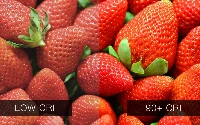
Imagine a gallery assistant unpacking a new oil painting. In the studio, the coat on the portrait was a deep, rich crimson. Under the gallery's brand-new LED tubes, it looks closer to brick-brown. She checks the box: "CRI 80+". That sounds respectable. So what went wrong?
The answer sits in one sentence most spec sheets never explain: CRI is an average, and averages hide things.

The Number That Hides Red
The general color rendering index (Ra) is calculated from only eight pastel test colors, R1 to R8. The other colors defined by the CIE, including saturated red, yellow, green and blue, plus skin tone, are left out of the formula. DigiKey's technical article on lighting color metrics explains that this lets a lamp score a high Ra while still rendering saturated colors poorly.
The most important missing sample is R9, saturated red. Red hides inside skin, wood, leather, food, fabric and oil paint, so a weak R9 makes all of them look flat. Supplier guidance on CRI and R9 offers a useful ballpark for how R9 typically moves with CRI:
| CRI class | Typical R9 | What you notice | Typical use |
|---|---|---|---|
| CRI 80 | about 25 | Reds look muted | Corridors, garages, back-of-house |
| CRI 90 | about 50 | Clear gain in vividness | Offices, retail, kitchens |
| CRI 95+ | about 90 | Reds, skin and wood look natural | Museums, galleries, photography |
Ballpark values; actual R9 varies by model and color temperature.

Look at the jump. Going from CRI 80 to CRI 95 does not add 15 points of quality evenly. It more than triples R9. That is why the crimson coat turned brown.
The Gallery's Second Problem: There Is Very Little Light to Work With
Here is where the story gets harder. The assistant's first instinct is to turn the lights up. But a conservator will stop her, because light itself damages artwork. Pigments fade, dyes bleach, and paper yellows, and the damage depends on both how bright the light is and how long it shines.
Museum guidance sorts objects into sensitivity classes, each with a recommended maximum illuminance and annual exposure:
| Sensitivity | Example materials | Max illuminance | Annual exposure budget |
|---|---|---|---|
| Very sensitive | Textiles, works on paper, furs, feathers, dyed leather | 50 lux | 100,000 lux-hours |
| Moderately sensitive | Oil and tempera paintings, wood, furniture, bone, ivory | about 150–200 lux | 450,000 lux-hours |
| Insensitive | Stone, ceramics, metal, glass | 300 lux | no tight limit |
Compiled from conservation lighting guidance and Museums & Galleries Scotland. Institutions differ on the exact 150 vs 200 lux figure.
Lux-hours are simply illuminance multiplied by time, and the two trade off evenly: a watercolor exposed to 50 lux for 100 hours suffers the same damage as one exposed to 100 lux for 50 hours. So what does that budget mean for a gallery that opens 8 hours a day, 300 days a year (2,400 hours)?

| Illuminance | Hours allowed per year (very sensitive, 100,000 lux-h) | Hours allowed per year (moderate, 450,000 lux-h) |
|---|---|---|
| 50 lux | 2,000 h | 9,000 h |
| 100 lux | 1,000 h | 4,500 h |
| 150 lux | 667 h | 3,000 h |
| 200 lux | 500 h | 2,250 h |
| 300 lux | 333 h | 1,500 h |
Even at the recommended 200 lux, a moderately sensitive painting gets about 2,250 hours, slightly less than our hypothetical gallery's opening hours. In practice, curators dim lights, rotate objects and use timers. The consequence for lighting choice is clear: when you can only use 50 to 200 lux, you cannot compensate for poor color by adding more light. The color quality has to be right at low brightness. This is also why the same guidance notes that conservation bodies have suggested a CRI of at least 85 for museum light sources, with some institutions asking for 90 or more (source). For the wider science of choosing a spectrum that balances color and damage, the U.S. Department of Energy hosts a presentation built around CIE 157:2004, the standard on controlling damage to museum objects from optical radiation.
What That Efficacy Gap Means in Watts and kWh
Efficacy is lumens per watt, so a lower number means more power for the same light. For a typical 4 ft tube producing about 2,000 lumens:
| Efficacy (lm/W) | Power for 2,000 lm |
|---|---|
| 80 | 25.0 W |
| 100 | 20.0 W |
| 110 | 18.2 W |
| 120 | 16.7 W |
| 130 | 15.4 W |
| 140 | 14.3 W |

Scale that to a real installation. Take 100 tubes running 3,000 hours a year:
| Efficacy | Power per tube | Annual energy (100 tubes, 3,000 h) | Difference vs 80 lm/W |
|---|---|---|---|
| 80 lm/W (older high-CRI design) | 25.0 W | 7,500 kWh | baseline |
| 110 lm/W | 18.2 W | about 5,450 kWh | about −2,050 kWh |
| 140 lm/W | 14.3 W | about 4,290 kWh | about −3,210 kWh |
The takeaway: the old reputation that "high-CRI tubes waste energy" belongs to older designs. Our high CRI T8 LED tube delivers CRI above 95 (97Ra and 98Ra on request, R9 above 80) at 110–140 lm/W, with a flicker-free driver and 0–10V or TRIAC dimming options. That is all you need to know about the specs to follow the rest of the story.
Dimming and Flicker: The Two Features Galleries Quietly Depend On
Remember the 50 to 200 lux limits. A tube that can only run at full output is a problem for a gallery that must hold light levels low, and dimming lets one fixture serve a textile room at 50 lux and a painting room at 200 lux. The second feature is a flicker-free driver. Visitors rarely notice flicker consciously, but cameras do, and photographers and video crews know it as banding in the frame. For studios and exhibition photography, a stable driver is as important as a high CRI.
Choosing the Color Temperature
CRI tells you how accurately colors appear; correlated color temperature (CCT) tells you how warm or cool the white looks. This tube is available in 3000K, 4000K, 5000K and 6000K. As a starting point, not a rule:
| CCT | Look | Typical starting use |
|---|---|---|
| 3000K | Warm white | Galleries with warm interiors, hospitality, retail displays of wood, leather, jewelry |
| 4000K | Neutral white | Libraries, general exhibition halls, workshops |
| 5000K | Daylight white | Photography and color-critical inspection; also the common reference for print viewing |
| 6000K | Cool daylight | Bright utility areas, some video and screen-matched work |
Always compare samples in your own room, because wall color, artwork and ambient light all change how a CCT looks.
Beyond Ra and R9: What a Serious Test Report Shows
Experienced buyers go one step further and ask for a full test report. The DigiKey article also introduces TM-30, a newer method that uses 99 color samples spread evenly across color space and produces a color-vector graphic showing how hues and saturation shift. It exposes things a single Ra number cannot. A useful report from an integrating sphere test typically covers:
| Item | Why it matters |
|---|---|
| Ra | The headline average of R1–R8 |
| R9, and ideally R1–R15 | Shows saturated red, skin tone and other special colors |
| CCT and Duv | Confirms the white point and whether it leans green or pink |
| Spectral power distribution | The full spectrum, the most honest picture of color quality |
| Flicker data | Matters for cameras and sensitive viewers |
If a supplier quotes "CRI 95" but cannot provide R9 or a spectrum, treat the number with caution.
Quick FAQ
- Is CRI 90 "good enough"? For retail and offices, often yes. For paintings, textiles, skin-tone work and photography, reds and skin tones improve further at 95+, and R9 is the number to check.
- Does higher CRI mean a brighter tube? No. CRI measures color accuracy, not brightness. Brightness is lumens, and high-CRI designs usually give slightly fewer lumens per watt, which is why the efficacy figure matters.
- Do I need 97Ra or 98Ra instead of 95Ra? For most galleries and shops, 95+ with a strong R9 is excellent. The 97 and 98 grades suit the most color-critical work, such as studio photography and conservation-grade display.
- Can high CRI replace the need for good lux control? No. High CRI helps colors look right at the low light levels museums use. It does not replace proper illuminance limits, UV control and exposure planning.
Want to See the Difference Under Your Own Lights?
Specifications are one thing, but color is something you judge with your own eyes. At Benwei Lighting, we are the factory behind this tube. We supply it in lengths from 0.3 m to 2.4 m, in 3000K to 6000K, with 0–10V or TRIAC dimming, and we accept small trial orders. For a related option, see our CRI>95Ra T8 LED tube.
Tell us your application, tube length and color temperature, and we will recommend the right CRI grade and send a quotation.