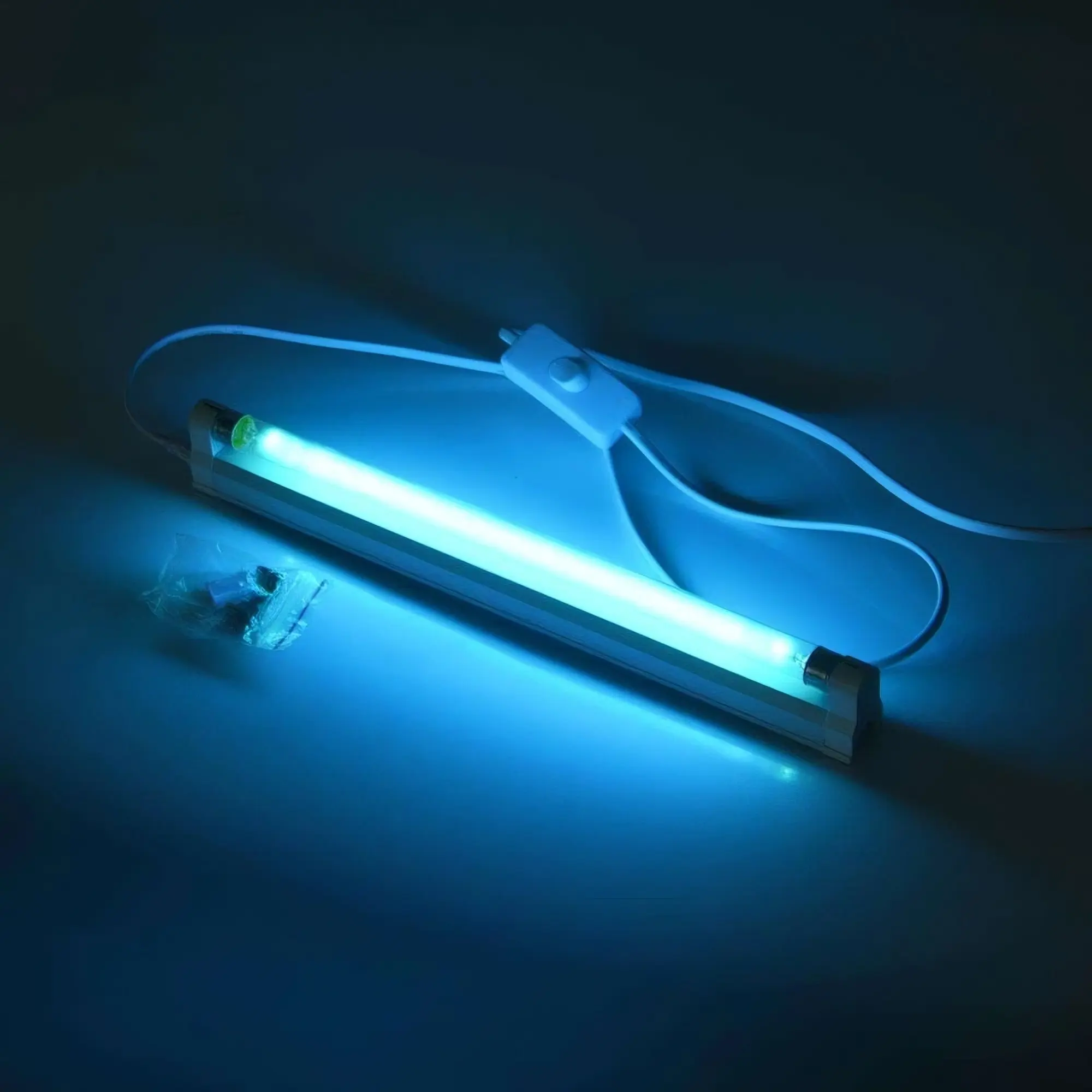
Picture a facility manager standing in a freshly cleaned storage room, a new UVC tube glowing a faint blue-violet overhead. Ten minutes, he thinks. Maybe an hour. Nobody told him, and the lamp's box only says "germicidal."
This is the question every UVC buyer eventually asks, and the honest answer is: it depends on the dose. Not the wattage printed on the tube, and not the color of the glow. The dose.
Dose: The Only Number That Matters
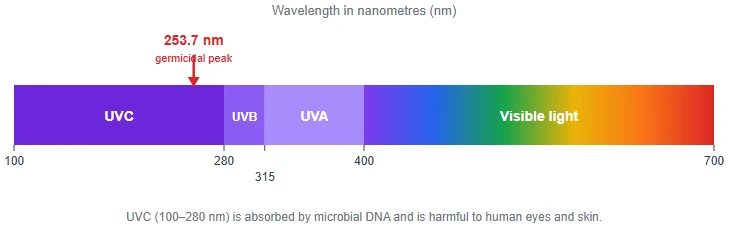
A T8 UVC lamp works by emitting short-wave ultraviolet light peaking at about 253.7 nm. At this wavelength, it damages the DNA of bacteria, viruses and mold so they can no longer reproduce. How much damage depends on one simple formula:
Dose (mJ/cm²) = Irradiance (mW/cm²) × Exposure time (s)
Every microorganism has its own "price" in dose. Here are commonly cited laboratory values at 254 nm:
| Microorganism | 90% reduction (mJ/cm²) | 99.9% reduction (mJ/cm²) |
|---|---|---|
| Staphylococcus aureus | 2.6 | 7.8 |
| Escherichia coli | 2.6 | 7.8 |
| Influenza virus | 3.4 | 10.2 |
| Salmonella typhimurium | 8 | 24 |
| Penicillium expansum (mold) | 13 | 39 |
| Aspergillus niger (black mold) | 132 | 396 |
Notice the spread. Common bacteria fall at single-digit doses, while black mold needs roughly 50 times more. Studies on SARS-CoV-2 at 254 nm show a similar pattern: a published inactivation study found more than 99% of viral particles inactivated in under a second under lab conditions. Another reference compilation, A Bit About Doses, lists Aspergillus niger at 226 mJ/cm², so published figures differ by source and test method.
From Dose to Minutes: The Math Buyers Skip
Now back to our facility manager. Exposure time is simply dose divided by irradiance, and irradiance drops quickly as you move away from the tube. Here is what that looks like:
| Irradiance at the surface | Time for 99.9% of E. coli (7.8 mJ/cm²) | Time for 99.9% of A. niger (396 mJ/cm²) |
|---|---|---|
| 10 µW/cm² (far from lamp) | 13 min | about 11 h |
| 50 µW/cm² | 2.6 min | about 2.2 h |
| 100 µW/cm² | 78 s | 66 min |
| 200 µW/cm² (close range) | 39 s | 33 min |
Calculated from the dose values above. 1 mW/cm² = 1,000 µW/cm².
The lesson: the same lamp can be "enough" for bacteria and nowhere near enough for mold, depending on distance and time. That is why professional installations are designed around distance, reflectors and exposure schedules rather than lamp count alone.
What About the Tube Itself?
You don't need to over-think the lamp's specs. A standard T8 UVC tube with a G13 base typically delivers its 253.7 nm output for around 8,000–10,000 hours, and manufacturers such as LEDVANCE publish datasheets showing a 30 W tube radiating about 12.6 W of UVC. Two practical points matter more than the numbers: output fades with age, so replace on schedule, and the tube needs a short warm-up before reaching full output.

Safety Is Part of the Specification
UVC harms eyes and skin. The same LEDVANCE datasheet classifies its tube as Risk Group 3 and says it should not be used for general lighting. UVC also can't pass through most materials or reach into shadows, so it only disinfects what it directly sees. The California Department of Public Health's UVGI review is also candid that evidence for unprotected household use against SARS-CoV-2 is limited. Use UVC in unoccupied spaces, with timers or motion-sensor cut-offs, and never as a substitute for cleaning.
Choosing the Right Lamp for Your Market
So back to the original question. Instead of asking "How many watts?", ask:
- What organisms are you targeting, bacteria or mold?
- How far is the lamp from the surface?
- How long can the space stay unoccupied?
- Which voltage and fixture (110V/220V, T8 G13) does your market use?
- Answer those, and the lamp choice becomes a calculation rather than a guess.
Planning a UVC Project or Looking for a Supplier?
At Aosay Light, we can help you match T8 UVC lamp sizes and wattages to your application, whether it's home sterilization products, cabinets, or commercial disinfection fixtures. Send us your target market, voltage standard and approximate quantity, and our team will reply with recommendations, samples and a quotation.
Contact us today for a free consultation and quote.