Comprehensive Guide to LED Tube Power Feeding Methods
In the installation and selection of LED tubes, the power feeding method is a critical technical point. Choosing the wrong method can not only cause the tube to malfunction but also create serious safety hazards. Currently, LED tubes on the market are mainly divided into double-ended feeding and single-ended feeding, with single-ended feeding further subdivided into UL-style (American) single-ended and IEC-style (European) single-ended. This article provides a systematic explanation.
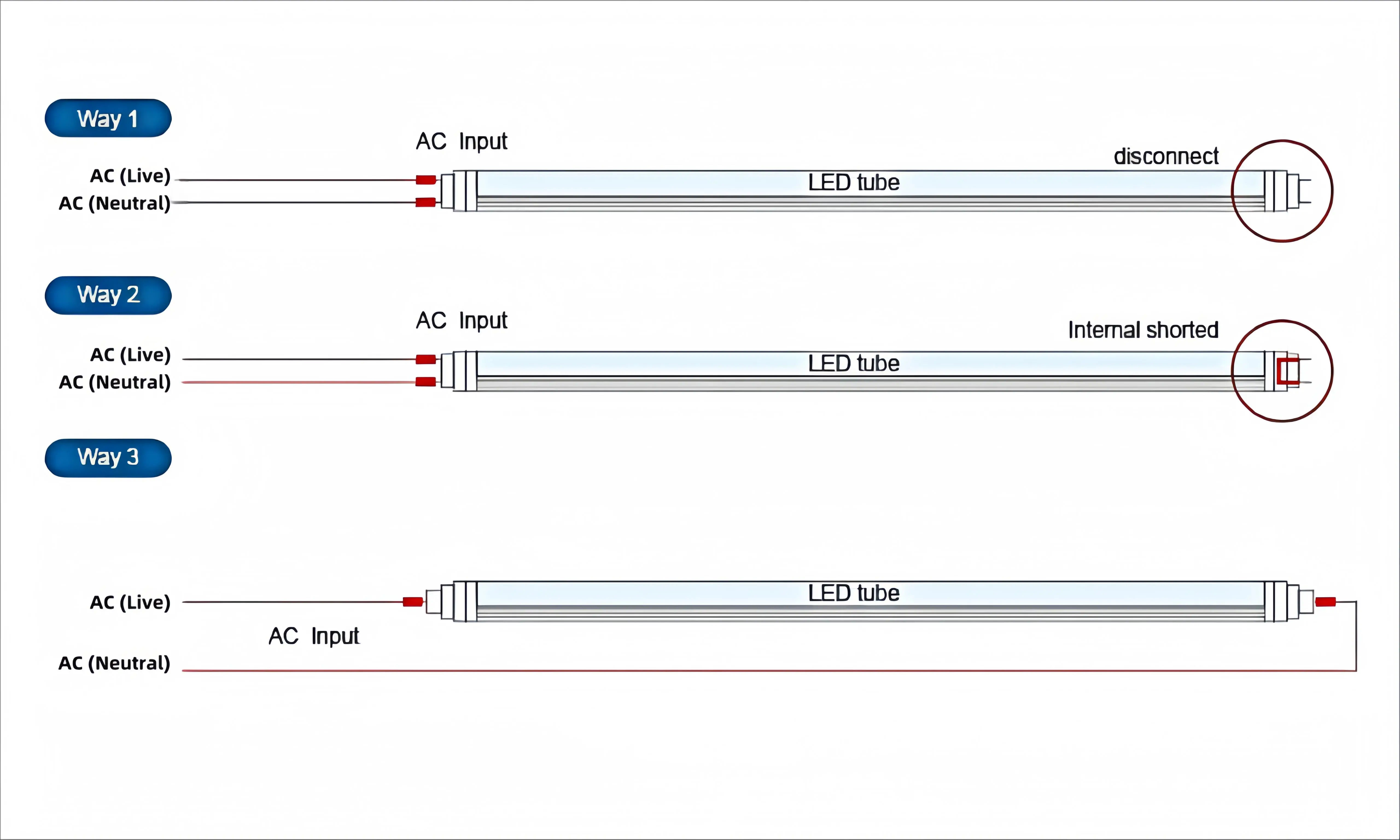
1. Double-Ended Feeding (Way 1)
Double-ended feeding is the most traditional wiring method, where live (L) and neutral (N) are connected to opposite ends of the tube – one end to live, the other to neutral. In this setup, both ends of the tube have electrical connections.
- Characteristics:
No polarity distinction during installation; either end can be connected arbitrarily.
Relatively low cost, common in early LED tube markets.
- Safety Hazards:
The biggest issue with double-ended feeding is electric shock risk. Since both ends are live, when installing or replacing the tube, even touching only one end may leave the other end energized. If a user accidentally contacts the pins on the other side, electric shock may occur. For this reason, according to IEC standards, single-ended wiring is considered safer than double-ended. In Europe, double‑ended LED tubes are now increasingly restricted.
2. Single-Ended Feeding (Way 2 & Way 3)
Single‑ended feeding means that the power (live and neutral) is connected only to one end of the tube; the other end serves solely as mechanical support and has no electrical function.
From a safety perspective, single‑ended feeding concentrates all live parts at the same end, greatly reducing the risk of accidentally touching energized components during installation and maintenance. This is the fundamental reason why major markets like North America and Europe increasingly require single‑ended supply.
However, single‑ended feeding is not a single standard. Depending on different safety regulations, it is further divided into UL‑style (American) and IEC‑style (European) single‑ended types, which differ fundamentally in how the non‑feeding end is handled.
2.1 UL‑Style Single‑Ended (Way 2)
UL‑style single‑ended follows the U.S. UL (Underwriters Laboratories) standards. Its core feature is: at the feeding end, live and neutral are connected; the other (non‑feeding) end has its internal pins short‑circuited.
Technical points:
Feeding end: two pins on the same side connect to live (L) and neutral (N), respectively.
Non‑feeding end: the two internal pins are shorted together (Internal shorted).
Although shorted, this end is not live – it only serves as mechanical fixation and part of the return path.
UL certification requirements:
In the North American market, LED tubes must comply with UL1993 to obtain UL certification. Notably, UL certification explicitly requires single‑ended feeding because double‑ended feeding cannot pass the 600V insulation test between the two end pins, nor the leakage current test between the live parts and ground.
Regarding the exact treatment of the non‑feeding end in UL style, there are different practices: some designs leave the pins completely open (not shorted), while others short them through a fuse. However, from the UL certification perspective, leaving the non‑feeding end open with no electrical connection is common and acceptable.
2.2 IEC‑Style Single‑Ended (Way 3)
IEC‑style single‑ended follows European IEC (International Electrotechnical Commission) standards. In contrast to UL style, its core feature is: the non‑feeding end of the tube is internally open‑circuit – meaning there is no electrical connection between the two pins.
Technical points:
Feeding end: two pins on the same side connect to live (L) and neutral (N), respectively.
Non‑feeding end: the two pins are open (disconnected) and serve only as mechanical support.
European testing laboratories generally recommend single‑ended feeding for LED tubes, primarily for safety reasons. However, IEC‑style single‑ended often requires modifications to the existing circuit (e.g., removing ballasts and starters), which may not be fully accepted by all laboratories in certain cases.
3. Comparison Between UL‑Style and IEC‑Style Single‑Ended
| Aspect | UL‑Style Single‑Ended (Way 2) | IEC‑Style Single‑Ended (Way 3) |
|---|---|---|
| Non‑feeding end status | Internally shorted | Internally open (disconnected) |
| Standard followed | UL (U.S.) | IEC (Europe) |
| Primary consideration | Pass UL insulation & leakage tests | Minimize electric shock risk |
| Installation requirement | Single‑end powered, other end shorted | Single‑end powered, other end open |
4. Installation Precautions
Regardless of the feeding method, the following points must be observed when installing LED tubes:
Always disconnect power first. Before work, turn off the main circuit breaker and verify with a voltage tester.
Remove old components. When replacing traditional fluorescent tubes, remove or bypass the ballast and remove the starter.
Identify wire colors. In Chinese standards, live (L) is usually red/brown, neutral (N) is blue, and earth (PE) is yellow‑green.
Do not parallel‑connect tubes. In single‑end powered fixtures, do not connect multiple LED tubes in parallel to the same terminal.
Confirm the feeding method. Before installation, verify whether the tube is single‑ended or double‑ended – the wiring is completely different, and mixing them up may cause accidents.
5. How to Choose?
For export to North America: Must comply with UL‑style single‑ended (other end shorted) and obtain UL certification.
For export to Europe: It is recommended to adopt IEC‑style single‑ended (other end open) to meet IEC safety requirements.
For the domestic market (China): Both types are used, but from a safety standpoint, single‑ended feeding is the better choice.
In summary, the choice of feeding method not only affects whether the tube works properly but also directly impacts safety. Correctly understanding the differences between single‑ended and double‑ended, and between UL and IEC styles, is fundamental knowledge for proper LED tube selection and installation.
✨Contact✨
🙋♀️Harriet
📫Email: bwzm88@benweilighting.com