Introduction: Why "Ordinary" Is the Real Problem
The Grey Ceiling of Conventional Wash Lighting
A Market Saturated with Utility Fixtures
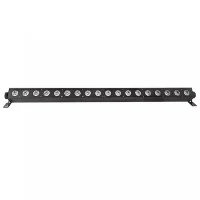
Walk down any commercial street after dark and you will see the same fixture repeated a hundred times. A black linear bar, bolted to a wall or a fascia, throwing a single flat wash of colour upward. It does the job. It also guarantees that the building looks exactly like the building next door. The wash light industry has spent two decades optimising cost per lumen and calling that progress, and the result is a market where most bars are interchangeable commodities that happen to have different logos on the carton.
That is the grey ceiling this product was designed to break. Not by adding another novelty effect, but by rebuilding the three things that actually decide how a facade looks at night: the colour system, the control resolution, and the physical construction that keeps both promises alive after two years outdoors.
The Symptoms Owners Actually Notice
Owners rarely complain about technical specifications. They complain about what they can see. The red that turns orange halfway up the wall. The wall that goes slightly greener in the middle because the RGB mix drifts between units. The pastel pink that cannot be produced at all because there is no white die to lift it. The chase effect that looks like a moving blur rather than a defined band of light because the LEDs are grouped in coarse blocks. The bar that looked superb in the showroom and looks tired after one summer of sun, rain and coastal air.
Every one of those complaints traces back to a design decision, and every one of them is addressed in the chapters that follow. This is not a fixture that asks to be admired for its datasheet. It asks to be judged on the wall, at night, in the second year of service.
What This RGBW Powerhouse Changes
Colour, Control, Construction
Three pillars carry the product. Colour: a genuine four-in-one RGBW emitter array, so that white is produced by a white die rather than by mixing red, green and blue and hoping the eye accepts the compromise. Control: point-level addressing along the bar, which turns a wash light into a linear effects instrument capable of running-horse chases, sweeps and travelling gradients. Construction: a cast aluminium body protected by a three-layer material system that combines a PVC outer layer, an imported alloy oxide layer and an advanced heat-resistant layer, giving the bar the heat resistance, anti-ageing and scratch resistance that outdoor work demands.
Each pillar is useful alone. Together they change the category the fixture belongs to. A bar with good colour but poor control is a decorative floodlight. A bar with good control but poor construction is a rental item with a short life. A bar with good construction but ordinary colour is the commodity we started with.
The Point of a Flagship Bar
A flagship bar earns its place by removing reasons to buy something else. It should be able to light a wall in clean warm white on a Tuesday and run a brand-coloured chase on a Friday. It should hold its colour across a hundred units on the same facade. It should survive the installation crew, the cleaning crew, the weather and the client's changing mind. Those are ordinary demands, and yet they are exactly where ordinary products fail.
Who This Is Written For
This article is written for four readers with four different questions. The lighting designer wants to know whether the colour and dimming behaviour will survive contact with a real specification. The integrator wants to know how it addresses, mounts and commissions. The venue owner wants to know what it will look like to customers and what it will cost to keep running. The distributor wants to know why this bar is easier to sell than the tenth identical alternative on the shelf.
The RGBW Architecture: Colour and White in One Body
Four-in-One Emitters Explained
One Optical Axis, Four Dice
A four-in-one LED packages red, green, blue and white dice inside a single emitter, under a single lens, sharing one optical axis. From the outside it looks like one small light source. Inside, four independent channels are driven separately, which means the mix happens before the light ever reaches the wall.
This sounds like a packaging detail. It is actually the difference between a clean wash and a coloured smear. When red, green and blue come from physically separated LEDs, each colour leaves the fixture at a slightly different angle, and a close-mounted wall will show coloured fringes at the edge of the beam or shadows behind the lens. When the four dice sit microns apart, the beam behaves as a single source with a single colour.
2.1.2 Why That Matters on a Wall
Consider a tall facade washed from a ledge four metres below the cornice. The beam travels a long distance at a shallow angle, and any colour separation in the fixture gets amplified by that geometry. Four-in-one emitters keep the beam coherent over that throw, so the gradient stays clean from the base of the wall to the top, and the trim line at the edge of the wash stays sharp rather than rainbow-fringed.
There is a second reason four-in-one packages are easier to live with on a real project. Emitters are binned at manufacture, and binning means tiny differences in wavelength and output between production batches. When red, green and blue sit in the same package, the factory can match the four dice inside a single LED, so the fixture's colour is a property of the LED rather than of a random pairing of three separate components. Across a hundred-unit facade, that is the difference between a wall that reads as one colour and a wall that reads as a patchwork.
There is also a service benefit. One emitter type means one spare part, one reflow profile, one binning strategy. A bar built on a single emitter family is easier to keep colour-consistent across production batches, which is precisely what a hundred-unit facade needs.
2.2 The Dedicated White Channel
2.2.1 The Limits of RGB White
Mixing red, green and blue to make white is the oldest trick in colour lighting, and it has never been a good one. The resulting spectrum is a set of three narrow peaks with gaps between them, which is why RGB white looks slightly cold, slightly violet, and slightly unreal on skin, fabric and stone. It also costs you brightness: to render white you must run three channels at high output, where a single white die would do the same work at a fraction of the drive current.
For architectural work this matters more than for stage work. A wall is a large, neutral surface that reflects whatever you give it, and the eye is extremely good at judging whether white looks like daylight, like a warm lamp, or like a photograph that has been badly white-balanced.
Pastels, Warm White and Everyday Light
A dedicated white channel does two jobs that RGB alone cannot do convincingly. First, it produces the tints that designers actually ask for on premium projects: champagne, blush, mint, sand, ice blue. Every pastel is white plus a little colour, and if the white is fake the pastel is fake. Second, it gives the venue a legitimate everyday mode. On a night with no event, the bar can run as a plain architectural wash in warm or neutral white, which is what most clients want ninety percent of the time.
The practical consequence is that one fixture covers both the marketing photograph and the maintenance Monday. That is a purchasing argument, not just a technical one.
Wash Quality: Gradient, Saturation and Camera Behaviour
Smoothness and Banding
A wash is judged by its transitions. Bad transitions show as steps: visible bands where the dimming curve jumps, or a hard line where two fixtures meet at different output levels. Smooth transitions depend on high-resolution dimming, a consistent dimming curve across units, and optics that spread light evenly rather than projecting a hot spot with a dark halo.
Saturation is the other half of the equation. Deep reds and deep blues are where cheap fixtures collapse into muddy approximations. A properly driven four-in-one emitter holds saturation at low output levels, which is exactly where architectural scenes spend most of their time, because a wall at full output is usually too bright to be pleasant.
Flicker and Video
Almost every installation now ends up in front of a camera. A phone, a drone, a promotional video, a news crew. Flicker that is invisible to the eye becomes rolling bands on a sensor, and a venue that looks beautiful in person can look broken on Instagram. Camera-friendly output depends on driver design and on stable, high-frequency dimming rather than on any single feature.
This is one of the invisible specifications that separates a professional bar from a consumer one, and it is worth asking about before a purchase rather than after a video shoot.
Output, Beam and Coverage
Coverage on a wall is a geometry problem. Beam angle, mounting distance and the angle of the fixture to the surface together determine the height of the wash, the brightness at the top of the wall, and how much spill reaches the sky. A narrow beam throws far and creates a dramatic, high-contrast column. A wider beam covers more wall at lower intensity and softer edges.
The right answer depends on the building. A tall, narrow tower wants a narrow optic and a carefully set tilt. A low retail frontage wants a wider, gentler wash that does not spill into the street and annoy drivers. Because the bracket on this bar allows precise angular setting and locking, the installer can dial the coverage on site rather than accepting whatever the factory chose.
Uniformity is the number to watch. A wash that is twice as bright at the base as at the top reads as a mistake. Consistency across the run of the bar, and across bars in a row, is what makes a facade look designed rather than lit.
Running Horse Point Control: Motion at Pixel Level
What Point Control Actually Means
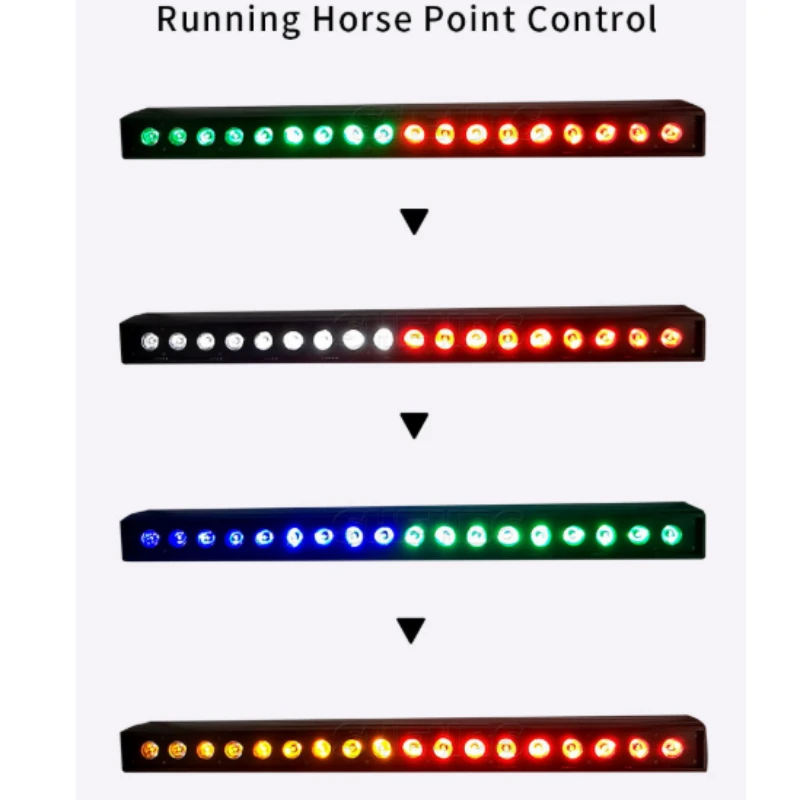
Point control means the bar is not one single colour address but a sequence of independently controllable points. Instead of the whole bar changing colour together, a defined number of LEDs at one end can be red while the middle is dark and the far end is blue, and that pattern can move. The traditional name for this behaviour in the trade is running horse, and it is the difference between a wash light and a linear effect fixture.
The value is not novelty. It is the ability to create motion with a single linear object, without adding moving heads, without adding a media facade, and without a video processor. A wall that breathes, a colonnade where light travels from column to column, a retail frontage where a highlight sweeps along the glass in the brand colour: all of it comes from addressing and programming, not from extra hardware.
Designing Chases That Look Expensive
Speed, Width and Direction
Three parameters decide whether a chase looks professional or cheap. Width is the number of points lit at once: a single point moving fast reads as a sparkle, a wide band moving slowly reads as a wave. Speed should be tied to the architecture, not to the maximum the controller can output; a wave that takes four seconds to cross a facade feels deliberate, while a wave that crosses in half a second feels like a fault. Direction should follow the building, running along the long axis rather than against it.
The most convincing chases are usually the simplest: a wide soft band, a low background level, a slow travel, and a long pause between passes. Restraint is what separates an architectural effect from a disco effect.
Colour Pairs and Backgrounds
A chase becomes a design when it has a colour relationship. Warm white travelling across a deep amber background. Ice blue over a static navy. Brand red over near-black. The background is the part most programmers forget, and it is the part that gives the moving band something to move against.
Because the bar carries a real white channel, the background can be a genuine warm white while the travelling band is saturated colour, which is a combination RGB-only fixtures physically cannot produce at full brightness. That single capability is often the reason a designer specifies this bar rather than a cheaper alternative.
Synchronising Multiple Bars
A run of bars on one facade must behave as one object. That requires correct addressing, consistent channel mapping, and a controller that can send a single scene to the whole universe without latency differences between the first and last fixture. Daisy-chained data makes the wiring simple; disciplined addressing makes the result predictable.
Reverse and mirror modes matter more than they sound. On a symmetrical building, two bars mirroring each other produce a centre-out wave that reads as intentional, while two bars running identically produce a wave that visibly collides in the middle. The ability to reverse a bar in software, rather than by remounting it, saves an installer an hour and a client an argument.
Applications: Where the Powerhouse Earns Its Price
Commercial Facades and Retail Frontage
Retail is the most colour-conscious client in the market. Brand colours are specified to a hex code, campaigns change quarterly, and the lighting has to be right in a photograph taken by a customer at night. A bar that can hit a brand red precisely, hold it identically across every unit, and switch to a clean white for the morning open is worth more than a bar that is cheaper per unit.
Frontage work also rewards point control. A slow sweep along a glass facade draws the eye along the shopfront in a way that a static wash never does, and it can be scheduled to run only during campaign weeks, so the street does not become a fairground.
Hospitality, Bars and Entertainment Venues
Hospitality wants two contradictory things: atmosphere at night and respectability by day. A coloured wash at 9 pm and a warm architectural glow at 2 am are the same fixture in different scenes, which is precisely what a four-in-one bar delivers. Venues also value the chase effects for event nights, product launches and DJ sets, where a linear bar on the wall is the cheapest way to add movement to a room.
Because the housing is built for outdoor duty, it also survives the realities of hospitality: cleaning chemicals, humid kitchens, coastal terraces, and the occasional hose-down of a courtyard.
Events, Stages and Temporary Installations
Temporary work punishes fixtures. They are rigged, struck, stacked, transported and rigged again, often by crews who have no time to be gentle. A cast aluminium body with a scratch-resistant outer layer is not a luxury in this context, it is a logistical requirement, because the third and fourth rental of a bar decide whether it was a good purchase.
On stage, the bar works as a low linear wash for ground rows and set walls, and as an effects surface for background motion. Camera-friendly dimming keeps it usable under video, which is now the default condition of any event.
Landscape, Gardens and Residential Exteriors
In residential and landscape work, subtlety is the specification. A villa facade wants a warm 2700 K-style glow with a hint of colour in the planting, not a saturated rainbow. The white channel carries that everyday scene, and the colour channels are held in reserve for occasions.
Outdoors, the enemy is time. UV, rain, salt air, garden irrigation and temperature cycling all attack the coating and the seals. A three-layer housing system is the difference between a garden that looks designed for five years and one that looks abandoned after two.
Control, Commissioning and Serviceability
DMX512 Compatibility
The bar speaks standard DMX512, which means it drops into the control infrastructure that almost every commercial project already owns. No proprietary processor, no vendor-locked software, no annual licence. The integrator patches it like any other fixture, and the client's facilities team can operate it with the console and the scene recall they already understand.
Channel mapping should be simple enough to remember and documented clearly enough to hand over. A fixture that requires a manual and a phone call to address is a fixture that gets misconfigured at 11 pm before an opening.
A Commissioning Workflow That Ends in a Signed Handover
Commissioning is a sequence, not a guess. Address the run, verify the map against the plan, test each channel group, set the mounting angle, then build scenes from static to dynamic. Testing before programming saves an enormous amount of time, because a chasing fault on a multi-bar run is almost always an addressing error rather than a hardware failure.
Handover should include the scene list, the addressing chart and a short operating note for the client. That document is what prevents the "someone changed the colours and now it looks wrong" conversation three months later.
Serviceability and Long-Term Ownership
Good fixtures are designed to be serviced rather than replaced. Accessible drivers, standard connectors, replaceable modules and a housing that can be opened without destroying its seals all reduce the cost of the fifth year. Combined with a construction that resists scratching and heat degradation, this is what makes a bar a capital asset instead of a consumable.
The Commercial Case
For the Installer
The installer's economics are simple: labour hours, callbacks and reputation. One fixture that covers white and colour removes the need for two product lines, two addressing plans and two sets of spares. A bracket that locks at the right angle removes a second visit with a ladder, and a bar that daisy-chains data and power keeps the cable run tidy enough to pass inspection first time. A housing that survives handling removes the callback where the client reports a scratched bar before the opening party.
For the Designer
The designer needs range without unpredictability. Four-in-one colour, a real white channel, smooth dimming and point control give creative room across a whole project, from a quiet residential facade to an animated retail frontage, using one specification line. Consistency across units is what allows a hundred-bar scheme to be specified with confidence rather than with a prayer.
For the Owner
The owner buys an impression. Tenants, guests and passers-by do not read datasheets; they decide in three seconds whether a building looks expensive. A facade that can change with the season, hold a brand colour exactly, and run a slow wave during an event signals investment. Add lower maintenance, energy-efficient LED operation and a long service life, and the purchase stops being a lighting cost and becomes a marketing budget line.
Conclusion: From Ordinary to Signature
Ordinary is not a price point, it is a set of compromises: colour that is approximately right, control that is coarse, construction that is adequate. This RGBW powerhouse removes those compromises one at a time. Four-in-one emitters give colour that mixes before it reaches the wall. A dedicated white channel gives the tints and the everyday light that RGB cannot fake. Point control turns a linear bar into an instrument. A cast aluminium body with a three-layer protective system gives all of it a working life measured in years rather than seasons.
The result is a fixture that is easy to specify, straightforward to install and hard to mistake for the bar next door. That is the entire argument for ditching the ordinary. Your building only gets one night view. It may as well be a signature rather than a repeat.
How To Cooperate With Us?
Since we have our own facilities, we are pleased to have complete control over the production process and the quality of our goods. We are committed to giving our clients the finest prices since we are manufacturers rather than just brokers. We encourage buyers to see our samples first since we are certain that the cost and calibre of our items are transparent. Our dedication to excellence and client happiness motivates us to consistently provide superior products.
Our address
3rd Floor, 5th Building, Hebei Industrial Park, Hualian Community, Longhua District, Shenzhen, China