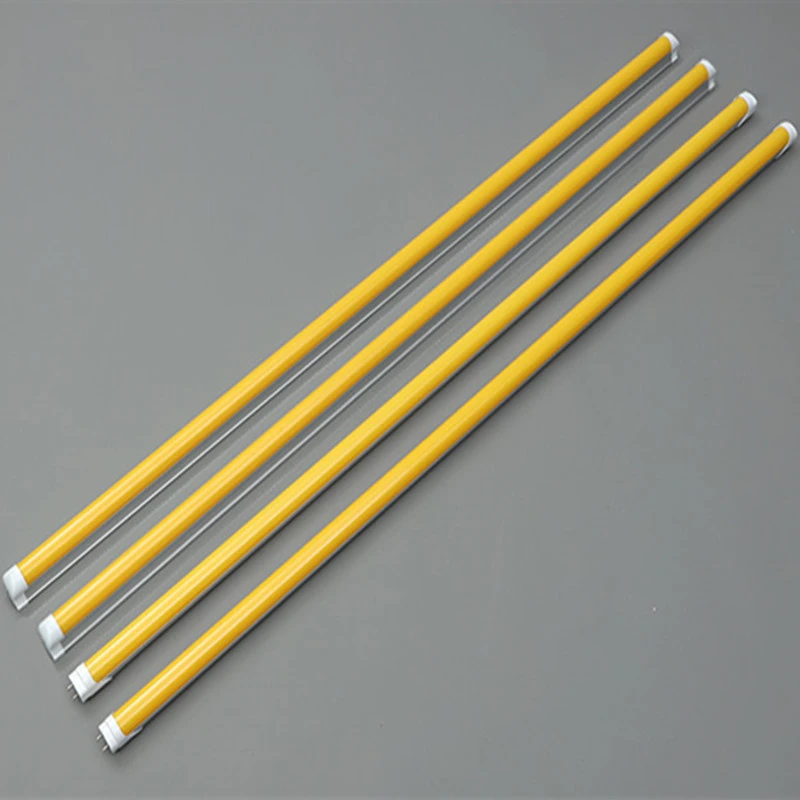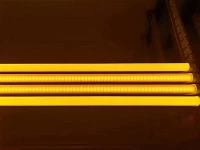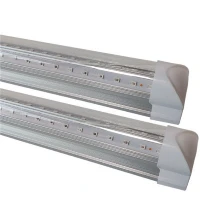

Most commercial lighting upgrades default to 4000K or 6000K white LED tubes-brighter on paper, lower on the spec sheet, and easy to justify. But there is a specific class of spaces where a standard white tube is not the "safe" choice. It is the actively harmful one. A yellow LED tube, such as the T8 anti-UV model from Benwei Lighting, exists for those spaces: rooms where short-wavelength light damages materials, disrupts biological rhythms, or pulls insects toward sensitive areas. The question is not "is it bright enough?" but "what is the white light doing that you cannot see?"
The Problem With "Just Use White": Three Measurable Costs
A conventional white LED tube emits across the visible spectrum, including the 400–500 nm band-blue-violet and near-UV. In most offices and warehouses, that spectrum is harmless. In three specific environments, it produces costs that show up in repair budgets, pest-control invoices, and preservation reports.
Insects. Field studies at six rural railway stations in Germany demonstrated that amber/1800K LED lighting attracted 40–50% fewer insects and up to 75% less insect biomass than the standard 4000K cool-white LED and 2000K high-pressure sodium lamps. The mechanism is spectral: many insects are disproportionately sensitive to short-wavelength light below ~500 nm, and amber/yellow sources emit comparatively little of it. A yellow tube does not make a space "insect-proof," but it removes the phototactic pull that turns a lit entrance or food-production corridor into a collection point.
Material degradation. The conservation literature is consistent: wavelengths below 500 nm are the primary driver of photochemical damage in organic materials-fading, yellowing, and embrittlement. Museum standards such as GB/T 23863-2024 set annual exposure limits for sensitive objects (e.g., ≤15,000 lx·h/a for certain categories) and require spectral control, not just lux control. A white LED tube that meets an illuminance target can still deliver damaging short-wavelength radiation; a yellow tube that cuts everything below 500 nm addresses the damage mechanism directly.
Circadian disruption. Controlled human exposure data show that yellow light (≈590 nm) does not alter the normal evening rise in salivary melatonin, while lighting with a blue component significantly suppresses it-e.g., office daylight-white exposure kept melatonin at 25 ± 16 pg/mL versus the dim-light baseline rise to 38 ± 27 pg/mL under yellow light. In spaces where people need to remain alert and comfortable without a blue-rich signal-hospital procedure rooms, darkrooms, night-shift inspection areas-this spectral difference is functional, not cosmetic.
Where the Data Says Yellow Wins: A Scenario-by-Scenario Comparison
The table below translates the research into the decisions a facilities or procurement team actually faces. The illuminance targets are drawn from application standards; the spectral and insect data come from the studies cited above.
| Environment | What white light does wrong | Yellow LED tube's measurable advantage | Relevant design target |
|---|---|---|---|
| Food production / entrance / loading dock | Attracts flying insects toward product and doorways | 40–50% fewer insects, up to 75% less biomass vs. 4000K LED | Perimeter lighting can be dimmer than task lighting; spectral control matters more than raw lux |
| Wine cellar / bottle storage | Short-wavelength light accelerates "light struck" off-flavors; heat adds stress | 500 nm cut-off removes UV and blue; <50 lx on bottles is achievable with yellow tubes | Storage: <50 lx; tasting/bar zone: 200–300 lx, UGR <19 |
| Museum / archive / gallery | Cumulative photochemical damage to pigments, paper, textiles | No wavelength below 500 nm; aligns with the damage-avoidance principle behind GB/T 23863-2024 | Sensitive objects: annual exposure capped (e.g., 15,000 lx·h/a); CCT ≤3000K |
| Semiconductor / PCB / cleanroom | Blue/UV exposure degrades photoresist and photosensitive materials | Zero transmittance below 500 nm; dominant wavelength 590–595 nm | Visual-task areas need adequate uniformity, but the spectrum must not expose resist |
| Darkroom / photosensitive storage | Fogging of film and sensitive stock | Complete 400–500 nm cut-off; yellow light is the safe work light | Illuminance is secondary; spectral exclusion is the primary requirement |
What a Yellow LED Tube Is-and What It Is Not
The T8 yellow tube referenced here is a spectrum-control device first, a general light source second. Its useful output sits at 1500–2000K, with a dominant wavelength around 590–595 nm and a hard cut-off below 500 nm. That spectral profile is what delivers the insect and material-protection benefits above.
The honest trade-off is color rendering. A pure yellow source has a low Ra by nature; the fixture's CRI is not comparable to a 90+ white LED tube, and it should not be specified for merchandising or tasks where accurate color discrimination is the objective. This is not a defect-it is the same physics that makes the tube protective. A yellow tube is the right tool when the job is "illuminate without exposing"; a white high-CRI tube remains the right tool when the job is "render color accurately." The mistake is treating them as interchangeable on a watt-for-watt basis.
The market context reinforces that this is not a niche curiosity. The global LED tube market was estimated at US$4.5 billion in 2024 and US$4.89 billion in 2025, with a forecast of US$11.28 billion by 2035 (CAGR 8.72%). Within that growth, spectral-control tubes are being pulled by semiconductor capacity, stricter museum conservation standards, and food-safety-driven pest management-not by general office relamping. LED linear lamps also last roughly 2.5× longer than tubular fluorescent lamps, which matters in hard-to-access ceiling installations such as cleanrooms and archives.
The ROI Case in One Table
For a procurement team, the decision ultimately reduces to avoided cost. The comparison below uses a 50-tube installation running 12 hours per day, with electricity at a representative commercial rate and maintenance/labor assumptions stated explicitly.
| Cost item | Fluorescent / standard white baseline | Yellow LED tube (spectrum-control) | Basis |
|---|---|---|---|
| Lamp life | 10,000–30,000 h (fluorescent tube) | 50,000–100,000 h | Manufacturer data and comparative lifecycle studies |
| Replacements over 50,000 h | ~2–5 fluorescent tubes per position | 1 LED tube per position | Derived from lifespan ranges |
| Energy per 18W-class tube (12 h/day) | ~79 kWh (fluorescent, with ballast losses) | ~79 kWh (LED, same nominal wattage) | Illustrative; actual wattage varies by product |
| Damage/pest externality | Unquantified in standard lighting ROI, but real | Reduced insect attraction and photochemical load | Field studies cited above |
| Maintenance access cost | 2–5× more frequent lamp changes | Single change over the LED's rated life | Labor rate is site-specific |
The energy line is not where the yellow LED wins-a 18W tube is a 18W tube. The ROI comes from eliminating avoidable replacements (fewer lamp changes in cleanrooms, archives, and high-bay food production areas) and from avoiding the damage that white light causes. In a museum or semiconductor fab, a single prevented incident-a faded dye lot, a rejected wafer batch-can exceed the entire fixture cost.
A Practical Selection Note
Yellow LED tubes are not a universal "upgrade" from white tubes. They are a targeted substitution for spaces where the 400–500 nm band is a liability rather than a benefit. The selection test is simple:
If the space contains photosensitive materials, UV-curable resist, or organic collections, specify a yellow tube with a verified cut-off at or below 500 nm-not a yellow-dyed cover over a blue-pumped LED, which may leak short wavelengths.
If the space has insect pressure at entries or product zones, pair yellow tubes with shielding and dimming; the spectral advantage is strongest when the source is also shielded from direct view.
If the space requires accurate color rendering for merchandise or branding, a yellow tube is the wrong choice, regardless of its other benefits.
If you are specifying spectrum-control tubes for a cleanroom, archive, wine store, or food-production facility, the most efficient next step is to share your application environment, ceiling height, existing tube count, and the specific material or process you need to protect. Send your project details to Benwei Lighting to receive a cut-off verification note, a lamp-count estimate, and a comparison against your current white or fluorescent load.