Do Dragon Fruits Need to "Sunbathe" at Night? How LED Grow Lights Can Double Your Yield
Dragon fruit originates from the tropical desert regions of Central America and is naturally light‑loving. It requires at least 12 hours of light per day to successfully flower and bear fruit. Under natural conditions, the flowering period of dragon fruit is typically from June to November – exactly when many other fruits are also on the market, often driving prices down. During winter and spring, insufficient light sends the plant into dormancy, halting flower bud differentiation and directly impacting yield and quality.
This is where LED grow lights come in – by simulating daylight at night, they extend the "daytime" for dragon fruit, encouraging continued growth and flowering. This technique has been proven to advance flowering, prolong the fruiting period, and add 3 to 5 extra harvests per year (1–2 more in winter and 2–3 more in spring).
How Supplemental Lighting Works: "Tricking" the Plant's Internal Clock
From a plant physiology perspective, light is not only the energy source for photosynthesis but also a signal that triggers flowering and fruiting. The essence of supplemental lighting is to extend the photoperiod beyond the critical 12‑hour threshold, satisfying the conditions for flower bud formation and differentiation.
In practice, growers typically supplement light for 4–6 hours from dusk to midnight during autumn and winter, bringing the total daily light exposure to about 14 hours. According to Guangdong Province's 2024 recommended technical plan, lighting can be started when the ambient temperature exceeds 15°C. After 20–60 consecutive days of supplemental lighting, dragon fruit can break dormancy and flower early.
How to Choose LED Grow Lights: 4 Key Parameters
With so many grow lights on the market, growers and buyers are most concerned about: which type of light truly meets dragon fruit's needs? Based on agricultural research and product specifications, the following four parameters are the most critical.
1. Power: 15W is the "sweet spot"
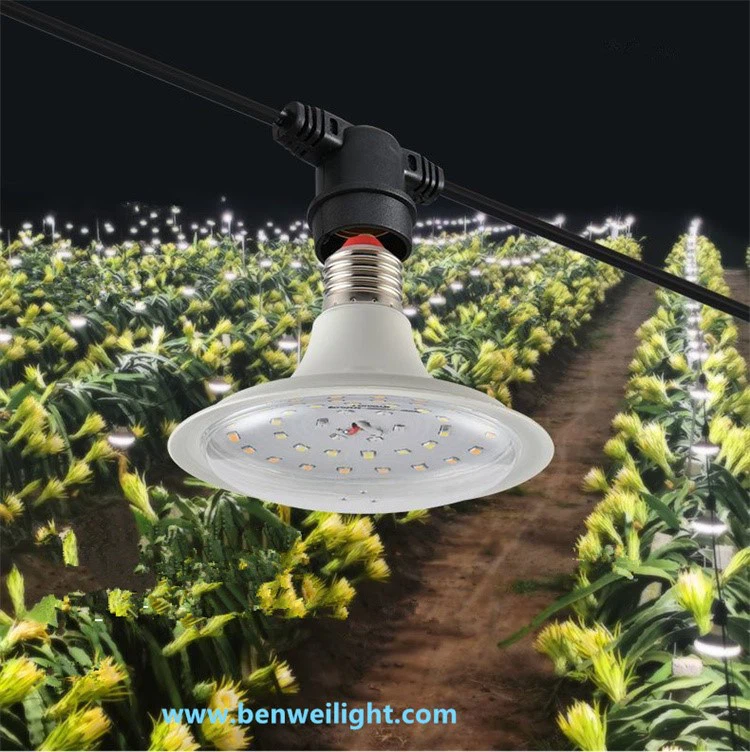
The supplemental lighting technical guide issued by Guangxi's Department of Agriculture and Rural Affairs clearly states that the power for dragon fruit grow lights should be 12–15W. Guangdong's main technical plan similarly recommends 12–15W high‑efficiency LED flowering‑induction lights. A 15W lamp provides sufficient light output (about 4000LM) while avoiding energy waste and heat damage from higher wattages. Taking Benwei's 10W/15W E27 LED plant grow light bulb as an example, the 15W model delivers 4000LM – combining high efficiency with adequate penetration, making it suitable for medium to large dragon fruit plantations.
2. Light Spectrum: Red + Blue is most effective
Dragon fruit is very sensitive to light quality. Studies have shown that supplementing with red and white light significantly promotes stem metabolites, chlorophyll, endogenous hormone levels, flower count and fruit yield. The industry generally recommends a red‑to‑blue ratio of at least 3:1, with peak wavelengths in the red zone (630–660nm) and blue zone (420–460nm). Benwei's grow light has a colour temperature of 4000–4500K – a neutral white full spectrum that covers the key bands for plant photosynthesis, suitable for dragon fruit from vegetative growth through to flowering and fruiting.
3. Waterproof Rating: IP65 for high‑humidity greenhouse environments
Dragon fruit grow lights are typically installed in greenhouses or open fields, where they are exposed to high humidity and even direct rain. The Guangxi guide emphasises that lights must have good moisture protection. An IP65 rating means the light is completely dust‑tight and can withstand low‑pressure water jets from any direction – whether from greenhouse misting, rain or routine cleaning – without affecting normal operation or lifespan.
4. Heat Dissipation and Lifespan: Aluminium body + PC cover
LED lights generate heat during prolonged operation. Poor heat dissipation leads to rapid light decay and greatly shortens the lamp's life. An aluminium body combined with a PC cover is the industry‑recognised solution – aluminium conducts heat efficiently, drawing it away from the chips; the PC cover provides high light transmission and impact resistance while adding extra protection. Benwei's product, for example, uses an aluminium housing with a PC cover, Epistar 2835 LED chips, and a rated lifespan of 50,000 hours – at 6 hours of daily use, that is nearly 23 years.
Installation and Usage Tips
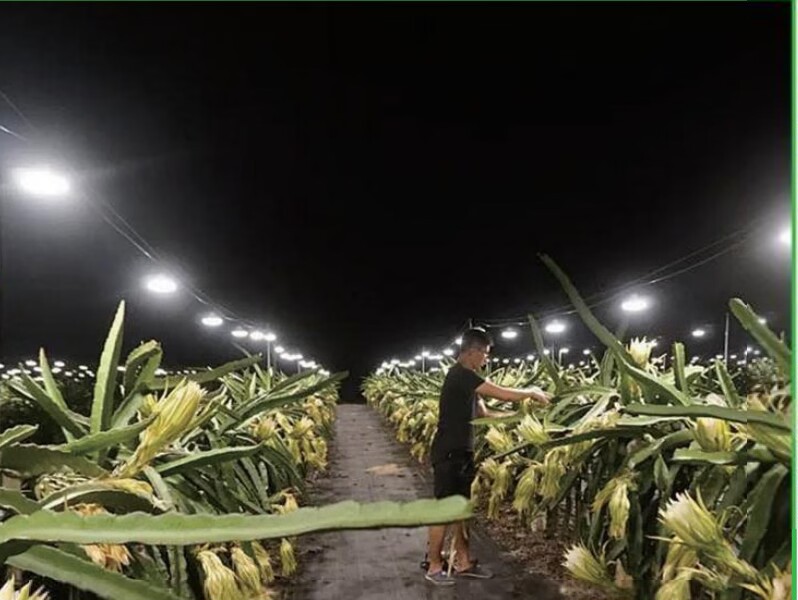
In practice, installation height and density are also crucial. Generally, the light should be about 1.2 metres above the dragon fruit branches, with 80–100 lights per mu (≈1/15 hectare) to ensure even coverage. For row planting, one light every 1.5–1.8 metres per row is sufficient. Lighting is usually scheduled from 18:00 to 24:00 (4–6 hours per day), controlled by a timer for automation – no need to switch manually each day.
Economic Benefits: One Light Can Transform an Orchard
The economic benefits of LED supplemental lighting are quantifiable. A field trial in Hai Duong Province, Vietnam, showed that after applying LED lighting, each dragon fruit plant produced 75 fruits per season, with a total yield of nearly 13 tonnes per season. The off‑season revenue reached 325–390 million Vietnamese Dong, while electricity costs were only 18 million Dong – an excellent input‑output ratio. In China's main dragon fruit producing regions such as Guangxi and Guangdong, this technology has been included in the 2024 Guangdong Province leading technique plan. Many plantations have achieved both higher yields and off‑season premium prices through LED lighting.
Conclusion
Supplemental lighting for dragon fruit is not a gimmick – it is a mature growing technique validated by agricultural research, with clear technical specifications. By choosing the right power, spectrum, waterproof rating and thermal design, a good LED grow light allows dragon fruit to "sunbathe" at night, delivering multiple harvests year‑round and real economic returns for growers.
Ready to boost your dragon fruit yield with the right LED grow lights? Contact us today for a customized lighting solution and free technical consultation.