Why COB LED Downlights Are the New Favorite in Commercial Lighting?
Hotel lobbies, brand showrooms, high‑end homes – why do these spaces increasingly prefer recessed COB downlights? The answer lies in the light source technology.
When you walk into a five‑star hotel lobby, those discreet, uniform light sources on the ceiling are most likely COB recessed downlights. When you stand in an art gallery admiring an oil painting, the precisely focused beam right at the centre of the frame probably comes from a COB downlight. Unlike traditional spotlights that cause harsh glare, or ordinary ceiling lights that scatter light loosely, COB downlights use a single "concentrated" light source to deliver precision, comfort and a premium feel.

From SMD to COB: More Than Just a Packaging Evolution
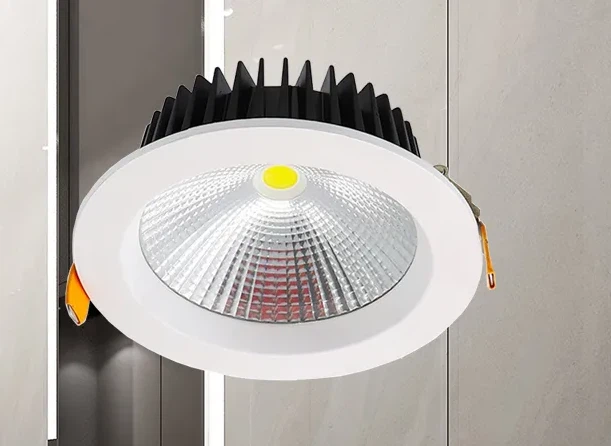
First, let's answer a basic question: what is COB? COB stands for "Chip‑on‑Board" – multiple LED chips are directly packaged onto a single substrate, forming a single, high‑density light source module. In contrast, SMD (Surface‑Mounted Device) uses many individual chips mounted separately on a circuit board, each emitting light independently.
The differences between the two technologies are reflected in three core areas: light efficacy, light quality and thermal management. The table below provides a direct comparison:
| Parameter | COB LED Downlight | SMD LED Downlight |
|---|---|---|
| Light source form | Single integrated source, near "luminous surface" | Multiple individual chips, dispersed emission |
| Beam angle | Narrow to medium (15°–60°), highly focused | Wide angle (90°+), broad and uniform |
| Luminous flux density | Up to 300 lm/mm² | Typically below 100 lm/mm² |
| Color Rendering Index | CRI ≥90 achievable, some ≥95 | Standard ≥80, high‑end up to 90+ |
| Color temperature consistency | CCT < 50K | CCT often > 200K |
| Thermal resistance | 1.2–2.5℃/W | 5–8℃/W |
| Rated lifespan | >50,000 hours | ~30,000 hours |
From the table, it is clear that COB's advantages lie in "precision" – concentrated light source, true colour rendering, and excellent thermal management. These characteristics make it the preferred solution for commercial lighting applications.
Three Core Advantages of COB Downlights
1. Better light quality: one clean beam is worth ten scattered lights
Because SMD downlights use dispersed chips, they emit light over a wide area, often producing multiple shadows and overlapping "ghost" effects. COB downlights, with their light source concentrated in a small area, produce a clean, uniform beam with clear edges – no multiple shadows, no messy overlaps. Moreover, COB chips have a natural advantage in high colour rendering; premium COB downlights can achieve CRI ≥90 or even ≥95, making exhibits, merchandise and skin tones appear more natural and true.
2. Precise light control: aim where you want
Because the COB light comes from a compact, well‑defined area, when combined with optical reflectors and lenses, it allows very accurate beam shaping – from a tight 15° spot to a 60° flood, with almost no stray light or glare. For applications that demand strict beam control – high‑end retail displays, gallery lighting, hotel accent lighting – this precision is difficult for SMD solutions to match.
3. Better heat dissipation: small size, big intelligence
COB chips package multiple LEDs directly onto a ceramic or aluminium substrate, resulting in a shorter thermal path and lower thermal resistance (COB: 1.2–2.5℃/W vs SMD: 5–8℃/W). This means COB downlights achieve better junction temperature control during long operation (COB can stay below 85℃, while SMD of the same power often exceeds 110℃), thereby extending lifespan and reducing lumen depreciation. With a high‑quality die‑cast aluminium heat sink, COB downlights typically last over 50,000 hours – much lower maintenance than traditional fixtures.
Choosing COB Downlights: Focus on Three Parameters
There are many COB downlight models on the market, but the real performance differences come down to the following three parameters:
| Parameter | Recommended Value | Reason |
|---|---|---|
| Color Rendering Index (CRI) | ≥90 (commercial), ≥95 (high‑end/art display) | True colour reproduction affects merchandise presentation and visual comfort |
| Correlated Color Temperature (CCT) | 2700K–3000K (warm ambience), 4000K (neutral office/commercial), 5000K+ (high‑visibility needs) | Different scenes require different colour temperatures; warm light creates atmosphere, cool light enhances focus |
| Beam angle | 15°–30° (accent/display lighting), 45°–60° (task/ambient lighting) | Beam angle determines coverage and focus, directly affecting spatial layering |
In addition, modern COB downlights often feature anti‑glare designs; many high‑quality products achieve UGR ≤19, significantly reducing visual fatigue. When selecting, it is advisable to consider the space usage, ceiling height and key display areas. Professional lighting simulation software like DIAlux can be used for verification when needed.
Where Are COB Downlights Best Suited?
COB downlights are widely used, especially in the following three types of spaces:
- Commercial retail & display – Brand clothing stores, jewellery showrooms, car exhibitions, etc., need light precisely directed onto products to highlight texture and details. COB downlights' high CRI and precise beam control make products "naturally radiant".
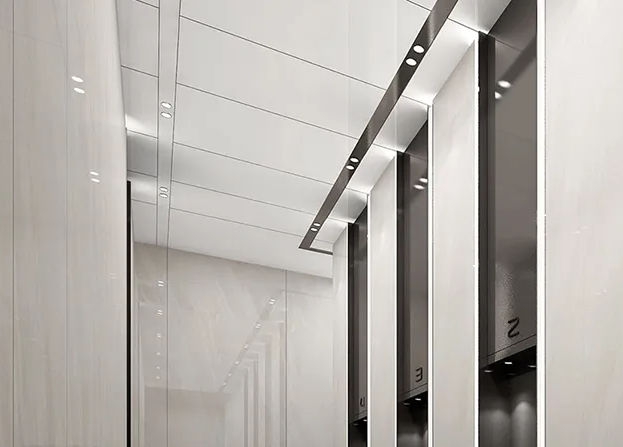
- Hotels & clubs – Lobbies, corridors, restaurants, guest rooms – when recessed into the ceiling, COB downlights with their frameless design and precise beam control create a premium atmosphere without glare interference.
- High‑end residential – Living rooms with no main light, focused lighting over kitchen islands, accent lighting for art pieces – COB downlights perform admirably. The fixtures themselves have a low visual presence, but the light they produce has a high impact.
Conclusion
COB technology has taken LED downlights from "being able to light up" to "lighting up beautifully". With a more concentrated light source, superior colour rendering and precise beam control, it answers the core needs of commercial spaces for high‑quality lighting. The global integrated LED downlight market reached USD 29.43 billion in 2025 and is expected to grow to USD 75.64 billion by 2035. When energy efficiency is no longer an issue, light quality – the true forte of COB downlights – becomes the next competitive battleground.
Looking for the right COB downlight specifications for your project? Benwei offers a full power range from 5W to 20W, with colour temperatures from 2700K to 6500K, high CRI, low UGR, and die‑cast aluminium heat sinks – a one‑stop solution for your commercial lighting needs. Contact us for selection advice and project quotes.