Are incandescent bulbs still in use? Now is the moment to choose a different course of action. In addition to using a lot of energy and costing you money each month, incandescent lights are also being phased out. The Department of Energy under President Joe Biden established a new efficiency regulation that requires lightbulbs to output a minimum of 45 lumens per watt after years of increasing requirements. Everything else will cease to exist, therefore putting an end to incandescent lighting as a whole.
If you haven't made the move to LED lights, the time has come, and the arguments are strong. To begin with, LED lights use substantially less energy while producing the same amount of light as incandescent bulbs. This is excellent for the environment and, in the long run, may save your power costs, particularly if you're replacing all of the bulbs in your house.
In fact, according to estimates from the Energy Department, this new regulation would result in power bill savings for US households of roughly $3 billion over the course of the next 30 years, while reducing carbon emissions that contribute to global warming by 222 million metric tons. If the low price and environmental advantages aren't enough to persuade you, LED bulbs also offer a number of fascinating and valuable features, such as lights that change color and lights that communicate with your preferred voice assistant or home security system.
But purchasing the correct LED differs from purchasing incandescent bulbs. Therefore, there are five things you should be aware of before purchasing.
1. Use lumens, not watts.
Your watts won't help you here, so forget all you know about incandescents.
You're undoubtedly used to searching for watts when buying bulbs to get an idea of how bright the bulb would be. This is due to the fact that for incandescent bulbs, wattage serves as a good predictor of the amount of light the bulb will produce: the higher the wattage, the brighter the tungsten filament within the bulb will shine. LED brightness, however, is decided in a somewhat different way.
Contrary to popular opinion, wattage is a measurement of how much energy the bulb uses, not a measure of brightness. Watts are often considered to be a good indicator of how bright an incandescent bulb will be, but with LEDs, this relationship is less clear. This is so that LEDs may be as effective as possible without sacrificing the quality of the light, and certain LEDs are more effective than others at doing this.
For instance, a 60-watt incandescent bulb's brightness may be achieved with an LED bulb that normally uses 8 to 12 watts. Consider finding two LEDs at the store that are labeled as 60-watt replacements and are sitting on a shelf. The difference between the two is 8 and 12 watts. You should practically disregard the wattage when seeking for brightness from your LED bulbs since it is quite probable that the 8-watt bulb will be brighter than the 12-watt light.
Fortunately, there is a more useful unit of measurement for brightness, the lumen. The lumen (lm), which is the correct unit of brightness measurement for lightbulbs, is the figure you should pay attention to while buying for LEDs. Here is a chart that compares the wattage of incandescent lights versus LEDs in terms of lumens for your reference.
An incandescent may use up to five times as many watts for the same amount of lumens, as seen in the chart above. Before you go shopping, determine the brightness (in lumens) you'll need and forget about your fondness for watts.
2. Ensure that you choose the appropriate LED color.
In contrast to LEDs, which come in a variety of hues, incandescent bulbs usually emit a warm, yellowish tone.
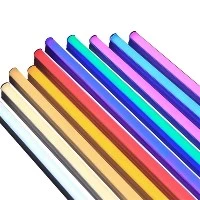
LED lights can exhibit an astounding variety of colors, from purple to red to a whole spectrum of whites and yellows, as shown by Philips Hue. But you're probably searching for anything that mimics the incandescent light for your house.
The two most often used LED colors are bright white and soft white (sometimes known as warm white) (also called daylight). Not at that difficult, is it?
While bulbs marked as bright white or daylight will provide a whiter light, closer to daylight and like that seen in workplaces and retail establishments, soft white and warm white will generate a yellow, candle-like glow, comparable to incandescents.
If you want to get scientific, color temperature—which is measured on the Kelvin scale—describes the hue of light that falls inside the white light spectrum. The light will be warmer (yellower) the lower the number. If you want a soft white LED bulb, aim for a temperature between 2,700K and 3,500K, which is the same range as your normal soft white incandescent. Need something with a daytime tone? Search for bulbs with a 5,000K or greater rating.