Are Bugs and Insects Drawn to LED Lighting?
What we can do to lessen bugs is crucial because they are bothersome. Furthermore, insects near lights have the potential to block light beams, decreasing coverage area and brightness. In addition to lowering lighting efficiency, this requires households to do extra cleaning. We'll go over why insects are drawn to lights, how LED UV lights are impacted, and some tips for keeping bugs away.
What Draws Bugs to Lights?
When insects are swarming around your light fixtures, an evening outside can soon become uncomfortable. These lights unintentionally draw unwelcome visitors rather than creating a calm atmosphere. However, what is the source of this attraction?
1. The Nature of Light Bulbs: According to one theory, bugs are attracted to particular features of the light bulbs that emit the light in addition to the light itself. This attraction may be influenced by elements like the bulb's size, shape, and kelvin rating.
2. Spectrum Attraction: The majority of insects are especially drawn to the three main light spectrum colors-green, blue, and ultraviolet-which are found in the wavelength range of 300–650 nm. Notably, they are particularly attracted to the 300–420 nm range. For comparison, human visible light usually falls between 400 and 800 nm.
3. The Insects and Their Motivations: A number of insects, including moths, beetles, mayflies, crane flies, and particular kinds of drosophila, can congregate at lights. They are drawn to these light sources for a number of reasons:
• Warmth: Many insects are drawn to lights because they offer a source of warmth on chilly evenings.
• Mating and Food: In their search for food or mates, certain insects are drawn to lights.
• Navigation: Some insects rely on their natural travel systems and use light for navigation.
• Mimicking Frequencies: Some lights' buzzing or flickering sound may mimic the frequencies that other insects generate, making them appealing.
• Light Intensity: Insects with complex eyes may become momentarily blinded by bright lights, which will attract them closer.
Avoid confusing BUG ratings for lights
Backlight, uplight, and glare ratings, or BUG ratings for lights, are used to enhance light quality. Check out our tech article.
What types of lights actually draw bugs?
More bugs are drawn to lamps designed to create ultraviolet and bright blue color spectrums than to any other type of light. The range of 300–650 nm is the ideal wavelength for drawing certain insects. In the 300–400 nm area of the visible spectrum, ultraviolet falls below it. Regretfully, more than half of the visible spectrum is still in the 400–650 nm range. Consequently, any light source that emits a wavelength between 300 and 650 nm has the capacity to attract various insects to it. White fluorescent, white incandescent, and mercury vapor lamps are a few types of light sources that draw insects.
Because the mercury atoms embedded in the spectral lamps undergo chemical changes, mercury vapor lights emit light beams. These lights provide a range of wavelengths from 184.5 to 1014 nm. The wavelength emission falls between 300 and 650 nm, which is the region that insects favor. Low-, medium-, and high-pressure vapor lamps are a few types of mercury lamps.
The wavelength range produced by compact fluorescent lights is 400–700 nm. Between 5 and 22 percent of the power used by fluorescent lamps is converted into visible light by the energy system. Additionally, a variety of gradations of red, blue, and green are produced by these lights. The attraction of various bugs is caused by the variety of light emitted. The light beams produced by the fluorescent lights provide full spectrum, cold white, and warm white lights.
Additionally, filament bulbs are more likely to attract insects. The color temperature of light produced by filament lamps ranges from 2,800 to 6,200 kelvin. Additionally, these color temperatures result in various bug-attractive color characteristics. Bugs congest the area around the filament lamp as a result. The temperature of the filament may reach 400 degrees Celsius. However, the vacuum and glass coating surrounding the filament wire minimize the majority of the temperature and heat produced. The insects have a warm atmosphere thanks to the decreased heat, which could make them more attractive.
High-pressure sodium lights and metal halide lamps are known to draw a variety of insects. The color temperature of the majority of metal halide lamps is 4,250 kelvins, which results in a mixture of warm and pure white light. Due to the rarefaction principle, it has been discovered that metal halides draw more insects than LED UVlights that produce the same kelvins. Additionally, the LED UV light from the lights is reflected off the metal halides, which attracts insects.
It is important to acknowledge that UV light is present in all types of light. During calibration in the production process, the light requires critical attention. Several insects will be less likely to flee to light if the ultraviolet emissions from the various lights are reduced, which will promote eco-protection.

Which Light Types Are Not Attractive to Bugs
Numerous insects are frequently drawn to outdoor illumination, which can be especially problematic in places like streets, porches, sidewalks, and fields. However, new solutions that are less enticing to these bothersome animals have been made possible by advances in lighting technology.
• UV-Reduction Lights: Certain contemporary lights have a unique coating intended to reduce blue and ultraviolet emissions, which are known to draw insects. Bugs find these lights less enticing when these emissions are reduced.
• LED lights with low UV emissions: LEDs with low UV emissions typically draw fewer insects. Improvements in the manufacturing process, such as effective heat preservation and dissipation, are responsible for this.
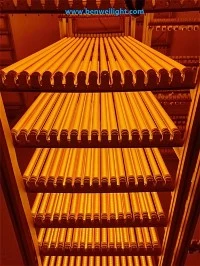
• Yellow Light Producers: Insects are less drawn to lights that generate yellow hues. The main reason for this is that they emit light that is outside of the usual spectrum, which attracts insects. For example, many insects find yellow Compact Fluorescent Lights (CFL) less enticing since they emit less energy and produce longer wavelengths.
• Halogen tubes: Because they emit longer wavelengths, which are less alluring to insects, these tubes are less likely to draw insects.
• Low-Wattage Lights: Compared to their high-wattage counterparts, lights with a lower wattage generate less heat. These low-wattage alternatives are less appealing to insects because they are attracted to heat.
• Warm-Tone Kelvins: Compared to colder tones, warm-tone lights may assist reduce insect attractiveness, even though many of them still have some blue in their spectrum.
Even though no light is impenetrable, choosing the right kind based on the aforementioned considerations will greatly lower the quantity of insects it draws.
What kind of LEDs draw insects?
During production, a color rendering index component is fitted in various lighting conditions. The color rendering index has a range of 0 to 100. The ability to produce visible color increases with the light's color rendering index. It has been suggested that visible color has a strong ability to attract insects. Consequently, LED lights with a higher coloring index are more likely to draw insects.
The color temperature of the LED also affects how attractive lights are to insects. Due to excessive heat and harsh light, the majority of bugs are dormant during the day, and they become more active at night. To avoid the effects of excessive cold, most bugs seek out locations of moderate warmth during the night. The neutral white produced by LED lights with a color temperature of 3,500–4,000 kelvin attracts bugs.
It has been discovered that bugs are drawn to LED lighting with a brightness proportion of about 1,100 lumens. These 1,100-lumen lights typically generate a warm white tint that doesn't harm insects' nervous systems. As a result, insects may fly to the LED lights and clog the light source.
Bugs are highly attracted to LED lights with a UV component in their light producing mechanism. Most insects' dichromatic and trichromatic eyesight tends to react to LED UV light, which has a wavelength of less than 380 nm.
Which LEDs don't draw insects?
High lumen light emissions are the primary purpose of LED manufacturing, not bug protection. The color temperature is a crucial component in the LED manufacturing process. Using the color rendering index, the color temperature is also in charge of producing the light color from the lights. Soft white light, for instance, can be produced at color temperatures between 2,700 and 3,000 kelvin, whereas sunlight-like light can be produced at color temperatures between 5,000 and 6,500 kelvin. LED lights with a color temperature higher than 5,000 kelvin will provide daylight-like light with a lot of blue in the 400–500 nm region. As a result of their nocturnal nature, bugs will be drawn to these lights. For a general (albeit incomplete) bug reduction, stick to warm-colored lights. Alternatively, spend money on some amber-colored lights, which are often in the 600–720 nm range.
Which LEDs Have the Lowest Probability of Attracting Bugs?
Certain features can affect an LED's appeal to insects, even if its primary purpose is efficient lighting rather than bug deterrence. An LED's spectrum of light emission is largely determined by its color temperature, which is connected to the color rendering index.
Color Temperature Understanding: • Soft White Light: LEDs that generate light with a color temperature of 2,700–3,000 kelvin produce a soft white light.
• Daylight Analog: LEDs with temperatures between 5,000 and 6,500 kelvin replicate the properties of daylight, generating a sizable proportion of blue light in the 400–500 nm region.
LEDs and Bug Attraction: Because insects are nocturnal creatures, they are attracted to LEDs that provide daylight-like light, particularly those with a high blue content. This is due to the fact that many insects are prone to using moonlight or starlight for navigation.
Minimizing Bug Attraction: For individuals who wish to lessen the attraction of bugs:
• Warm Colored Lights: Choose LEDs that provide warmer hues, since this may somewhat reduce the attractiveness of insects.
• Amber-colored lights: These are less likely to draw insects and usually have wavelengths between 600 and 720 nm.
One can prevent undesired insect gatherings near their lighting fixtures by making an informed decision based on the color temperature of the LED.


http://www.benweilight.com/professional-lighting/uv-lighting/uv-light-black-light-for-halloween.html
Our address
No. 5-3 Niujiao Road, Yanchuan Community, Yanluo Street, Bao'an District, Shenzhen
Phone Number
+86 18659785153
bwzm04@ledbenweilighting.com