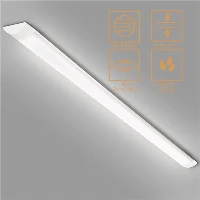
The appropriate lighting may benefit the team's productivity as well as the comfort of hard-working individuals.
But it appears that humans have always had trouble figuring out how to provide the correct lighting and provide enough illumination in offices for employees to work.
Therefore, is there a simple way to estimate the wattage and number of bulbs that should be chosen for the office space?
How does a lamp cast light around a space?
Let's examine the lighting on the main work surface in the room. Part of the light from the lamp will initially strike the surface directly, while the remainder will be reflected by the wall and then, in turn, reflected to the ceiling. Finally, a portion of the light will be divided in the same manner to the working surface by the wall and ceiling.
Thus, the light that the visual working surface perceives is really a combination of many reflections from numerous angles and the most direct irradiation. The light that strikes the work surface most directly is also referred to as main light, while the light that is reflected is referred to as secondary light.
According to this working theory, if we want to determine the precise number of lamps and their wattages for the space, we must first evaluate the lamps that will be installed. Then, we must determine how much light is required to illuminate the workspace, which must be determined by combining primary light and secondary light.
How to determine how many lighting fixtures there are
The lumen calculation technique, also known as the utilisation coefficient approach, allows us to rapidly determine how much illumination can be produced with how many lights in a given location.
The meaning of illumination We are all aware that illuminance refers to the light flux measured above the unit square.
How much of the light flux that our lamp emits, in accordance with the ratio, lands on your work surface? Xiaozhi provided the findings right away, without additional delay.
Utilisation coefficient, one maintenance coefficient, and space area are all related to luminance.
This is a quick technique of estimating the illumination of the work surface in the space.
The "utilisation coefficient method" is another name for the lumen calculation technique.
Average illumination is equal to the product of the luminous flux of the light source and the utilisation, maintenance, and area of irradiation coefficients.
Quickly knowing the solution, astonished, yet not surprised.
How, therefore, can you not comprehend it? Do not be concerned; we will explain what each parameter is.
The utilisation coefficient describes how much of the lamp's light falls on the work surface, and the magnitude of the utilisation coefficient is highly correlated with both the environment of the room and the lamp's light distribution. The utilisation coefficient of ordinary traditional lighting is typically between 0.3 and 0.5 in the commonly utilised area. This implies that between 30 and 50 percent of the light may hit your workspace, while the remaining 50 to 70 percent either stays within the lamp or is refracted by the reflected lamp on the wall, preventing it from hitting your workspace and being wasted.
The utilisation coefficient of the present LED lamp seems to be greater since it does not account for internal lamp loss and its luminous flux is the whole luminous flux of the lamp.
The utilisation coefficient of standard LED bulbs therefore varies from 0.5 to 0.8. The precise quantity depends on a number of variables, thus determining whether it should be 0.5 or 0.8 requires additional expertise.
The following additional elements also affect the utilisation coefficient:
1, how the bulb distributes its light
2, the location of the lamp's installation
3, the lamp's lighting effectiveness
4, the space material's reflectivity
The space chamber form index is five.