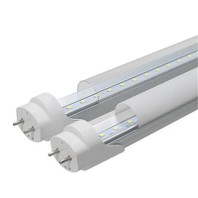
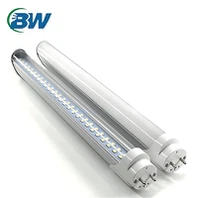
There are two types of Benwei led tubes, one is split type, and the other is built-in rechargeable battery. The so-called split type is led tube + inverter + battery + tube bracket. That is to say, external connections form an emergency LED tube group. The battery is built-in, that is, the inverter and battery are all put into the LED tube. The appearance looks the same as the ordinary LED tube, but the function is different.
At the beginning of March 2019, we received a call from a Hong Kong company that needed emergency LED tubes. According to the requirements described by him, we also provide two kinds of emergency LED tubes. Customers can't pay attention for a while, so we provide samples and let them choose by themselves. Both were tested with them, and both met their requirements. Out of cost considerations, the second option was finally selected, the integrated built-in power supply solution. The reason is that 1. The cost is lower 2. The installation is simple, and they can continue to use the lamp holder before the transformation. The external power supply and battery are too large to replace all of them, which requires a lot of work. 3. The installation is simple, the one-piece type can be used only by simple modification. The usage is the same as ordinary led fluorescent tube.
From March 2019 to April 2019, customers reported that the use effect was very good, the energy saving effect was obvious, the reliability was high, and the emergency lighting requirements were also met in the dimly lit state. It is said that there is no problem in using it for a period of time, and it will be considered to use this solution for other projects.
Experience tells us that a bold attempt will have unexpected results. Enterprises must continue to innovate and have a promising future.
The device that converts chemical energy into electrical energy is called a chemical battery, generally referred to as a battery for short. After discharging, the internal active material can be regenerated by charging-storing electrical energy as chemical energy; when it needs to be discharged, chemical energy is converted into electrical energy again. This type of battery is called a storage battery (Storage Battery), also called a secondary battery.
The so-called storage battery is an electrochemical device that stores chemical energy and releases electrical energy when necessary.
Storage Battery is a device that directly converts chemical energy into electrical energy. It is a rechargeable battery designed to recharge through a reversible chemical reaction. It usually refers to a lead-acid battery, which is a type of battery , Belongs to the secondary battery. Its working principle: When charging, use external electric energy to regenerate internal active materials, store electric energy as chemical energy, and convert chemical energy into electric energy again when it needs to be discharged, such as cell phone batteries commonly used in life.
It uses a lead substrate grid filled with spongy lead (also called a grid) as the negative electrode, and a lead substrate grid filled with lead dioxide as the positive electrode, and uses dilute sulfuric acid with a density of 1.26--1.33g/mlg/ml as the electrolyte. When the battery is discharging, metallic lead is the negative electrode and an oxidation reaction occurs to produce lead sulfate; the lead dioxide is the positive electrode and a reduction reaction occurs to produce lead sulfate. When the battery is charged with direct current, elemental lead and lead dioxide are respectively generated at the two poles. After removing the power source, it returns to the state before discharge, forming a chemical battery. Lead storage battery can be charged and discharged repeatedly. Its cell voltage is 2V. The battery is a battery pack composed of one or more cells, referred to as storage battery. The most common is 6V, and there are 2V, 4V, 8V, 24V storage batteries. . For example, the battery used in the car (commonly known as the battery) is a 12V battery pack with 6 lead-acid batteries connected in series.
For traditional dry-charged lead batteries (such as automobile dry-charged batteries, motorcycle dry-charged batteries, etc.), distilled water should be added after a period of use to keep the dilute sulfuric acid electrolyte at a density of about 1.28g/ml; for maintenance-free batteries, the There is no need to add distilled water until the end of life.