Full Spectrum vs. Red-Blue Mixed Light: Which Grow Light Is Better for Your Growing Scenario?
In the field of LED grow lights, full spectrum and red-blue mixed light are the two mainstream technical approaches. Many growers often feel confused when making a choice: Which type of light is truly better for plants? Why do some lights appear pinkish-purple while others look like white light? How do their costs and effects compare?
This article systematically breaks down the technical principles, performance data, application scenarios, and real costs of these two types of grow lights, helping you make the most scientific decision based on your crop type, growing scale, and budget.

1. Plant Physiology Behind the Spectrum: What Light Do Plants Actually Need?
Plant photosynthesis mainly relies on chlorophyll a and chlorophyll b. These two pigments have strong absorption peaks in red light (around 660nm) and blue light (around 450nm). From a purely photosynthetic efficiency perspective, providing sufficient red and blue light allows plants to grow reasonably well. This is the design basis for "red-blue mixed" grow lights.
However, plants are more than just photosynthetic machines. Light also acts as an environmental signal, regulating plant morphogenesis, flowering time, stress resistance, and more through photoreceptors (such as phytochromes and cryptochromes). Wavelengths such as green, far-red, and ultraviolet play irreplaceable roles at specific growth stages.
Table 1: Comprehensive Effects of Different Spectral Bands on Plant Growth
| Band | Wavelength Range | Effect on Plant Growth | Required? |
|---|---|---|---|
| UV | 280–400nm | Promotes accumulation of secondary metabolites (anthocyanins, flavonoids), enhances stress resistance; excessive amounts inhibit growth | ✅ Beneficial |
| Blue | 400–500nm | Promotes leaf expansion, stomatal opening, inhibits stem elongation, affects phototropism | ✅ Essential |
| Green | 500–600nm | Penetrates canopy to illuminate lower leaves, improves overall photosynthetic efficiency; participates in light signaling | ✅ Beneficial |
| Red | 600–700nm | Efficiently drives photosynthesis, promotes stem/leaf growth, flowering, and fruiting | ✅ Essential |
| Far-red | 700–800nm | Regulates photoperiod (e.g., promotes flowering in long-day plants), affects plant height and internode elongation | ⚠️ Beneficial in specific scenarios |
Conclusion: Red and blue light are the "main meal" for plant growth, while full spectrum is a balanced "meal with vitamins and minerals". For commercial cultivation, your choice depends on your comprehensive consideration of yield, quality, working experience, and cost.
2. Full Spectrum vs. Red-Blue Mixed: Technical Principles and Visual Differences
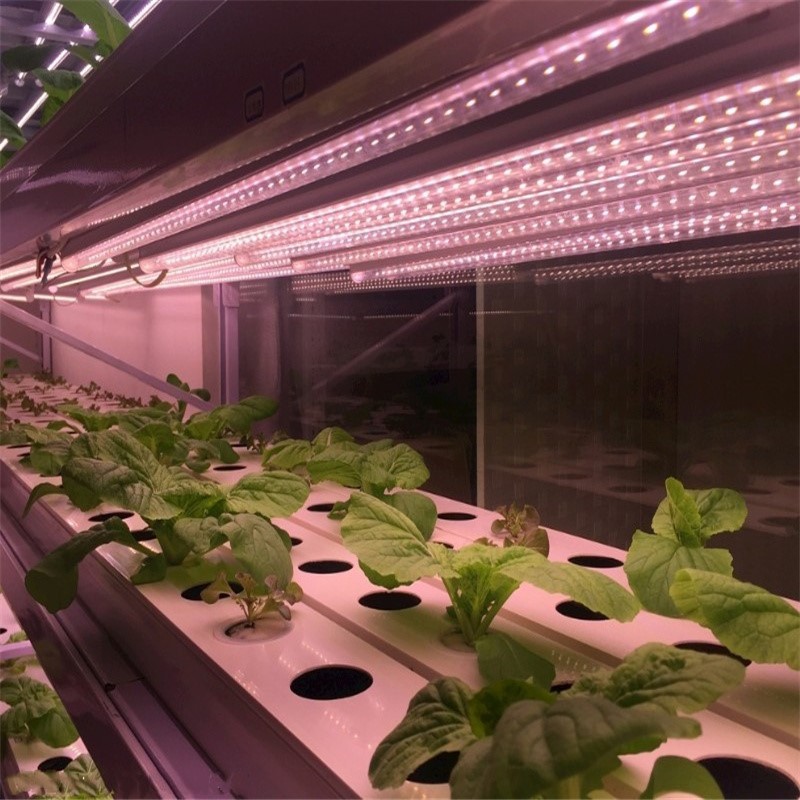
- Red-Blue Mixed Grow Light: Typically uses only red chips (620–660nm) and blue chips (440–460nm) combined in a certain ratio (e.g., 3:1, 5:1, 8:1). Due to the absence of green light, the human eye perceives the light as pinkish-purple or magenta. These lights can achieve very high photosynthetic photon efficiency (PPE) (≥2.8 μmol/J) because almost all energy is concentrated in the chlorophyll absorption peaks.
- Full-Spectrum Grow Light: Uses multiple phosphors or a combination of LED chips (e.g., white LEDs + red LEDs, or direct full-spectrum chips) to simulate the spectral distribution of sunlight. The spectrum continuously covers 400–700nm, and some products add a small amount of far-red (around 730nm) or UV light. The light appears warm white, natural white, or cool white (color temperature typically between 3000K and 6500K), visually very close to general illumination lighting.
Table 2: Core Parameter Comparison – Full Spectrum vs. Red-Blue Mixed Grow Lights
| Dimension | Red-Blue Mixed Grow Light | Full-Spectrum Grow Light |
|---|---|---|
| Visual color | Pinkish-purple / magenta | Warm white / natural white / cool white |
| Spectral coverage | Only red + blue (narrowband) | Continuous coverage 400–700nm, some include far-red/UV |
| Photosynthetic efficiency (PPE) | 2.6–3.2 μmol/J | 2.2–2.8 μmol/J |
| Illumination of lower leaves | Poor (red/blue have weak penetration) | Better (green light penetrates canopy) |
| Working comfort | Poor (eyes tire easily, difficult to distinguish colors) | Excellent (close to daylight, long-duration work possible) |
| Protective glasses needed? | Strongly recommended | Generally not needed |
| Plant morphogenesis control | Focuses on promoting growth and flowering | More balanced, can inhibit elongation or promote stretching |
| Effect on secondary metabolites | Weaker | Stronger (especially when UV is included) |
| Power consumption per area | Lower | Slightly higher (for same PPFD) |
| Typical applications | Commercial supplemental lighting for cannabis, tomatoes, cucumbers | Plant factories, seedling propagation, home gardening, leafy greens, ornamental plants |
3. Empirical Data: Real Growing Performance Comparison
To illustrate the differences more intuitively, we compare the results of growing lettuce (leafy green) and tomatoes (fruiting vegetable) under both light types at the same PPFD (300 μmol/m²/s for lettuce, 600 μmol/m²/s for tomatoes), based on multiple published academic studies and commercial growing data.
Table 3: Lettuce Growing Comparison (16h photoperiod, 30-day growth cycle)
| Parameter | Red-Blue Mixed (R:B=4:1) | Full-Spectrum White (5000K) |
|---|---|---|
| Fresh weight per plant (g) | 98.2 | 102.6 |
| Dry matter content (%) | 5.2% | 5.8% |
| Number of leaves | 12.3 | 14.1 |
| Leaf area (cm²) | 680 | 745 |
| Vitamin C content (mg/100g) | 12.4 | 15.7 |
| Nitrate content (mg/kg) | 2850 | 2060 |
| Operator subjective rating | Color distortion; eye fatigue with prolonged work | Close to natural light; high comfort |
Interpretation: Lettuce grown under full spectrum showed slight advantages in biomass, leaf count, and leaf area. More importantly, quality indicators (higher vitamin C, lower nitrate) were significantly better than under red-blue mixed light. This is crucial for growers pursuing "premium quality at premium price".
Table 4: Tomato Growing Comparison (16h photoperiod, 110-day full cycle)
| Parameter | Red-Blue Mixed (R:B=5:1) | Full Spectrum (4000K + 660nm red supplement) |
|---|---|---|
| Yield per plant (kg) | 3.15 | 3.42 |
| Fruit sugar content (Brix°) | 5.8 | 6.5 |
| Lycopene content (mg/100g) | 3.2 | 4.1 |
| Days to flowering | 32 | 35 |
| Internode length (cm) | 8.5 | 7.2 |
| Fruit drop rate (%) | 8.2% | 5.6% |
Interpretation: Red-blue mixed light led to slightly earlier flowering, but full spectrum significantly outperformed in total yield and quality indicators (sugar content, lycopene). Plants under full spectrum were more compact (shorter internodes) with lower fruit drop rates and a higher proportion of marketable fruits.
Key conclusion: Red-blue mixed light is not inferior to full spectrum in pure photosynthetic efficiency – in fact, its PPE can be higher. However, full spectrum has clear advantages in crop quality, working experience, and overall plant health. If your goal is to maximize biomass (e.g., certain cannabis varieties), red-blue mixed offers better cost-effectiveness. If you prioritize fruit flavor, nutritional quality, or a comfortable working environment, full spectrum is the better choice.
4. Selection Guide: Make a Decision Based on Your Growing Scenario
Based on the above analysis, we provide a simple decision matrix to help you quickly determine which type of light is better for you:
Table 5: Growing Scenario and Recommended Grow Light Type
| Growing Scenario | Recommended Type | Key Reason |
|---|---|---|
| Large-scale cannabis cultivation (maximizing flower yield) | Red-Blue Mixed | Highest PPE, lowest energy consumption, maximize yield |
| Commercial greenhouse for tomatoes/cucumbers/sweet peppers | Full Spectrum + Red supplement | Improves sugar content and fruit quality, higher selling price |
| Plant factory (fully artificial lighting) | Full Spectrum | Workers need long-term exposure; improves leafy green flavor and reduces nitrate issues |
| Home gardening / indoor growing | Full Spectrum | Visually comfortable, not harsh, suitable for viewing |
| Succulents / flower seedling propagation | Either red-blue mixed or full spectrum | For succulents: use blue-heavy red-blue mix to prevent elongation; seedlings: full spectrum recommended for balance |
| Tissue culture / research experiments | Tunable full spectrum | Need precise spectral ratio control for comparative studies |
| Vertical farm (multi-layer shelves) | Full spectrum (higher green light ratio) | Green light penetrates upper canopy, improving lower leaf illumination |
| Supplemental lighting in greenhouses (top lighting) | Red-Blue Mixed | Sunlight already provides full spectrum; only red/blue supplementation needed |
5. Practical Buying Tips – Avoiding Common Pitfalls
- Don't rely on lumens – Lumens are based on human eye sensitivity and are meaningless for grow lights. Focus only on PPF, PPFD, PPE, and the spectral graph.
- Beware of "fake full spectrum" – Some products simply combine red, green, and blue LEDs in a crude manner, resulting in a discontinuous spectrum with sharp peaks and valleys. A true full-spectrum curve should smoothly cover 400–700nm.
- Red-blue ratio is not fixed – For leafy greens, R:B = 3:1 to 4:1 is recommended; for fruiting vegetables, 5:1 to 8:1; during flowering, up to 10:1. Choose dimmable or swappable products for flexibility.
- PPFD uniformity is critical – The same light installed at the wrong height or spacing can cause high PPFD in the center and low PPFD at the edges. Always ask for a PPFD distribution map from the supplier.
- Heat dissipation and lifespan – Red-blue mixed lights typically have higher power density and generate more heat. Always choose products with aluminum heat sinks, branded LED chips, and long warranties (3–5 years).
Summary
Full spectrum and red-blue mixed light each have their advantages. There is no absolute "best" – only "most suitable." If you pursue the highest energy efficiency and lowest initial investment, and workers do not need to spend long hours under the lights (e.g., automated greenhouses), red-blue mixed is a good choice. If you value crop quality, worker experience, and more comprehensive plant physiological control, full-spectrum grow lights are a more forward-looking investment.
In practice, many commercial growers are adopting hybrid lighting solutions: using red-blue mixed lights in main growing areas to save energy, and full-spectrum lights near walkways or observation zones to improve working conditions. You can also customize the lighting combination for your specific crops based on photobiological research results.