Anyone who’s tried growing plants from seed knows that proper lighting is critical to producing an abundance of stocky, green seedlings. For those of us lucky enough to have a south-facing window with 12+ hours of full sun, lighting isn’t an issue. But for the rest of us, an indoor lighting system of some kind is a necessity.
This primer on indoor lighting for seed starting will help you choose the options that work best for you.
Light Color
Light color is also referred to as color temperature, with cool light describing the blue end of the spectrum and warm light being the red end. Sunlight contains the complete spectrum of light, including all colors of the rainbow.
Although plants use the full spectrum for photosynthesis, red and blue light seem to be most critical. Red light stimulates vegetative growth and flowering (but if a plant gets too much, it will become tall and spindly). Blue light regulates plant growth, which makes it ideal for growing foliage plants and short, stocky seedlings (but too much will result in stunted plants).
You can tell which color a grow light produces by looking at its Kelvin rating. Lamps with a rating of 5000 Kelvins will appear bluish, while those with a 2500 Kelvin rating will be reddish.
Light Intensity
The intensity of light that a plant receives is determined by the wattage of the bulb and the distance between the plant and the light source. So, for example, a brighter bulb that's farther away from the plant could provide the same light intensity as a dimmer bulb that's closer to the plant.
Different plants have different light intensity needs, but most seedlings grown for the garden will need higher intensity light to flourish. In general, the leaves should be about 2 - 4 inches away from the light source (assuming use of a fluorescent bulb – see below).
Duration of Light Exposure
There's still debate about how many hours of supplemental light is ideal when starting seeds and growing plants indoors.
Most vegetables and garden plants require at least 16 to 18 hours of light each day; without enough light, they get pale and leggy. The conventional advice was to turn lights on for 16 hours each day. However, some growers maintain that 24 hours of consistent light every day provides a better outcome when growing seedling (i.e., there's no need to give seedlings a nightly rest but this advice doesn't necessarily apply to full-grown plants).
It's certainly easier to leave your grow lights on all the time and that's what I do. If you choose to go with 16 hours on, 8 hours off, put the lamp(s) on a timer so you won't forget to turn the lights on or off.
Types of Bulbs
You can choose between incandescent, fluorescent, LED, and high-intensity discharge (HID) bulbs, each of which has its own pros and cons. Choose the grow light that works best for the type of plants you want to grow and where you plan to grow your seeds.
Incandescent Bulbs
These include halogen bulbs and are the type of light bulbs still used in most homes (although they're getting harder to find now that stores are carrying only more efficient bulbs, such as CFLs and LEDs).
Incandescent bulbs are a good source of red light, but a poor source of blue, meaning that plants will likely become spindly when grown under incandescent light.
Incandescent bulbs, and especially halogen bulbs, also produce a lot of heat in relation to the amount of light they give off; plants growing too close to the bulb can be easily burned.
Generally speaking, these are not the best type of lamps for growing seedlings.
Fluorescent Bulbs
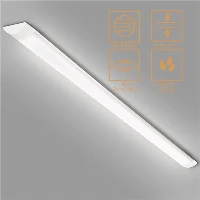
These types of bulbs produce two to three times more light than incandescent bulbs for the same amount of energy and are the most inexpensive lights for indoor gardening. However, they usually require bulky external ballasts (like, for example, overhead shop lights) so aren't as easy to work with as incandescent and LED bulbs.
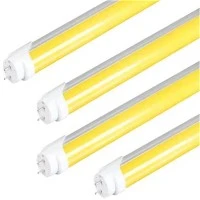
Cool white bulbs are a good source of blue and yellow-green light, but are a poor source of red light. Plants grown under cool white bulbs will be stocky or even slightly stunted. Warm white bulbs emit plenty of orange and red light, but less light in the blue and green spectrum. These bulbs, when used alone, result in tall, spindly plants. If you are growing seedlings under two-bulb fluorescent fixtures, you can usually achieve a good color balance by combining one cool white and one warm white bulb.
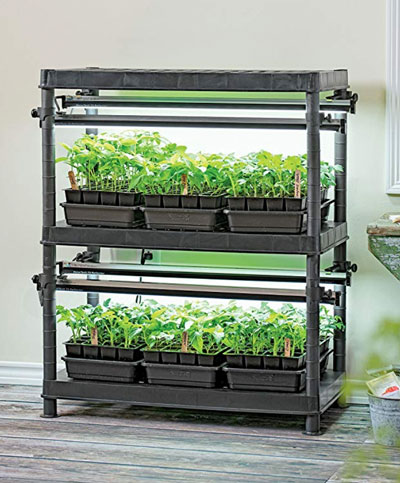
A set of stacked shelves with fluorescent T5 lamps (or LED lamps) makes it easier to grow a large number of seedlings.
Full-spectrum fluorescent bulbs produce a balance of cool and warm light that replicates the natural solar spectrum, although these are less energy efficient than other fluorescent bulbs and tend to produce more heat. But, given the wider range of light frequencies emitted by these bulbs, they are a good choice for growing seedlings.
T5 lamps are fluorescent lamps that are 5/8" of an inch in diameter, making them much less bulky than typical fluorescent bulbs. These are the lamps you're most likely to find in grow light kits.