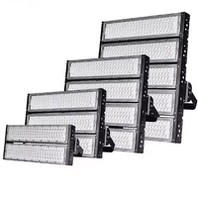
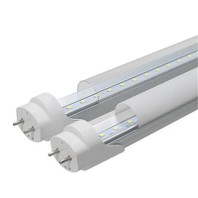
Large area lighting is a drain on energy because high mast luminaires must output a substantial volume of lumens to cover an expansive zone from a long distance. High mast fixtures for road, area and industrial lighting applications also operate for significantly longer periods than lighting products in other categories. As a result, there's a never-ending quest for new lighting technologies that comply with ever-changing energy codes. To stay in line with the budget and energy constraints, the outdoor lighting market had long tolerated the terrible color rendition (22 CRI) and low mesopic luminous efficacy (S/P ratio 0.65) of high pressure sodium (HPS) lighting. Since a number of outdoor applications, such as sports lighting and industrial lighting involving color-critical operation, require a decent color rendition, metal halide (MH) lamps had been used to as a supplement to HPS lighting. Although MH lamps deliver a 65 CRI, their luminaire efficacies are significantly low (40 - 50 lm/W). In fact, even the luminaire efficacy of HPS lamps at a typical 61 lm/W is far from perfect. Useful life is another downside of traditional lighting. High-intensity discharge (HID) lamps, including HPS and MP, have only two- or three-year maintenance cycle. Short lifespan severely affects the ROI of HID lamps.
Over the past decades, solid state lighting (SSL) has been making breathtaking progress that is profoundly changing the way light was generated. Outdoor lighting applications are rapidly migrating to LED light sources which provide overwhelming advantages over HID lamps with regards to efficacy, lifespan, light quality, optical performance, and environmental sustainability. While the initial capital costs are higher than traditional lighting systems, LED lighting provides a significantly better return on investment when overall energy and maintenance savings are taken into account. It's no surprise that LED luminaires can achieve a system efficacy way over 150 lm/W, which results in an accelerated payback. A properly designed and engineered LED luminaire can last over ten years, which translates to a significantly longer gain from the investment. High mast luminaries are energy intensive systems. High energy and maintenance savings with high power LED luminaires over a long period provides a sound justification for investing in LED technology.
Beyond financial returns, LED lighting performs a lot better than HID systems in terms of light quality and optical performance. The scotopic/photopic (S/P) ratio is used to evaluate light source performance in mesopic vision which is the typical vision state in street and roadway lighting. An S/P ratio of up to 2.0 with LED lighting contributes to improved visibility in low light levels and consequently traffic safety. When it comes to outdoor lighting, LEDs have an inherently high color performance. The 70 - 80 CRI is only of low end colorimetric quality for LEDs. Yet this color performance is sufficiently good for outdoor lighting applications, including sports lighting which requires an accurate color reproduction of the illuminated object in order to meet the visual requirements of players, spectators and television broadcasting. HID luminaires cause the area where the luminaire aims to have much higher illuminance than areas around the beam center, which leads to a poor uniformity ratio (6:1 typical). In contrast, the uniformity ratio was improved by more than a factor of two with the LED luminaires. Good uniformity ensures minimal distortion of the visual perception, helps create comfortable visibility, and maximizes pole spacing.