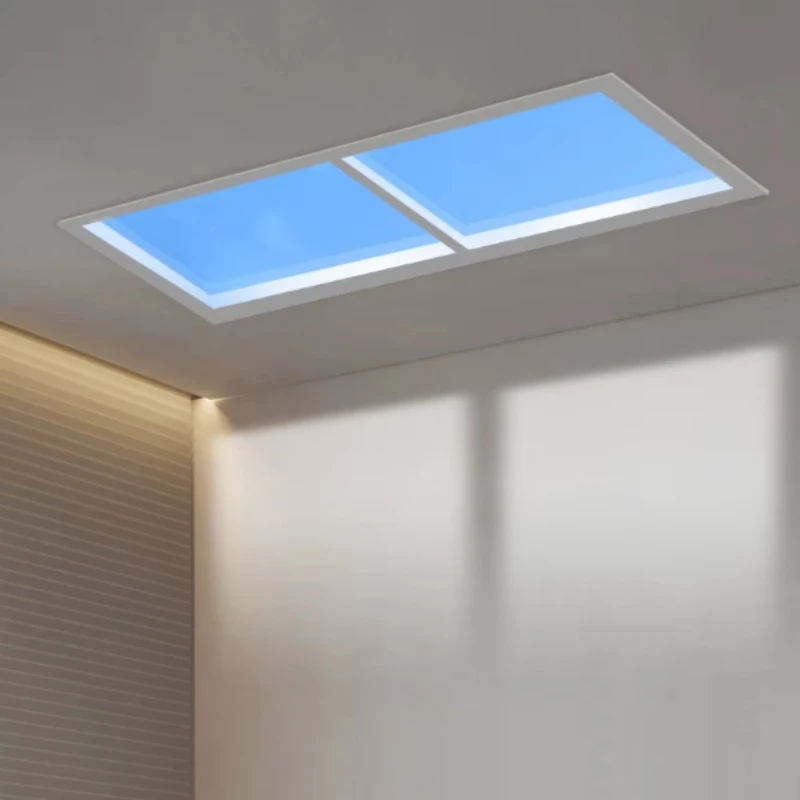
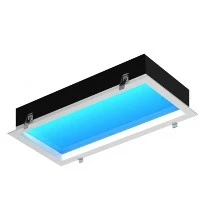
You've invested a significant budget into an LED "sky panel," but the moment you switch it on, you're left feeling a bit disappointed. Sure, it's bright-but it just looks like a white light panel. The ceiling remains a ceiling, and there's absolutely no sense of "looking up into the sky." This isn't just your imagination, nor does it necessarily mean the product is defective. Creating an LED sky panel that is truly convincing-one that can "pass for the real thing"-is far more challenging than standard lighting. Products labeled as "sky panels" can vary drastically in quality. Let's break down why some look "flat" or "fake," and what you should look for when purchasing and installing one.
Lack of "Depth" in the Light
The reason the real sky feels "vast and distant" is that our brains perceive depth based on how light behaves. Many low-end sky panels are essentially standard flat-panel lights covered with a printed film; the light is emitted from a single, flat surface, making it immediately obvious to the eye that it's just a "flat plane."
High-quality sky panels utilize multi-layered light guidance, micro-structured diffusion, or even simulations of Rayleigh scattering to give the light a sense of transparency and depth. As you view the panel from different angles, the brightness and hue should shift subtly-this is what convinces the brain that there is actual "space" above. If the light looks exactly the same from every angle, it's likely because its internal structure is too simplistic.
Overly Uniform Light Distribution
This is the most common issue. The real sky is never uniformly bright: it's more intense near the sun and gradually dims further away, while clouds create natural variations in light and shadow.
Many sky panels, in an attempt to "avoid hotspots," use excessive diffusion, resulting in a panel with perfectly uniform brightness-essentially a glowing sheet of white paper. A sense of realism comes from subtle brightness gradients and localized variations. Uniformity does not equate to high quality; in the case of sky panels, it's actually what makes them look "fake."
Unnatural Color Reproduction and Gradients
"Blue sky" isn't just one shade of blue. From the zenith (the point directly overhead) to the horizon, the color transitions from deep blue to a lighter blue, sometimes even taking on a whitish or warmer tint toward the edges. Common issues include the following:
The blue tones are overly saturated or lean toward purple, resembling plastic cellophane.
There are visible "breaks" or "banding" in the color gradients.
The edges of cloud patterns appear harsh, looking like stickers.
These problems are often related to the image's color depth, the printing precision on the film material, and the spectral quality of the LEDs. A light source with a low Color Rendering Index (CRI) can also make the image appear dull or grayish.
Lack of "Sky Logic" in Color Temperature and Brightness
"Sky lights" must serve both as a representation of the sky and as functional lighting-two requirements that often conflict.
If the color temperature is fixed at a cool setting and the brightness is no different from that of a standard light, the human eye perceives it merely as a "cool-white light" rather than "sunlight streaming in." Real daylight possesses a sense of direction and a contrast between warm and cool tones: sunlight tends to be warm, while skylight is cool.
Products that support adjustable color temperature and independent control of sunlight and skylight components make it easier to achieve a natural lighting effect. Brightness should be sufficient without being glaring; if it's too dim, the light lacks presence, while if it's too bright, it "washes out" the image.
Visible LED Beads and Frames
If even a single detail gives the game away, the illusion of a "sky" is shattered. For example:
Individual LED beads are visible when viewed from a close distance.
The frame is too thick or features an intrusive color, making it immediately obvious that it is a "light fixture mounted on the ceiling."
There are noticeable seams where panels are joined.
For large-scale sky lights, the handling of seams is particularly critical. The narrower the frame and the more seamless the transition into the ceiling, the easier it is for the viewer to forget that it is a light fixture at all.
Mismatch Between Installation Height and Spatial Dimensions
Sometimes the issue lies not with the light itself, but with how it is applied.
A sky light requires a certain "viewing distance" to convincingly mimic the sky. In rooms with low ceilings or small floor areas, viewers are often too close, making it easy to discern the materials and fine details. Furthermore, if the light fixture is too small, it occupies only a tiny portion of the field of view, appearing more like a glowing painting than a sky.
Generally speaking, a larger surface area-which occupies a greater portion of the visual field-creates a stronger sense of immersion. Whether the installation covers the entire surface or is designed as a "framed view"-resembling a window-will result in completely different visual effects. If your space has unique characteristics, it is best to confirm the dimensions and installation method before selecting a specific model.
Lack of Dynamic Change
The real sky is "dynamic": clouds drift, and light shifts over time-appearing different in the morning, at midday, and at dusk.
Static imagery can quickly begin to feel artificial. Products that feature simulated sunrises and sunsets, slowly drifting clouds, or color temperature shifts over time are much more effective at maintaining a sense of realism. Of course, dynamic effects should be used with restraint; if they are too fast or overly flashy, the result can end up looking cheap.
Summary
If you are currently in the process of purchasing such a system, or if you have already installed one but are not satisfied with the result, you can use these seven points as a checklist to identify the underlying issues.
Looking for an LED "sky light" that truly captures the essence of the sky?
We offer a wide range of LED sky lights, available in various sizes, structural configurations, and lighting effects. These can be customized to suit your specific ceiling height and intended application-whether for residential, commercial, medical, or exhibition spaces. We can also provide samples so you can compare the effects firsthand.
If you have a specific project in mind, or if you would like to understand why your current setup isn't delivering the desired effect, please feel free to reach out. Simply share your space dimensions and some reference images, and our team will recommend a more suitable solution and provide a quote.
https://www.benweilight.com/lighting-tube-bulb/grow-lights-for-seedlings.html