Introduction: The Hidden Lifespan Bottleneck of Traditional T8 LED Tubes
Misunderstanding of T8 LED Tube Lifespan cognition in the Market
Manufacturers often designate the service life label of T8 LED tubes as 30,000, 50,000, or even 80,000 hours in the worldwide commercial lighting industry. Nevertheless, many inexpensive T8 LED tubes in real-world engineering applications experience noticeable light deterioration, brightness attenuation, stroboscopic flicker, and even lamp burnout after one to three years of usage, which is significantly short of the stated service life limit. According to extensive industry verification, the driving power supply system's instability is the primary cause of this issue rather than the ageing of housing materials or the attenuation of LED chips. Simple resistance-capacitance step-down driving schemes or open-loop constant-voltage driving methods are used in the majority of low-end T8 LED tube products available. These driving circuits are unable to react to the power grid's voltage fluctuations and the temperature-induced change in LED chip impedance. They also lack dynamic adjustment functionalities and real-time current monitoring. Long-term operation under unstable current circumstances will cause irreversible light degradation, hasten the ageing of the lamp tube's internal components, and ultimately result in the lamp's premature failure.
The actual service life of LED tubes directly affects future maintenance costs, replacement frequency, and overall lighting system operation benefit for commercial lighting scenarios like supermarkets, warehouses, office buildings, and school classrooms that need continuous lighting for extended periods of time. A single batch of subpar LED tubes with a limited lifespan would result in significant labour expenses and material loss for recurring replacement, and it may even interfere with the regular operation of commercial spaces and educational settings. Therefore, the key to achieving long-term steady illumination and lowering overall running costs is realising the critical role that the driving system plays in the service life of T8 LED tubes and choosing goods with high-quality constant-current drivers.
Core Status of Constant-Current Driver in LED Lighting System
Typical current-driven semiconductor devices are LED chips. Changes in current have a significant impact on their service life, operating temperature, and luminous efficiency. In contrast to conventional incandescent and fluorescent bulbs, which can adjust to a certain range of voltage changes, LED chips rely entirely on steady current output to function. When the current is too low, the luminous efficiency is insufficient, the lighting effect cannot meet the standard, and long-term low-current operation will also cause abnormal ageing of the chip circuit. Conversely, when the current is too high, the chip will produce excessive heat, leading to thermal runaway, rapid light decay, and permanent burnout.
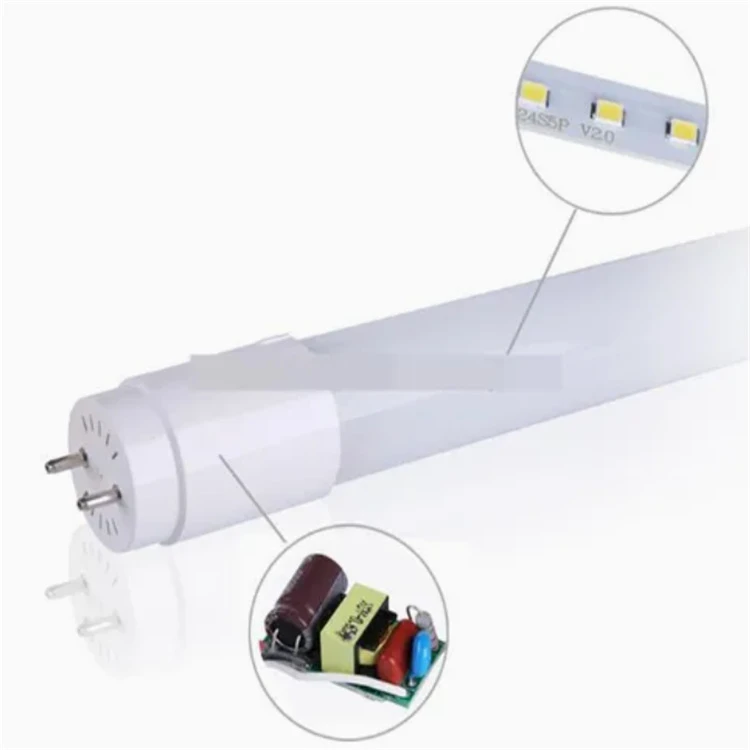
The primary control element that keeps the operating current of LED chips within the ideal safe range is the constant-current driver. The high-performance IC constant-current driver used by premium T8 LED tubes includes a closed-loop feedback adjustment mechanism, in contrast to standard constant-voltage drivers that simply stabilise voltage. It can monitor the lamp tube's working current in real time, dynamically modify the output voltage in response to variations in the power grid and the chip's temperature impedance, and consistently maintain a steady and constant current. This exact electrical control provides a strong basis for an exceptionally long service life and essentially resolves the issue of unstable LED tube functioning brought on by variations in temperature and power supply.
Working Principle of Constant-Current Driver for T8 LED Tubes
Basic Operating Logic of Constant-Current Driving Technology
"Real-time monitoring + dynamic adjustment + constant current locking" is the fundamental logic of the constant-current driver. The drive system's control center is the internal high-precision IC chip. The IC chip will instantly gather the LED lamp bead array's real-time working current data when the T8 LED tube is turned on. It will automatically determine the lamp tube's current operating condition when combined with the chip's preset optimum current threshold. The forward voltage and internal impedance of LED chips will fluctuate dynamically during operation due to external temperature variations, grid voltage fluctuations (with a broad voltage range of 100-277V), and component ageing. In order to counteract the impedance shift, the constant-current driver will now quickly modify the output voltage via the closed-loop feedback circuit, guaranteeing that the current flowing through the LED chip stays constant.
The open-loop functioning flaw of conventional resistance-capacitance driving is entirely abandoned by this operating mode. There is no feedback adjustment feature on conventional low-end drivers. The current passively varies with temperature and voltage after the electricity is switched on. The LED chip and its peripheral circuitry will be continually impacted by long-term current surges and unsteady operation. In contrast, the constant-current driver takes the initiative to regulate the lamp tube's current state so that the LED chip consistently operates within the specified ideal current interval, preventing electrical stress damage and optimising the chip's performance and service life.
Structural Advantages of High-Quality IC Constant-Current Driver
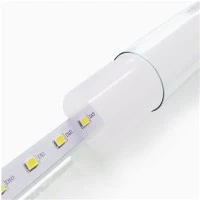
The brand's high-performance T8 LED tube includes an updated built-in IC constant-current driver board, which has clear structural and technological benefits over standard driving schemes. In order to achieve ultra-precise current output, the driver first uses a high-precision integrated IC chip with an exact current control error managed within ±3%, which is much less than the ±10% error of regular drivers. Second, the driving circuit has many protection modules, such as short-circuit, over-voltage, over-current, and over-temperature protection. In order to prevent damage to the LED chip and circuit board, the driver will instantly switch off the unsteady current output in the event of an instantaneous surge voltage or local circuit short circuit.
Additionally, the constant-current driver can operate steadily in the 100-277V AC complete voltage range because to its outstanding broad voltage adaption ability. In addition to avoiding frequent current fluctuations and equipment ageing brought on by erratic grid voltage, it can adjust to complicated power supply situations in various locations and construction scenarios. In order to ensure the long-term consistency of the driving system, the entire circuit of the driver uses high-temperature resistant and anti-aging electronic components that can maintain stable working performance for a long time in the working temperature range of -20°C to 120°C and won't fail or drift due to temperature changes.
Mechanism Analysis: How Constant-Current Drivers Extend T8 LED Tube Service Life
Suppress Thermal Runaway and Reduce Chip Heat Aging
Thermal runaway is the primary cause of T8 LED tubes' premature failure. LED chips will generate heat while they are in use. As operational current increases, so does the temperature at which heat is produced. When the surrounding temperature rises or the grid voltage surges, normal non-constant-current driving schemes will immediately increase the current flowing through the LED chip. Excessive current will cause the chip's temperature to rise dramatically, creating a vicious cycle of "temperature rise - current increase - higher temperature"-also referred to as the thermal runaway phenomena. The chip's internal impedance will be further reduced by this temperature increase, increasing the current inflow.
Thermal runaway will cause irreparable damage to the chip's luminous wafer and phosphor layer, resulting in rapid light decay, colour temperature offset, and reduced luminous efficiency. In addition to burning out the chip circuit, long-term cyclic heat impact may age and remove the chip packing glue. The constant-current driver effectively lowers the risks of thermal runaway by precise current locking. By limiting the working current within the rated safe value, it significantly slows down the thermal ageing speed of the core luminous components, prevents excessive temperature accumulation, ensures that the chip operates in a low-load and stable state for a long time, and controls the LED chip's heat generation in a stable range.
When compared to typical driving devices under the same working conditions, LED tubes with constant-current drivers may reduce the chip ageing rate by more than 60% and the chip operating temperature by 15–25°C, according to industry test data.
Reduce Luminous Attenuation and Maintain Long-Term High Lumen Retention
An essential metric for determining the LED tubes' service life is light decay. In the lighting business, the working hours at which the luminous flux drops to 70% of its starting value are often referred to as the "lamp tube service life" (L70 standard). The primary cause of LED tubes' fast light degradation is unstable current. Current fluctuates continuously throughout the operation of standard drive schemes. The LED chip's crystal lattice structure will be harmed by frequent current impact, which will also lower the phosphor layer's luminous activity and cause the luminous flux to continuously attenuate. Inadequate driving LED tubes have a very quick light decay rate, and after one to two years of use, the brightness will drastically decrease, making them unable to meet lighting standards, particularly in long-term uninterrupted working environments like warehouses and factory workshops.
The LED chip may receive steady and consistent power supply stimulation for an extended period of time without frequent current impact and overload operation thanks to the high-precision constant-current driving technology, which achieves zero-fluctuation current output. This steady operating condition achieves ultrahigh lumen retention rates, effectively slows the pace of light decay, and maximally safeguards the chip's luminous performance. The T8 LED tube with IC constant-current driver can fully meet the L70 international service life standard by maintaining more than 92% of the initial luminous flux after 20,000 hours of operation and 75% of the initial brightness after 50,000 hours of prolonged use, according to professional ageing tests. Ordinary non-constant-current LED tubes, on the other hand, essentially lose their usefulness after 20,000 hours of usage since they only maintain less than 65% of the light flux.
Avoid Circuit Impact and Reduce Component Aging Failure Rate
In addition to the LED chip, the ageing of internal driving circuits, circuit boards, pins, and other auxiliary components limits the service life of T8 LED tubes. All of the electronic components within the lamp tube will experience occasional electrical impacts due to unstable current and voltage surges. Ageing circuit board lines, oxidation of component pins, drift of component characteristics, and ultimately an open circuit, short circuit, or drive failure will result in the whole lamp being scrapped.
Multiple safety prevention measures are included into the constant-current driver, effectively isolating anomalous power fluctuations, instantaneous current surges, and grid voltage spikes. It prevents electrical impact damage, slows the ageing of driving chips, circuit boards, and pins simultaneously, and offers a steady and secure working environment for all internal light tube components. In order to prevent the "barrel effect," which occurs when a single component ages too quickly and causes the whole lamp to fail, a high-quality constant-current driving system may achieve synchronised ageing of all lamp tube components, matching the service life of the driver, chip, and housing. T8 LED tubes have an overall service life of more than 50,000 hours thanks to its synchronous ageing design, which is three to six times longer than that of typical inexpensive LED tubes.
Comparative Test: Constant-Current Driver vs Ordinary Driving Scheme
Service Life and Light Decay Data Comparison
We performed a 50,000-hour continuous ageing comparison test on T8 LED tubes with constant-current drivers and regular resistance-capacitance driving products under the same environmental conditions (room temperature 25°C, 12-hour daily continuous lighting, conventional grid voltage) in order to intuitively verify the difference in service life caused by different driving schemes. According to the test results, the standard resistance-capacitance driving LED tubes exhibit noticeable light decay after 8,000 hours of operation; the luminous flux falls to 82% of the initial value and stroboscopic flicker starts to appear; after 15,000 hours, the luminous flux is less than 70%, and several samples experience driving failure and lamp burnout issues, reaching the service life limit.
After 20,000 hours of continuous operation, the luminous flux retention rate of the T8 LED tube with IC constant-current driver is as high as 92%, there is no stroboscopic flicker, no colour temperature offset, and the working state is stable; after 50,000 hours, the luminous flux still maintains 75% of the initial value, all internal components function normally, and there is no failure or ageing damage. The test unequivocally demonstrates that the constant-current driving method can provide long-term steady and high-efficiency illumination by totally removing the service life bottleneck of conventional LED tubes.
Stability and Adaptability Comparison in Complex Scenarios
Commercial lighting situations are complicated and dynamic, with significant seasonal temperature variations and erratic grid voltage in certain areas, which raises the bar for LED tubes' environmental adaptability. LED tubes with standard non-constant-current driving are quite sensitive to variations in voltage and temperature. In regions with unstable grid voltage, voltage swings may result in frequent brightness changes, severe stroboscopic phenomena, and a significantly reduced service life; in high-temperature summer conditions, the current will surge with the temperature increase, speeding chip burning.
The constant-current driver is very effective at preventing interference from the surroundings. The closed-loop current adjustment mechanism can automatically counteract the current variations brought on by temperature and voltage fluctuations, and the broad voltage design of 100-277V AC can adapt to international power supply standards. It can maintain steady current and stable operation, guaranteeing consistent illumination effect and extended service life in all situations, whether it is operating in a high-temperature indoor environment in the summer, a low-temperature dormant environment in the winter, or an unstable power supply environment.
Practical Value and Purchasing Advantage of Constant-Current Driver T8 LED Tubes
Reduce Comprehensive Operation and Maintenance Costs
The total cost of lighting equipment for commercial lighting projects includes labour, maintenance, and replacement costs in addition to the original purchase price. Ordinary low-cost T8 LED tubes are inexpensive to buy initially, but their short service life necessitates regular replacement and maintenance, which results in very high long-term overall expenses. Frequent replacement of the thousands of lamp tubes in large-scale lighting situations, such supermarkets, warehouses, office buildings, and campus buildings, would need a significant amount of labour and material resources and may even interfere with the venue's regular operations.
With a service life of 50,000 hours, the T8 LED tube with a high-performance constant-current driver may operate steadily for almost 8 years with 12 hours of daily usage. It significantly lowers the frequency of lamp tube replacement, saves a significant amount of labour and material expenses for subsequent maintenance, and prevents financial losses brought on by malfunctioning lighting equipment. Additionally, the steady constant-current operating condition lowers invalid power consumption, increases the lamp tube's energy efficiency, and further lowers the project's long-term electricity cost, providing both maintenance and energy savings.
Improve Lighting Quality and Use Experience
Stroboscopic flicker, uneven light production, and colour temperature divergence in LED tubes are mostly caused by unstable current. The undetectable high-frequency stroboscopic flicker that ordinary driving items emit while in use may easily induce visual fatigue, dizziness, and eye pain for students and long-term office workers. Additionally, they do not adhere to the health lighting regulations of contemporary commercial environments. The overall homogeneity and aesthetics of the illumination will be impacted by the uneven brightness of many lamp tubes in the same area due to the ongoing light degradation.
Through exact current regulation, the constant-current driver achieves consistent and flicker-free light output. The lamp tube satisfies worldwide health lighting requirements with its consistent light output, gentle light colour, lack of stroboscopic and blue light hazards, and other features. A comfortable and healthy lighting environment is created, the long-term stable luminous performance prevents the brightness difference brought on by light decay, guarantees the consistent lighting effect of the entire space for many years, and significantly enhances the user experience in commercial and educational scenarios.
High Safety and Long-Term Reliability
When it comes to business lighting equipment, safety is a crucial indication that cannot be disregarded. Long-term operation of inferior driving schemes may result in current surges and overheating, which can cause internal lines to age and melt as well as concealed risks of fire and short circuit. With its many safety protection features, the premium IC constant-current driver can automatically protect and cut off abnormal current in the event of overcurrent, overvoltage, overtemperature, or short circuit, thereby preventing equipment failure-related safety incidents.
The constant-current driver T8 LED tube provides superior insulation, fire resistance, and drop resistance when paired with a strong anti-aging structural design and a high-temperature resistant flame-retardant PC shell. With a low failure rate and great dependability, it can function securely and steadily for an extended period of time in a variety of indoor business settings. For project procurement and bulk purchase clients, the product comes with a 2-year official warranty that removes any use concerns and offers a dependable after-sales assurance.
Conclusion
It has been thoroughly confirmed via methodical technical study and performance comparison testing that the constant-current driver is the primary factor that determines the ultra-long service life and reliable performance of T8 LED tubes. The majority of T8 LED tubes on the market have premature failure and quick light degradation due to the unstable driving mechanism of low-end devices, despite the LED chip itself having great long-life performance. By suppressing thermal runaway, lowering luminous attenuation, preventing electrical impact damage, and achieving synchronous ageing of all lamp tube components through real-time current monitoring and dynamic adjustment, the high-precision IC constant-current driving technology significantly extends the service life, stability, and safety of T8 LED tubes.
The secret to achieving long-term high-cost performance and reliable lighting effects in commercial lighting project procurement and everyday lighting equipment selection is to give up on the single price-oriented buying approach and concentrate on the core driving performance of LED tubes. The most dependable and economical long-term lighting solution for contemporary commercial, industrial, educational, and retail scenarios is the T8 LED tube with high-performance constant-current driver, which has clear advantages in service life, stability, energy savings, and safety. It can also effectively lower the overall operation and maintenance cost of the lighting system and improve the lighting quality.
How To Cooperate With Us?
Since we have our own facilities, we are pleased to have complete control over the production process and the quality of our goods. We are committed to giving our clients the finest prices since we are manufacturers rather than just brokers. We encourage buyers to see our samples first since we are certain that the cost and calibre of our items are transparent. Our dedication to excellence and client happiness motivates us to consistently provide superior products.
Our address
3rd Floor, 5th Building, Hebei Industrial Park, Hualian Community, Longhua District, Shenzhen, China