

As light emitting diodes are nearly monochromatic light sources that emit light that has a single color while white is essentially a blend of light of two or more colors (or wavelengths), at the present time the most preferred route for creating white light from an LED module is by employing a single color LED (mainly a blue LED) and a wavelength converting element (which is usually a yellow phosphor). The color emitted by an LED is typically determined by the material from which it is formed. A representative illustration of a white LED consists of a package of a blue LED chip, made of gallium nitride (GaN), coated with a phosphor most notably Yttrium Aluminum Garnet (YAG) which operates as a wavelength converting element (WCE) to generate a white color of the desired color temperature. By changing the fill fraction composition or % weight the white light color can be tuned. The characteristics to generate white light across a large chromaticity space is advantageous for different lighting applications.
How is White Light Generated
Sep 15, 2022
Previous: Led Street lighting Color Temperature
Next: Blue Light Hazard
Send Inquiry
Related Knowledge
-
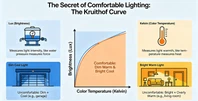 Lux and Kelvin: How to Match Brightness and Color Temperature for Perfect Room Lighting22 May, 2026
 -
 Are LED lights harmful to the human body? How to choose LED lights?21 May, 2026
 -
 How Much Electricity Can You Actually Save with LED Lights?21 May, 2026
 -
 High CRI and Low M/P Ratio: Can You Have Both in LED Lighting?21 May, 2026