When installing T8 grow lights on shelving, the most common problems are usually not that the lights fail to turn on. They come from two "take-it-for-granted" assumptions: first, that "hanging the light up is enough," and second, that seeing "IP65" means "spray it or soak it freely." The first fails on uniformity; the second fails on protection expectations. Getting these two issues straight is more useful than simply comparing wattage.
Mistake 1: Assuming "Hanging It Up Is Enough" and Ignoring Shelf Uniformity and Shadows
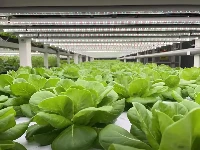
The most common failure in shelf supplemental lighting is not a dead tube-it is bright under the light, dark at the shelf edges. A linear T8 tube spreads light along its length, but in the direction perpendicular to the tube, intensity drops with distance. A single tube hung in the center can leave the two sides of the shelf with noticeably lower PPFD than the center. The result: compact plants in the middle, stretched plants at the edges, uneven plant shape across the batch, and higher management costs later.

1.1 Uniformity Is Not "It Looks Bright"-It Means Canopy PPFD Should Not Vary Too Much
The human eye is not sensitive to small differences in brightness and may feel that "the whole shelf looks bright," but plants receive photon density. What really matters in shelf supplemental lighting is whether PPFD is similar at different positions across the canopy. Too bright in the center and too dim at the edges makes plants grow toward the light: edge plants stretch internodes and develop weak stems, while center plants may become too dense and reduce airflow. Poor uniformity also makes plants in the same batch respond differently to water, fertilizer, and light duration, making uniform management difficult.
| Layout method | Common problem | Actual consequence | Improvement approach |
|---|---|---|---|
| Single tube hung in the center | PPFD drops sharply on both sides | Edge plants stretch, uneven plant shape | Add tubes according to shelf width or lower hanging height appropriately |
| Tube spacing too large | Dark bands between light spots | "Yin-yang plants" across the shelf | Reduce spacing so adjacent tube light spots overlap |
| Tubes installed flush against the top | Insufficient canopy PPFD | Weak plants, elongated internodes | Lower the height or increase the number of tubes |
| Ignoring shadows from brackets and pot rims | Local areas blocked from light | Uneven light exposure and growth | Adjust tube position; use light-colored reflective surfaces to reduce shadows |
| Buying tubes only by area, not by shelf width | Coverage does not match the shelf | Some tiers too bright, others insufficient | Measure shelf width and tier height first, then create an evenly spaced array |
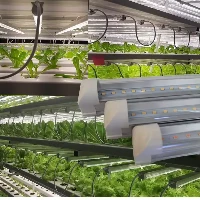
1.2 The Right Way to Use T8 Linear Lights Is "Layout," Not "One Tube Covers Everything"
AOSAY's T8 grow light tube is available in 60 cm, 90 cm, 120 cm, and other lengths. It is a linear supplemental light fixture that supports clip mounting and daisy-chain connection. Its advantage is not "one tube lights the whole tier," but that it can be arranged in an evenly spaced array according to shelf width. By adjusting hanging height and tube spacing, you can bring canopy PPFD into the target range. Shelving applications usually require multiple tubes in parallel, not just one centered tube.
Installation height should also be adjusted by stage: during seedling stage, the lamp distance can be closer, but too close may cause local light inhibition or heat stress; after entering vegetative growth, gradually raise it. As distance increases, PPFD drops, so you need to compensate by adding tubes or extending light duration to meet the daily light integral. First measure shelf width, tier height, and target PPFD; then decide tube length, quantity, and hanging height. Reversing this order easily wastes money.

Mistake 2: Seeing the Word "Waterproof" and Assuming You Can Spray or Soak It Freely
When choosing lights for humid environments, the IP rating must be checked, but it is easy to misread. IP65 is often simplified as "waterproof," but it actually means "dust-tight + protected against water jets," not "immersible." IP65 is fine for hydroponic shelves and condensation-prone greenhouses, but long-term direct spraying or soaking will cause problems even with a high protection rating.
2.1 What IP65 Does and Does Not Protect Against
According to IEC 60529 and corresponding standards, the first digit "6" in IP65 means dust-tight: dust cannot enter the housing. The second digit "5" means protected against water jets: it can withstand low-pressure water sprayed from any direction, but it does not mean it can be immersed in water. The product page also specifically notes: IP65 is suitable for hydroponic systems, humid grow rooms, and greenhouses with condensation, but the tube must not be immersed in water.
| Common misreading | Standard meaning | Scenarios it can handle | What you must not do |
|---|---|---|---|
| "IP65 means waterproof, spray it freely" | Dust-tight level 6, water-jet protection level 5 | Hydroponics, humid grow rooms, condensation environments | Do not immerse in water |
| "Any light will do in a humid environment" | Low-IP fixtures easily let moisture in | - | Short circuits, corrosion, accelerated light decay |
| "Condensation is not a problem" | Water-jet protection is not protection against continuous dripping | Occasional splashes are manageable | Avoid long-term direct dripping; maintain ventilation |
| "Just rinse it with water when dirty" | Water-jet protection has direction and pressure conditions | Light splashing for cleaning is manageable | Do not use high-pressure water directly on seams and end caps |
2.2 The Real Risk in Humid Scenarios Is Moisture Slowly Getting Inside
IP65 addresses the risk of mist and condensation seeping through gaps and causing short circuits or corrosion, and it also slows metal oxidation and electronic component aging in high-humidity environments. But it is like a reliable raincoat-rain is no problem, but don't wear it diving. In hydroponics and humid greenhouses, fixtures should still avoid long-term direct spraying or continuous condensation dripping. Good ventilation not only benefits plants but also reduces condensation on the fixture surface. For cleaning, wipe the surface with a damp cloth; do not blast end caps and seams with a high-pressure water gun.
2.3 Protection Rating Should Be Considered Together with Heat Dissipation and Lifespan
This T8 uses an aluminum alloy housing with a PC transparent cover: aluminum quickly conducts internal heat away, while the PC cover protects the chips and optical structure. The rated 50,000-hour lifespan is a statistical indicator ending when light output decays to a certain percentage under normal thermal management-not a claim that it will stop working at hour 50,001. Combined with a 5-year warranty, this means fewer lighting interruptions and less crop risk for commercial growers. IP65 makes the fixture more resistant in humid environments, but only if the installation position is reasonable, ventilation is adequate, and it is not soaked in water.
Looking at the Two Mistakes Together: Do Three Things Before Buying
| Do this first | Question to answer | Mistake it helps avoid |
|---|---|---|
| Measure the shelving | How wide is the shelf, how high is each tier, how many tiers? | Mistake : single centered tube, excessive spacing |
| Set the target | What crop, which stage, what target PPFD? | Mistake : looking only at wattage, not uniformity |
| Check the environment | Is there spraying, condensation, or direct dripping? | Mistake : treating IP65 as a diving suit |
A T8 full-spectrum grow light tube contains no less knowledge than hardware: the advantage of a linear light lies in layout flexibility, and the value of IP65 lies in splash protection rather than immersion. Once you understand shelf uniformity and protection expectations, the tube is no longer something you just "hang up"-it becomes a way to deliver light where the plants actually need it.
If you are choosing supplemental lighting for hydroponic shelves, seedling racks, or humid greenhouses, please send us your shelf dimensions, crop, growth stage, target PPFD, and the required tube length (60 cm/90 cm/120 cm) and quantity. We can provide product datasheets, PPFD test data, shelf lighting layout recommendations, sample testing, and bulk quotations, and we support OEM/ODM customization. Work out the light and installation first, then decide how many tubes to buy-so every T8 counts.