When it comes to shelving supplemental lighting, there are two extremes to avoid: looking only at wattage and assuming "brighter is better," or looking only at labels and thinking "full spectrum" and "IP65" mean everything is covered. In reality, whether a T8 LED grow light tube works well depends on how you connect spectrum, PPFD, ingress protection, and installation method. The tables below break down the confusing parts.
1. Full Spectrum Is Not a "Guarantee of Efficiency"-It Makes the Light Signal More Like Natural Light
The value of full-spectrum LEDs is that while covering the key red and blue bands, they retain continuous spectrum including green and yellow light. This makes plant photoperiod, morphogenesis, and stress responses closer to natural-light conditions, and it is also more comfortable for the human eye. But full spectrum does not equal high photosynthetic efficiency-if too much yellow-green light is included, people may think it looks "really white and bright," while chlorophyll may not necessarily benefit.
| Spectrum option | Plant utilization characteristics | Human visual comfort | Selection note |
|---|---|---|---|
| Red-blue monochromatic | Targets chlorophyll blue and red absorption peaks; efficiency is direct | Purple-red light, unfriendly for home/workspace | Suitable for closed growing spaces where visual comfort is not important |
| Full spectrum | Continuous spectrum, balancing photosynthesis and light-signal regulation | Better color rendering, more natural visually | Must be evaluated together with PPFD; don't be misled by "white and bright" |
| High yellow-green "pseudo-full-spectrum" | Looks very bright to the human eye | Looks comfortable | Limited contribution to chlorophyll; check measured PPFD |
AOSAY's T8 grow light tube is rated CRI > 80, with color temperatures covering 3000K–6000K and a full-spectrum option. The idea is to make working in the grow room less harsh on the eyes while giving plants more natural light exposure. But remember: full spectrum is like "balanced side dishes," not "staple food that fills you up." What really satisfies the plant is PPFD.

2. PPFD Is How Many Photons the Plant Actually "Eats"
Wattage only indicates power consumption, not how much light the plant receives. PPFD is measured in µmol/m²/s and represents how many photosynthetically active photons reach the canopy per unit area per second. Requirements vary greatly by crop and stage:
| Crop/stage | Common PPFD target (µmol/m²/s) | Common light duration | Implication for selection |
|---|---|---|---|
| Leafy greens, vegetative stage | 100–250 | 12–16 hours/day | Multiple tubes in parallel; distance can be slightly closer |
| Fruiting crops, vegetative stage | 250–400 | 12–16 hours/day | Higher density or stronger fixtures needed |
| Fruiting crops, flowering/fruiting stage | 400–600+ | 12–16 hours/day | A single T8 tube rarely meets this alone; array layout needed |
| Seedling/cutting | Around 100–200 | 12–16 hours/day | Close distance but guard against heat damage and light inhibition |
This table illustrates a simple principle: first determine "what you are growing, at which stage, how large the canopy is, and what PPFD target you need," then work backward to the number of tubes and hanging height. That is far more reliable than only asking "how many watts is this tube?" AOSAY's T8 is available in 60 cm, 90 cm, 120 cm, and other lengths. It is a linear supplemental light fixture, so the coverage area and center PPFD of a single tube are strongly affected by installation height and tube spacing. Shelving applications usually require multiple tubes arranged in parallel.
3. IP65 Is a "Splash-proof Raincoat," Not a "Diving Suit"
IP65 is often simplified as "waterproof," but the two digits each cover something different:
| IP code position | Meaning | What it protects against | What it does not protect against | Application note |
|---|---|---|---|---|
| First digit "6" | Dust-tight | Dust cannot enter the housing | - | Humid, dusty growing environments |
| Second digit "5" | Protected against water jets | Low-pressure water sprayed from any direction | Cannot be immersed in water | Hydroponics, condensation-prone greenhouses, humid grow rooms |
The product page also specifically notes: IP65 is suitable for hydroponic systems, humid grow rooms, and greenhouses with condensation, but the tube must not be immersed in water. This protection addresses the risk of mist and condensation seeping through gaps and causing short circuits or corrosion, and it also slows metal oxidation and electronic component aging in high-humidity environments. It is like a reliable raincoat-rain is no problem, but don't wear it diving.

4. Installation Height and Heat Dissipation: Hanging the Tube Is Not the Same as Installing It Correctly
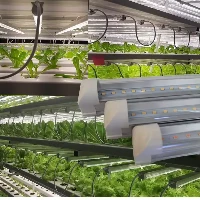
T8 linear lights support daisy-chain connection and mounting clips, and can be fixed to growing racks, hung, or installed horizontally. But "it can be installed" is only the beginning; "installed correctly" is the real dividing line. The following are empirical ranges; actual settings should be based on measured PPFD and plant response:
| Stage | Reference lamp distance (linear T8 supplemental lighting) | Risk if too close | Result if too far |
|---|---|---|---|
| Seedling/cutting | About 10–30 cm | Local light inhibition, heat stress | Insufficient PPFD, stretching |
| Leafy greens, vegetative growth | About 20–40 cm | Uneven light spots, leaf-edge burn | Insufficient daily light integral at canopy |
| Fruiting crops, vegetative growth | About 30–60 cm | Too strong in center, weak at edges | Need more tubes or longer duration |
| Flowering/fruiting stage | About 40–80 cm or higher | Multi-light array needed | Single tube cannot cover; density must be increased |
LED chips hate to "sweat." This tube uses an aluminum alloy housing with a PC transparent cover: aluminum conducts heat away quickly, while the PC cover protects the chips and optical structure. The rated 50,000-hour lifespan is a statistical indicator ending when light output decays to a certain percentage under normal thermal management-not a claim that the tube will stop working at hour 50,001. Combined with a 5-year warranty, this means fewer replacement and maintenance costs. For commercial growers, one less lighting interruption can mean one less crop risk.
If you are selecting lighting for hydroponic racks, seedling shelves, or greenhouse supplemental lighting, please contact us. Tell us your crop, growth stage, canopy area, target PPFD, and required tube length (60 cm/90 cm/120 cm) and quantity. We can provide product datasheets, PPFD test data, installation layout recommendations, sample testing, and bulk quotations, and we support OEM/ODM customization. Let a tube be not just bright, but bright in a way you can understand and choose with confidence.