Choosing a marine LED light: the core principle is to first match the organisms you keep, then determine intensity based on tank depth, and finally evaluate durability and control features. Its logic is very different from that of freshwater planted-tank lights: the spectrum and intensity of a marine light must precisely serve the zooxanthellae inside corals.
1, Step 1: Clarify the purpose-fish-only or coral?
This is the most fundamental decision point and directly determines what kind of light you need.
Fish-Only Tank: There are no corals, so there are no special biological lighting requirements. Choose a full-spectrum light that illuminates the entire tank and lets you see the fish's colors clearly; there is no strict PAR threshold.
Reef Tank: This is where marine lights come into play. Coral health, growth, and coloration depend entirely on lighting. Different corals have vastly different light requirements, and this is the core basis for choosing a light.
2, Step 2: Focus on two core optical metrics: spectrum and PAR/PUR
Do not be misled by marketing terms such as "full spectrum." For corals, the key is light at specific wavelengths and sufficient intensity.
Spectrum: Blue-violet light is the absolute foundation.
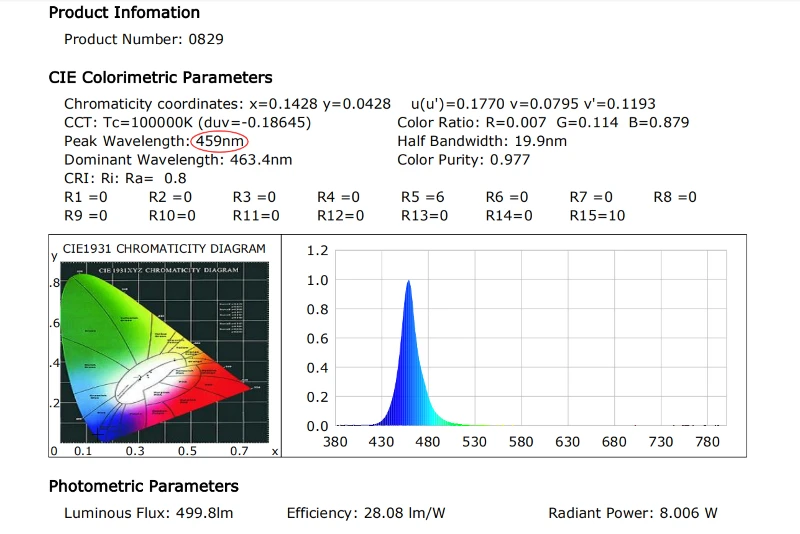
The zooxanthellae in corals perform photosynthesis and most efficiently use the blue-violet band (approximately 400–460 nm). This band directly drives coral growth and the expression of fluorescent proteins (i.e., "coloration"). Therefore, a good marine light must have sufficiently strong output in the 400–460 nm range. Some high-quality fixtures are designed to concentrate the effective spectrum between 380 and 480 nm.
Red and green light are also needed, but their roles are different: moderate red light (620–660 nm) and green light can improve the visual coloration of corals to the human eye, making red and orange corals more vivid. However, excessive red light strongly stimulates algae blooms-this is a trap to watch out for. Therefore, the ideal choice is a light with independently adjustable spectral channels, so you can find a balance between "coral growth" and "human viewing" while controlling algae risk.
you can see below 450-460nm diagram reported from BENWEI
Intensity (PAR/PUR): Brighter is not always better; rather, "the right light" must be strong enough.
PAR (Photosynthetically Active Radiation): This measures the total amount of all photosynthetically active light in the 400–700 nm range, in units of µmol/m²/s. It is an important intensity reference, but it cannot distinguish between "effective light" and "ineffective light."
PUR (Photosynthetically Usable Radiation): This is a more precise metric because it counts only light in the specific bands that corals can actually use. High PUR means the fixture's spectrum is well matched and less energy is wasted.
Simply put, look at the PAR value, but even more importantly, check whether the spectral curve covers the blue-violet peak that corals need most.
3, Step 3: Determine intensity based on tank depth and coral type
Light attenuates in water, so the deeper the tank, the higher the penetration requirement (PAR value) for the light.
A practical reference framework is to estimate based on the LED wattage required per 24-inch (about 60 cm) square of tank bottom area. This is more scientific than looking only at total wattage:
| Coral Type | Recommended LED Power (per 24" x 24" area) | Target PAR Range (most areas of the tank) |
|---|---|---|
| LPS & soft corals | 50–100 W | 50–150 |
| Mixed reef tank | 100–150 W | 150–250 |
| SPS stony corals | 150–200 W | 250–350 |
Note: Wattage is a rough estimate, and the luminous efficacy of LEDs varies greatly between brands. The most reliable method is to check measured PAR data for the fixture at the corresponding depth in your tank. For example, some fixtures can maintain 100–150 PAR at a depth of 50 cm, which is a good level for a mixed tank. For strong-light corals such as SPS, at a depth of 18 inches (about 45 cm), at least 150–200 µmol/m²/s PAR is required.
4, Step 4: Hardware qualities that cannot be ignored-waterproofing, heat dissipation, and durability
The marine environment is harsh on light fixtures; salt mist and humidity accelerate damage to inferior lights.
IP Rating: If the light will be exposed to moisture or may be splashed, IP68 is a basic safeguard. However, note that merely being labeled "IP68" is not enough; where possible, confirm its test conditions (such as immersion depth and duration). For lights installed above the aquarium (not underwater), good moisture-proof design is also essential.
Heat Dissipation Structure: LED chips are sensitive to heat, and poor heat dissipation directly accelerates light degradation (rapid brightness decline) and shortens lifespan. Choosing a fixture with large heat sink fins and a high-quality driver power supply (preferably with overheat protection) is key to ensuring stable long-term output.
Housing Material: In a marine environment, aluminum housings carry a corrosion risk. Higher-end fixtures may use more corrosion-resistant materials or special coating treatments.
5, Step 5: Control functions-the convenience of modern LED lights
Modern marine LED lights generally support programmable dimming and fine spectral tuning. You can set sunrise/sunset and moonlight simulation, and adjust the ratios of blue, white, red, and other channels for different corals. The convenience of app or controller operation and whether multi-light synchronization is supported are also important aspects that improve the experience.
6, Quick Decision Reference
You can quickly narrow down your options based on the following scenarios:
Fish-only (FOT): Any full-spectrum LED aquarium light with an appearance you like is sufficient; there is no need to pursue high PAR.
Mainly soft corals/LPS, tank depth <45 cm: Choose a fixture with moderate power (e.g., 50–100 W per 60 cm square), a mainly blue-violet adjustable spectrum, and PAR in the 50–150 range.
SPS stony corals, or tank depth >50 cm: You must choose a high-PAR-output fixture (target 250+ at the tank bottom), with strong blue-violet penetration and excellent heat dissipation (150–200 W per 60 cm square or higher), and be sure to check its measured PAR data at the target depth.
Mixed reef tank: Choose a medium-to-high-power fixture with good spectral adjustability and a relatively wide PAR coverage range (100–250), and use placement to meet the needs of different corals. you can see more information on http://www.benweilight.com