How to Install Bathroom Downlights: A Step-by-Step Guide for Safety & Style

Bathrooms are one of the most used spaces in any home, and good lighting is non-negotiable – whether you're shaving, applying makeup, or just unwinding with a shower. Bathroom downlights (also called recessed bathroom lights) have become a top choice for homeowners and contractors alike, thanks to their sleek, space-saving design and ability to deliver bright, even light without cluttering the ceiling. But installing bathroom downlights isn't the same as installing standard indoor lights: bathrooms are high-moisture areas, so safety and compliance with electrical codes (like the U.S. NEC or EU IEC standards) are critical.
If you're looking to upgrade your bathroom lighting with downlights, this step-by-step guide will walk you through the process – from pre-installation checks to final testing. We'll cover tools you need, safety rules you must follow, and pro tips to ensure your installation is safe, functional, and long-lasting. Whether you're a DIY enthusiast or a contractor working on a client's project, this guide is tailored to meet global safety standards, making it ideal for international audiences in 2025.
Why Bathroom Downlights Need Special Attention
Before diving into installation, it's important to understand why bathrooms require unique lighting solutions. Electrical codes worldwide classify bathrooms as "wet" or "damp" locations, unlike living rooms or bedrooms. This means any light fixture installed here must be protected against moisture, which can cause short circuits, electrical shocks, or even fires.
Bathroom downlights are designed to meet these demands, but only if installed correctly. Key code requirements to keep in mind include:
IP Rating: As with indoor patios, bathroom downlights need an IP (Ingress Protection) rating. For most bathrooms, IP44 is the minimum (dustproof, protected against splashing water)-ideal for areas like vanities or toilet zones. For shower enclosures or above bathtubs (where water spray is direct), choose IP65 or higher (fully dustproof, protected against low-pressure water jets).
Zone Classification: Many countries (e.g., the EU, the UK, Australia) divide bathrooms into "zones" based on proximity to water sources:
Zone 0: Inside the shower or bathtub, only low-voltage (12V) fixtures with IP67+ are allowed.
Zone 1: Above the shower/bathtub (up to 2.25 m high)-IP65+ is required.
Zone 2: 0.6 m outside Zone 1 – IP44+ required.
Zone 3: Beyond Zone 2 (e.g., vanity areas)-IP44+ is recommended.
Voltage: In some regions, high-voltage (230V/120V) downlights are allowed in Zones 2 and 3, but low-voltage (12V) is mandatory for Zones 0 and 1 (paired with a safety transformer).
Ignoring these rules can lead to code violations, insurance claims denial, or serious safety risks. Always check your local electrical code (e.g., NEC in the U.S., BS EN 60598 in the EU) before starting.
Pre-Installation: What You Need to Prepare
Installing bathroom downlights requires a mix of tools, materials, and pre-checks. Gather these items first to avoid delays:
1. Tools
Voltage Tester: To confirm the power is off (critical for safety).
Hole Saw Kit: This tool is used to cut holes in the ceiling for downlights. Match the saw size to the cut-out diameter of your downlight; common sizes are 4", 5", or 6".
Drywall Saw/Utility Knife: For trimming ceiling material (if needed).
Screwdrivers: Phillips and flathead (for wiring and securing fixtures).
Wire Strippers: To remove insulation from electrical wires.
Pliers: Needle-nose pliers for bending wires.
Tape Measure & Pencil: To mark hole positions and ensure even spacing.
Stud Finder: To locate ceiling joists (you can't cut holes through them; fixtures must be mounted between them).
Ladder/Step Stool: Sturdy and non-slip, to reach the ceiling safely.
2. Materials
Bathroom-Approved Downlights: Ensure they have the correct IP rating for your bathroom's zone (IP44 for Zone 2, IP65+ for Zones 0/1). Opt for LED downlights -they're energy-efficient, moisture-resistant, and have a long lifespan (50,000+ hours).
Electrical Wire: If extending wiring to new fixture locations, use 14/2 (U.S.) or 1.5mm² (EU) copper wire rated for damp locations.
Wire Nuts/Connectors: Approved for damp environments (look for "UL-listed" or "CE-approved" labels).
Safety Transformer: Required if installing low-voltage (12V) downlights in Zones 0 or 1.
Junction Box: If splicing wires, use a waterproof junction box rated for bathroom use.
Fire Rating Seal: In some countries (e.g., the UK, Australia), recessed downlights must be fitted with fire-rated seals to prevent fire from spreading through ceiling cavities.
3. Pre-Checks
Turn Off Power: Locate your home's electrical panel and switch off the circuit breaker for the bathroom. Use a voltage tester to confirm no power is flowing to the existing lighting wires – never skip this step!
Inspect Ceiling Cavity: If possible, check the space above the ceiling (e.g., via attic access) for hidden wires, pipes, or insulation. Ensure there's at least 3-6 inches of clearance around each planned downlight location (for heat dissipation and wiring).
Plan Fixture Layout: Mark where you'll install downlights using a tape measure. For even lighting:
Space fixtures 2-3 feet apart (or 1.5-2 times the ceiling height).
Avoid placing downlights directly above the centre of the shower (to prevent glare) or too close to walls (leave 12-18 inches).
For vanities, install 2-3 downlights above the mirror (spaced evenly) to eliminate shadows on the face.
Step-by-Step Guide to Installing Bathroom Downlights

Follow these steps carefully to ensure a safe, code-compliant installation. If you're unsure about any step (e.g., wiring), hire a licensed electrician – electrical work in bathrooms is not the time for guesswork.
Step 1: Cut Ceiling Holes
Use the stud finder to mark ceiling joists – draw lines along their edges to avoid cutting into them.
Mark the center of each downlight location with a pencil; use your pre-planned layout.
Attach the correct-sized hole saw to your drill (match the downlight's cut-out diameter).
Drill a pilot hole at each marked centre, then use the hole saw to cut through the ceiling material (drywall, plaster, or wood). Apply gentle, steady pressure – let the saw do the work to avoid splintering.
Remove the cut-out piece of ceiling and discard it. Check the hole for any hidden wires or pipes – if you identify any, reposition the downlight.
Step 2: Run Electrical Wiring (If Needed)
If you're replacing existing lights, you can use the existing wiring. If installing new downlights (e.g., adding more fixtures), you'll need to run new wire:
From the existing light switch or junction box, run the electrical wire through the ceiling cavity to each downlight hole. Leave 6-8 inches of wire sticking out of each hole (for connecting to the fixture).
Use wire staples to secure the wire to ceiling joists (keep it at least 1.5 inches away from insulation to prevent overheating).
If splicing wires (e.g., connecting multiple downlights in a series), use a waterproof junction box. Strip ½ inch of insulation from the wire ends, twist matching wires together (black to black, white to white, and green/bare to green/bare), and secure with wire nuts. Wrap the connections with electrical tape for extra protection.
Step 3: Install the Safety Transformer (Low-Voltage Only)
If you're using 12V downlights (required for Zones 0/1), install a safety transformer first:
Mount the transformer in a dry location (e.g., outside the bathroom, in the attic, or in a waterproof box in Zone 3). Never install it in Zones 0, 1, or 2.
Connect the transformer to the main electrical supply (black wire to hot, white to neutral, green/bare to ground).
Run low-voltage wire from the transformer to each downlight hole (use 18/2 wire for low voltage).
Step 4: Connect the Downlight to Wiring
Remove the downlight's trim and bulb (if pre-installed) to access the wiring compartment.
For high-voltage (120V/230V) downlights:
Strip ½ inch of insulation from the downlight's wires and the ceiling wires.
Match the wires: hot (black/red) to hot, neutral (white) to neutral, and ground (green/bare) to ground.
Twist the wires together and secure with wire nuts. Wrap each connection with electrical tape (moisture-resistant tape is best for bathrooms).
For low-voltage (12V) downlights:
Connect the low-voltage wires from the transformer to the downlight's wires (most use colourcoding: red to red, black to black).
Use wire nuts or the downlight's built-in terminal block to secure the connections.
Step 5: Secure the Downlight in the Ceiling
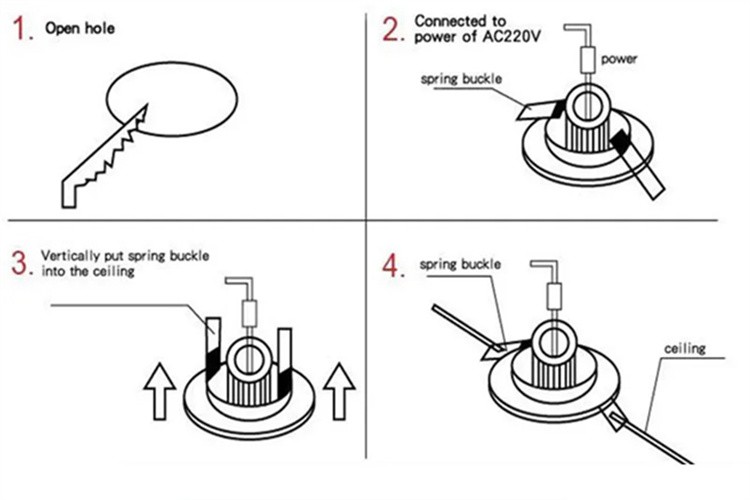
Most bathroom downlights use spring-loaded clips or mounting brackets to stay in place:
Push the downlight's housing (the part with the wiring) into the ceiling hole. Ensure the gasket (if included) is flush against the ceiling (this prevents moisture from seeping into the ceiling cavity).
For spring-loaded clips: As you push the housing in, the clips will expand and press against the ceiling material, holding the fixture in place. Give the fixture a gentle tug to confirm it's secure.
For mounting brackets: Screw the brackets to the ceiling joists (or ceiling material) using the included screws, then attach the downlight housing to the brackets.
Step 6: Install the Trim and Bulb
Reattach the downlight's trim (the visible part) to the housing – most trims snap or screw into place. Ensure the trim is tight to prevent moisture from entering.
Insert the LED bulb (use a bulb rated for damp locations – look for "bathroom-safe" or "IP44+" on the packaging). Avoid incandescent or halogen bulbs – they generate too much heat and are less moisture-resistant.
Step 7: Test the Installation
Go back to the electrical panel and turn the bathroom circuit breaker back on.
Flip the light switch to test the downlights – they should turn on immediately with no flickering or humming.
Check for any signs of overheating: After the lights have been on for 10-15 minutes, touch the trim gently (it should be warm, not hot). If it's overheating, turn off the power and check the wiring (loose connections can cause heat buildup).
Test moisture resistance (optional): Run the shower for 5-10 minutes to create steam, then check the downlights for water buildup or malfunctions.
Post-Installation Tips for Long-Lasting Bathroom Downlights
To keep your bathroom downlights working safely and efficiently for years:
Clean Regularly: Dust and moisture can build up on the trim and bulb, reducing light output. Wipe the trim with a damp cloth (turn off the lights first!) and replace the bulb if it becomes cloudy.
Replace Bulbs Promptly: If a bulb burns out, replace it within a few days – empty sockets can let moisture into the fixture housing.
Inspect Annually: Every year, check the wiring connections (turn off power first) and the fixture's gaskets for wear. Replace gaskets if they're cracked or missing.
Avoid Overloading Circuits: Don't connect too many downlights to one circuit – check your local code for maximum wattage per circuit (e.g., 120V circuits in the U.S. typically handle 1,440 watts).
Common Installation Mistakes to Avoid
Skipping the Voltage Test: Never work on live wires – even if you think the power is off, use a voltage tester to confirm.
Using the Wrong IP Rating: Installing an IP20 downlight (not moisture-resistant) in a shower area is a major safety hazard. Always match the IP rating to the bathroom zone.
Cutting Holes Through Joists: This weakens the ceiling structure and is against most building codes. Use a stud finder to locate joists before cutting.
Forgetting the ground wire can lead to electrical shocks, so always connect it.
Overcrowding Fixtures: Too many downlights can cause glare and waste energy. Stick to the 2-3 foot spacing rule for even lighting.
Conclusion
Installing bathroom downlights is a rewarding DIY project that can transform your bathroom's look and functionality – if done safely. By following this guide, you'll ensure your installation meets global electrical codes, protects against moisture, and delivers bright, efficient light for years to come. Remember: Safety always comes first. If you're unsure about any steps, hire a licensed electrician – they have the expertise to handle wet-location electrical work.
With the right tools, materials, and attention to detail, your bathroom downlights will not only enhance your daily routine but also add value to your home. Whether you're upgrading a small powder room or a large master bathroom, this guide has everything you need to get the job done right – no matter where in the world you live.
https://www.benweilight.com/lighting-tube-bulb/15w-bathroom-downlights.html
Shenzhen Benwei Lighting Technology Co.,Ltd
Telephone: +86 0755 27186329
Mobile(+86)18673599565
Whatsapp :19113306783
Email:bwzm15@benweilighting.com
Skype: benweilight88
Web: www.benweilight.com