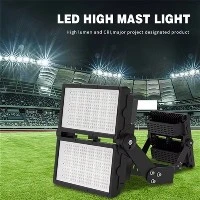
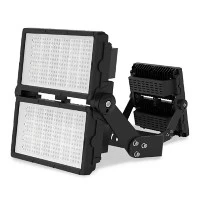
Why Do Horse Riding Arena Lights Need 30°/60°/90°×135° Beam Angles? It's Not Just About Brightness
When selecting LED lights for a horse riding arena, most buyers pay attention to wattage and lumens. But, anyone who has ever seen a dimly lit arena compared to a professionally lit one knows that it is not just the amount of light, but the distribution of the light that makes the difference.
We are often asked: "Why do you have beam angles of 30°/60°/90°×135° for your horse arena lights? Isn't one angle enough?"
The answer lies in the unique visual needs of both horse and rider-and in the realisation that a horse's eye sees light very differently than a human's.

1. The Horse's Eye: A Different Visual System
Horses have laterally placed eyes, giving them nearly 350° monocular vision but a limited binocular field (about 65° directly ahead). Their eyes are also highly sensitive to sudden contrast changes and flicker, which can trigger startle responses.
In a riding arena, lighting that creates harsh shadows, uneven patches, or direct glare can cause:
- Hesitation or spooking at jump approaches
- Reduced rider confidence due to poor depth perception
- Eye fatigue during long training sessions
This is why professional arena lighting isn't just about putting up the brightest fixtures-it's about creating a uniform, glare-free visual environment.
2. Why Multiple Beam Angles Matter
A single beam angle cannot adequately cover a large, rectangular arena while maintaining uniformity from the centerline to the walls. Our 30°/60°/90°×135° asymmetric optical design addresses this through targeted light distribution:
|
Beam Component |
Function |
Benefit |
|
30° |
Focused central illumination |
High intensity directly along the arena centerline and jump areas |
|
60° |
Mid range spread |
Fills the primary riding zone with even light |
|
90°×135° (asymmetric) |
Wide lateral spread |
Extends coverage to the perimeter walls and corners without adding extra fixtures |
This combined optical system achieves excellent uniformity (U0 > 0.7) -meaning the difference between the brightest and darkest spot in the arena is barely perceptible to horse and rider.

3. Uniformity: The Invisible Safety Feature
Poor uniformity creates a "spotlight effect"-bright pools of light alternating with dark zones. For a horse moving at speed, these transitions can appear as sudden changes in footing, triggering caution or evasion.
With a well designed multi angle optical system:
- No dark corners that hide obstacles or footing issues
- Smooth light transition across the entire arena
- Reduced shadow length under fences and rails
In practice, this means safer training at dusk or night, fewer refusals at jumps, and extended usable hours for arenas.
4. Glare Control: A Hidden Performance Factor
Glare is measured as UGR (Unified Glare Rating). For equestrian facilities, a UGR < 22 is recommended to avoid discomfort. Our lights achieve this through:
- Precision engineered reflectors that direct light downward, not outward
- Multiple beam angles that eliminate the need for fixtures aimed directly at riders' eye level
- 180 lm/W high efficacy that achieves required lux levels with fewer fixtures, reducing cumulative glare
Riders report noticeably less eye strain after 2 hour sessions, and horses show calmer behavior under consistently distributed light.

5. Beyond Optics: The Complete Reliability Package
Light distribution alone isn't enough for outdoor arenas. The fixtures must withstand dust, rain, and vibration. Our horse riding lights are built with:
|
Component |
Specification |
Why It Matters |
|
Driver |
Meanwell, AC 185-305V, PF > 0.95, THD < 15% |
Stable power under voltage fluctuations; long term reliability |
|
Housing |
IP67 |
Fully protected against dust and temporary immersion-suitable for outdoor arenas |
|
Lumen maintenance |
L70 > 50,000 hrs, decay < 10% in 5 years |
Consistent light output year after year; lower maintenance costs |
|
Dimming options |
0-10V, DMX, DALI |
Allows adjustment for different activities (flatwork vs. jumping) and energy savings |
Real-World Application: What 30°/60°/90°×135° Looks Like in an Arena
Imagine a standard 60m x 30m outdoor arena:
- With single-beam lights (60° round): You'd need 12–16 fixtures to avoid dark spots, often creating glare overlap at the center.
- With our multi-angle optics: 8 fixtures strategically positioned deliver 200 lux minimum at the centerline and 150 lux along the walls, with uniform coverage and no direct glare to riders or horses.
The result: a professional-grade lighting environment that supports training, competition, and horse welfare.
Conclusion: Choose Optics That Respect Horse and Rider
When evaluating arena lights, don't just ask "How many lumens?" Ask:
- Is the beam angle designed for rectangular arenas?
- What is the uniformity ratio (U0)?
- Are there independent test reports for lumen maintenance and glare?
We engineer our LED horse riding lights not only for brightness and efficiency-but for the safety, comfort, and performance of the horse and rider.
Looking for arena lighting that delivers both performance and value?
Contact us to request IES files, photometric reports, or a customized layout proposal for your client's facility.