Light with a wavelength of 660 nm refers to deep red visible light with a peak wavelength of 660 nanometers. Lying at the far end of the red region in the visible spectrum, it is known as the "golden wavelength" in biophotonics.
In terms of physical properties, it boasts an extremely high photosynthetic efficiency, precisely matching the absorption peak of chlorophyll a. In biomedicine, it can penetrate the superficial layer of human skin and be absorbed by cytochrome c oxidase in mitochondria, thereby activating cellular energy metabolism.
As a bald engineer who has spent more than a decade in an optical lab, I have witnessed countless hues of light flickering inside integrating spheres. But honestly, I still feel a thrill whenever the curve on the spectrum analyzer surges to its peak at 660 nm. This is more than just a beam of red light-it is the "engine" of plant life and the "energy bar" for cellular repair. During our R&D work, we found that no other waveband can dominate both modern precision agriculture and cutting-edge medical devices in the way that 660 nm does. Today, I'm not here to sell any products; I'm just here to break down the hardcore science behind this magical red light.
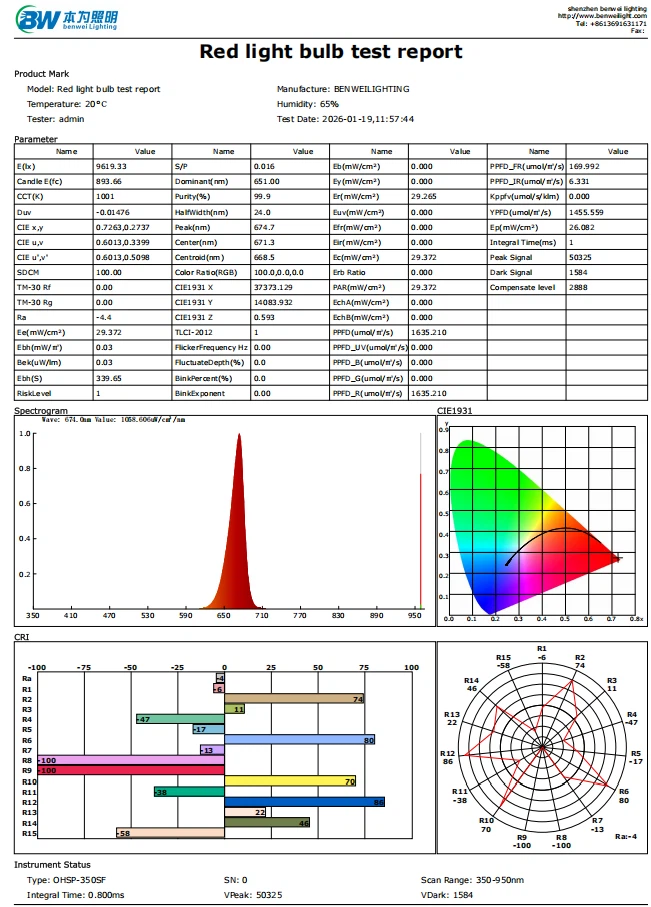
Light Color Positioning: Deep red visible to the human eye, darker and dimmer than ordinary red indicator lights (630 nm).
Plant Core: The peak absorption wavelength of chlorophyll a and chlorophyll b, directly driving the light-dependent reactions of photosynthesis.
Medical Principle: A foundational waveband for photobiomodulation (PBM), used to accelerate wound healing and anti-inflammation.
Penetration Depth: Moderate penetration in human tissue, superior to blue and green light, suitable for the treatment of superficial muscles and skin.
Technological Maturity: The LED epitaxial growth technology is extremely mature, with an ultra-high wall-plug efficiency (WPE).
Safety: Classified as non-ionizing radiation, with no side effects on the human body when used properly.
Frequency and photon energy
Light with a wavelength of 600 nm has a frequency of approximately 4.54×10¹⁴ Hz, and each 660 nm photon carries an energy of about 1.88 electron volts (eV).
This energy value is exquisitely calibrated. Unlike ultraviolet light, which has excessively high energy that breaks chemical bonds (causing sunburn), or far-infrared light, which has too low energy to produce nothing but thermal effects, its energy is precisely sufficient to induce electronic transitions within biomolecules, thereby triggering photochemical reactions rather than simple thermal heating.
At the same radiant flux, a 660 nm LED generates approximately 35% more photons than a 450 nm blue LED. This means that for the same power consumption, 660 nm light delivers a greater molar amount of photons that "do the work"-a key reason why it is the preferred primary wavelength for high-efficiency plant grow lights.
Spectral Purity: The Importance of Full Width at Half Maximum (FWHM)
The red LEDs you find on the market vary in hue-some appear overly bright and vivid, others dull and muted. For industrial-grade applications, what we focus on is the Full Width at Half Maximum (FWHM).
The spectrum of a high-quality 660 nm LED chip is not a single sharp line, but a bell-shaped curve. Premium chips typically have their FWHM controlled within a range of 15 nm to 20 nm.
An excessively wide FWHM will disperse light energy to wavelengths around 630 nm (low luminous efficacy) or 690 nm (reduced photosynthetic efficiency), significantly compromising the overall system performance. Precisely locking the peak wavelength is the key to packaging technology.
Wavelength Drift: Temperature Impacts Not Only Lifespan, But Also Color
A crucial detail many overlook: an LED's wavelength shifts as it generates heat.
"For AlGaInP (Aluminum Gallium Indium Phosphide) red light chips, the wavelength drifts toward the longer waveband by approximately 2–3 nm for every 10 °C rise in junction temperature. Poor thermal design can cause a chip rated at 660 nm to shift to around 670 nm under high-temperature operation, leading to a slight drop in the utilization efficiency of photosynthetically active radiation (PAR)."
This is why we impose near-exacting requirements on thermal resistance when designing high-power red light modules.
Core Mechanism of 660 nm Light in Plant Lighting
If a plant were compared to a factory, light at 660 nm would be its most critical power source. Its impact on plant growth is decisive, a fact underpinned by solid theoretical foundations in plant physiology.
Chlorophyll Absorption Peak: The "Main Meal" for Photosynthesis
Chlorophyll a and chlorophyll b in plant leaves are the key players in photosynthesis.
Chlorophyll a: Major absorption peaks at 430 nm (blue) and 662 nm (red).
Chlorophyll b: Major absorption peaks at 453 nm (blue) and 642 nm (red).
You will find that 660 nm aligns almost perfectly with the red light absorption peak of chlorophyll a. This means when plants receive 660 nm light, they can convert light energy into chemical energy (sugars) with maximum efficiency. This explains why plant grow lights always appear distinctly red-this is the waveband plants crave the most.
Emerson Effect
Irradiating plants with 660 nm light alone yields high photosynthetic efficiency, yet it is not the ultimate limit. As early as 1957, scientist Robert Emerson discovered a remarkable phenomenon.
When plants are irradiated with both 660 nm (red light) and 730 nm (far-red light) simultaneously, their photosynthetic rate exceeds the sum of the rates achieved by irradiating them with each light individually. This is the renowned Emerson Enhancement Effect.
This synergistic effect is like adding a turbocharger to the photosynthetic system, which drastically accelerates the plant's growth rate.
Photomorphogenesis: Not Just Growth in Height, But Flowering Control
Beyond providing energy, 660 nm light also acts as a signal light for plants. There is a receptor in plants known as phytochrome.
Pr form (red-light absorbing form): Converts to the Pfr form upon absorption of 660 nm light.
Pfr form (biologically active form): This is the key signal that triggers plant germination, flowering and stem elongation.
By controlling the irradiation duration and intensity of 660 nm light, we can precisely regulate when plants flower and whether they grow tall or short.
Scientific Principles of 660 nm Light in Biomedical and Phototherapy Fields
If you see a red light therapy device in a beauty salon or rehabilitation department, it is most likely powered by 660 nm light. This is by no means a scam, but rather a treatment grounded in the rigorous science of photobiomodulation (PBM).
A Charger for Mitochondria: Cytochrome C Oxidase
There are countless power stations in our cells-mitochondria. Within mitochondria lies a key enzyme known as cytochrome C oxidase (CCO).
Studies have shown that CCO exhibits specific absorption of light in the 600 nm–850 nm waveband, with a particular affinity for 660 nm light. When this enzyme absorbs red light photons, its activity is significantly enhanced.
Cell Repair Mechanism: Accelerated ATP Production
Once CCO is activated, mitochondria will ramp up the production of adenosine triphosphate (ATP).
What is ATP? It is the universal energy currency of cells.
Outcome: With more energy available, cells can conduct self-repair, synthesize collagen, and clear metabolic waste at a much faster rate.
Basis for Clinical ApplicationIndustry Data: Multiple clinical controlled trials have demonstrated that irradiating chronic wounds with a 660 nm LED light source can increase the wound closure rate by approximately 20%–40% and significantly reduce the expression of inflammatory factors.
This has led to the widespread application of 660 nm light in the following areas:
Wound Healing: Diabetic foot, burn repair.
Skin Aesthetics: Stimulating collagen regeneration and reducing wrinkles.
Sports Rehabilitation: Alleviating muscle fatigue and joint pain.
Wavelength Comparative Analysis: 660 nm vs. Adjacent Wavelengths
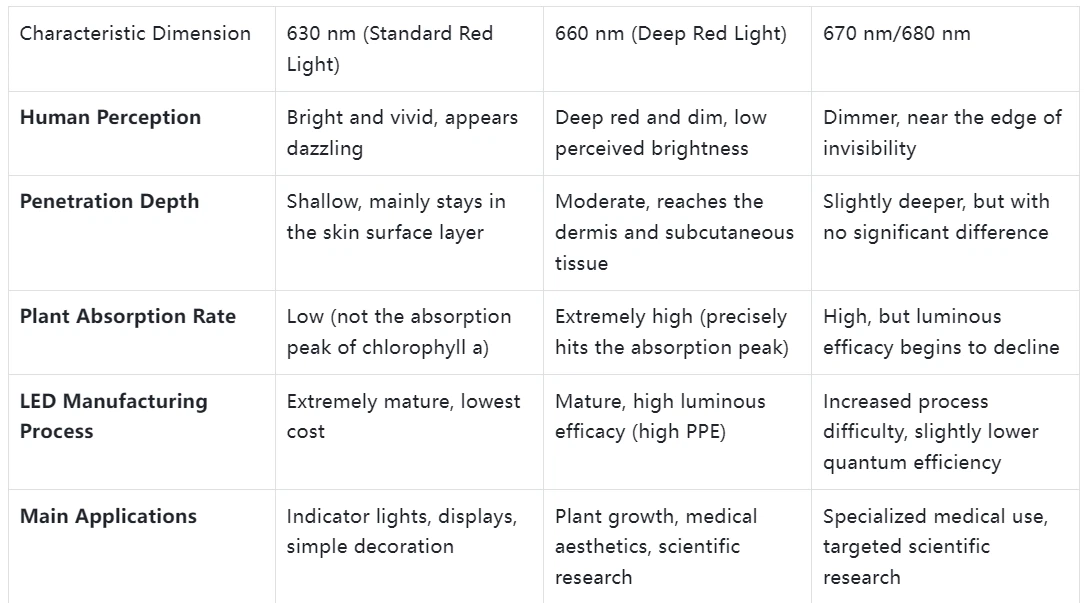
Why the Industry Prefers 660nm
While 630nm is more cost-effective, it delivers diminishing biological returns for the effort invested. Though 670nm/680nm also offer favorable biological effects, the quantum efficiency (the ability to convert electricity into light) of current LED chips for these wavelengths lags behind that of 660nm. When balancing biological efficacy and electro-optical conversion efficiency, 660nm stands as the ultimate choice for the current industry.
Impacts of Packaging Materials and Performance on 660nm LED Light Sources
Given the importance of 660nm, the technology of light emission is also a sophisticated discipline. For B2B buyers and R&D engineers, the packaging format determines the success or failure of a product.
Packaging Structure: Ceramic vs EMC
Standard bracket packaging may suffice for low-power applications. However, in high-power plant grow lights or medical probes, 660nm chips generate highly concentrated heat.
EMC3030: Ideal for medium-power scenarios, boasting a high cost-performance ratio and strong yellowing resistance.
Ceramic 3535/5050: The top choice for high-end applications. Ceramic substrates feature a thermal conductivity far superior to conventional materials, enabling rapid heat dissipation from chips.
Heat accumulation not only causes wavelength shift (as mentioned earlier) but also leads to severe light degradation. Especially for devices requiring long-term operation, selecting high-thermal-conductivity packaging is critical.
In tests conducted by Benwei lighting, 660nm light beads with high-thermal-conductivity ceramic substrates maintained a lumen maintenance rate of over 98% after 5,000 hours of continuous operation. Such high-performance packaging is indispensable for industrial and agricultural projects pursuing extreme stability.
If you are interested in packaging solutions for high-power and high-heat-dissipation requirements, you can refer to our Ceramic 5050 Light Bead Catalog for parameter performance across different power ratings.
Photon Efficacy (PPE) and Radiant Flux
To evaluate the quality of a 660nm light bead, lumen (lm) is not the metric to focus on. Since the human eye is insensitive to 660nm light, lumen values are typically low. The key metrics are:
Radiant Flux (mW): The absolute optical power output.
Photon Efficacy (PPE, µmol/J): The amount of micromoles of photons generated per joule of electrical energy consumed. The current cutting-edge level has exceeded 4.0 µmol/J.
Frequently Asked Questions
Q: What color is 660nm light to the naked eye?
A: It is a deep red. When a 660nm light is placed next to a roadside red light (typically around 625nm), the 660nm light appears slightly "dim" and even has a faint purplish hue-this is precisely a reflection of its high purity and deep wavelength.
Q: What is the scientific rationale for the ratio of 660nm red light to 450nm blue light in plant grow lights?
A: It depends on the growth stage of the plant. Generally, red light promotes biomass accumulation (vegetative growth), while blue light prevents etiolation (ensures sturdy stem and leaf development). During the flowering and fruiting stage, the proportion of 660nm red light is usually increased significantly, for example, a red-to-blue ratio of 5:1 or even 8:1.
Q: Can 660nm light penetrate clothing to act on the skin?
A: Ordinary cotton clothing blocks most visible light. To achieve therapeutic effects (Photobiomodulation, PBM), direct irradiation on exposed skin is recommended, and the light source should be kept at an appropriate distance to ensure the required energy density.
Q: Is long-term exposure to 660nm red light safe for the human eye?
A: 660nm is part of the visible light spectrum, not ultraviolet light, and poses no risk of ionizing radiation. However, high-power 660nm LEDs emit an extremely high radiant intensity (even though they appear dim to the naked eye); prolonged direct viewing may cause photochemical damage to the retina. Wearing safety goggles is recommended during industrial operations.

https://www.benweilight.com/lighting-tube-bulb/led-bulb-light/e27-led-light-bulbs-12w.html