Why LED Grow Lights Shouldn't Be Judged by "Brightness" Alone: Spectrum and Waterproofing Matter More
In plant factories, greenhouses, or home growing setups, LED grow lights have become essential tools for accelerating growth and increasing yields. However, many buyers still focus only on "how bright the light is" or "whether the purple light looks nice," while overlooking the core parameters that truly determine plant health and production efficiency.
Today, we'll quickly explain the four key points you must pay attention to when selecting LED grow lights.
1. Spectrum: Plants Need a "Recipe," Not a "Rainbow"
Plants respond very differently to different wavelengths of light. Not all colors are useful – some can even be harmful.
| Spectral Range | Wavelength | Effect on Plants |
|---|---|---|
| Blue | 420–520nm | Peak chlorophyll absorption; promotes leaf growth, prevents leggy growth |
| Red | 610–720nm | Strongly influences photosynthesis; promotes flowering and fruiting |
| UV‑A | 320–420nm | Regulates morphology, enhances stress resistance |
| Far‑red | 720–1000nm | Low absorption; high proportions inhibit flowering |
| UV‑B / UV‑C | <320nm | Harmful or lethal (used only for specific sterilization) |
✅ Conclusion: A quality grow light should allow customization of the red/blue ratio and be adjustable to suit different plants (leafy greens, fruiting vegetables, flowers) and different growth stages (seedling, vegetative, flowering).

2. Waterproof Rating: The "Lifeline" in High‑Humidity Environments
In plant factories, tissue culture rooms, and greenhouses, humidity often exceeds 80%. Ordinary lights can fail within days due to moisture ingress. The IP rating is a critical specification:
- IP65: Protected against water jets – suitable for general greenhouses
- IP66/IP67: Resists powerful water jets or short‑term immersion – ideal for hydroponics, aeroponics, and cleanable environments
Products with IP67‑rated waterproof drivers + waterproof PCBs offer dual protection, ensuring long‑term stable operation in wet conditions with a far lower failure rate than ordinary lights.
3. PPFD: The Real "Light Intensity" That Matters
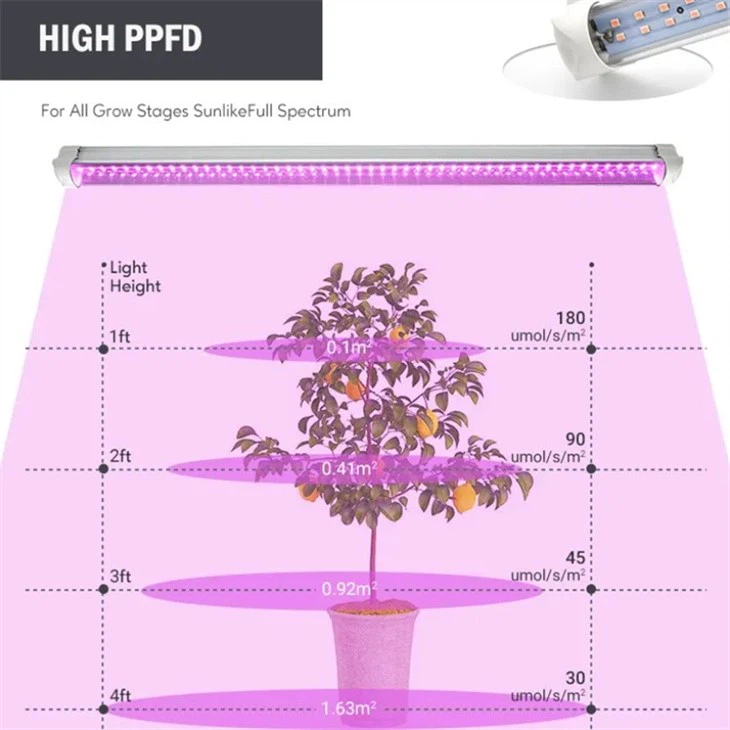
Brightness (lumens) is designed for the human eye. Plants need photosynthetically active radiation. The professional metric is PPFD (µmol/m²/s) – the number of photons received per square meter per second.
- Leafy greens: 100–300 µmol/m²/s
- Fruiting vegetables: 300–600 µmol/m²/s
- High‑light crops (e.g., tomatoes): up to 600–1000+
✅ When purchasing, ask the supplier for a PPFD distribution map – don't rely only on LED power or lumen ratings.
4. Customization: One Light for Many Scenarios
Different customers have very different needs: laboratories require precise spectra, commercial growers need high efficacy and durability, and home users want safety and aesthetics. A professional grow light supplier should support:
- Spectrum customization – adjust ratios of red, blue, UV, and far‑red
- Power customization – from tens of watts to thousands of watts
- Size customization – to fit different shelf heights and growing areas
- Waterproof rating customization – from IP65 to IP68 depending on the installation environment
Quick Selection Checklist
| Parameter | Recommended Standard |
|---|---|
| Spectrum | Adjustable red/blue, optional UV/far‑red |
| Waterproof rating | ≥IP65 for high‑humidity environments |
| PPFD | Based on crop needs; request measured data |
| Driver | Branded driver, warranty ≥3 years |
| Thermal management | Aluminum PCB + waterproof coating – ensures controlled lumen depreciation |
| Certifications | CE, RoHS, etc. |
Bottom Line
An LED grow light is not about "the more purple, the better" – it's about precise spectrum, reliable waterproofing, and adequate PPFD. Choose the right light, and turn every kilowatt‑hour into plant yield.
Need a custom spectrum solution for your growing project? Provide us with your plant species, growing area, and target yield, and we will design the optimal light recipe for you.