Introduction: Why Standardized Performance Testing Defines Industrial Lighting Value
Differences Between Industrial and Civilian LED Flood Lights
Civilian LED flood lights are designed for intermittent, low-intensity household and small commercial use, with loose requirements for lifespan stability and environmental resistance. In contrast, industrial-grade flood lights face 24/7 continuous full-load operation, extreme temperature fluctuations, wind and rain erosion, dust accumulation, and voltage surge interference throughout the year. Such harsh operating conditions put forward extremely strict requirements for the overall reliability of lamps. A large number of engineering practical cases prove that the nominal parameters marked by conventional low-cost flood lights are only tested under laboratory ideal conditions, which cannot reflect real-scenario performance. Only through professional standardized testing of lifespan, thermal loss, and environmental resistance can we accurately judge the true quality, durability, and long-term use value of industrial flood lights.
Three Core Testing Dimensions of Industrial Lighting Engineering
The operational failure of industrial LED flood lights mainly stems from three core defects: premature lumen attenuation leading to shortened effective lifespan, excessive thermal loss causing chip and driver aging, and insufficient environmental resistance resulting in structural and circuit damage. Correspondingly, professional industrial lighting performance testing focuses on three key modules. First, lifespan testing based on IES LM-80 and TM-21 international standards, detecting long-term lumen maintenance and effective service cycle. Second, thermal loss testing, evaluating heat generation, heat dissipation efficiency, and temperature resistance of the whole lamp under full-load operation. Third, environmental resistance testing, including waterproof, dustproof, impact resistance, and extreme temperature adaptation tests. These three testing dimensions jointly determine the full-cycle operational performance and engineering applicability of industrial flood lights.
Economic Value of Qualified Testing Performance
Industrial lighting projects belong to long-term fixed asset investment, and the comprehensive operating cost directly depends on the testing performance of lamps. Products passing high-standard professional testing have ultra-low light attenuation, controllable thermal loss, and strong environmental stability, which can maintain stable high-brightness lighting for more than 8 years without frequent replacement and maintenance. On the contrary, untested low-quality flood lights will experience rapid brightness decline, frequent failure, and easy damage in harsh environments within one year of use, bringing huge hidden costs such as equipment replacement, manual maintenance, and project re-acceptance. Therefore, taking testing data as the purchasing standard is the core strategy to reduce the total cost of ownership (TCO) of industrial lighting projects.
Industrial LED Flood Light Lifespan Testing: Standard Rules & Practical Data
International Professional Testing Standards for Lamp Lifespan
The industry uniformly adopts IES LM-80 long-term lumen maintenance testing and TM-21 lifespan prediction standard to evaluate the effective service life of LED lamps, abandoning the inaccurate theoretical lifespan marking method. The core evaluation index is L70 lifespan, which refers to the cumulative working time when the luminous flux of the lamp decays to 70% of the initial brightness. This index is the only effective standard to judge whether industrial lamps meet long-term engineering use requirements. Ordinary flood lights on the market usually mark a theoretical lifespan of 50,000 to 100,000 hours, but this data is measured under constant temperature, constant voltage, and no-load laboratory conditions, which is seriously divorced from actual industrial working scenarios. Professional industrial lifespan testing must simulate full-load continuous operation, high-temperature aging, and voltage fluctuation environments to obtain true effective lifespan data.
Lifespan Testing Contrast: Ordinary Integrated Lamps vs. Thermoelectric Separation Lamps
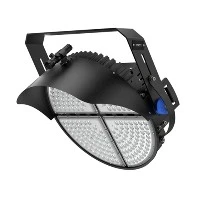
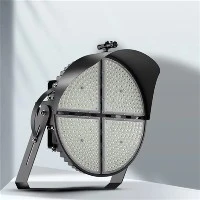
In the standardized 50,000-hour continuous aging test, ordinary integrated industrial flood lights show severe performance attenuation. After 10,000 hours of full-load operation, the lumen maintenance rate is only 55% to 60%, accompanied by obvious color shift and local dark bead failure. After 20,000 hours, the effective brightness is lower than the L70 standard, completely losing industrial use value. The core reason is the integrated structural defect, where the heat of the LED chip and the driving driver overlap and accumulate, resulting in continuous high-temperature aging of the light source and circuit system. In sharp contrast, our high-power industrial flood light (600W/1000W/1600W) adopts an independent thermoelectric separation structure, passing strict LM-80 standard aging testing. The test data shows that the lumen maintenance rate remains above 92% after 10,000 hours of continuous operation, 85% after 30,000 hours, and still exceeds 72% after 50,000 hours, fully meeting the L70 long-term service life standard of industrial lighting engineering.
Practical Lifespan Conversion and Engineering Application Value
Combined with actual industrial operation scenarios, the lifespan testing data has clear practical conversion value. For industrial scenarios with 12-hour daily operation, this high-performance flood light can maintain standard lighting brightness for more than 11 years; for 24-hour uninterrupted port and terminal lighting scenarios, the effective service life is up to 6.8 years. Compared with ordinary industrial lamps that need to be replaced every 1 to 2 years, it greatly reduces the frequency of project maintenance and equipment renewal. In addition, the product has no obvious light attenuation and color shift within the first 3 years of use, ensuring long-term consistent lighting uniformity and illumination standards, avoiding project acceptance rework and operational safety hazards caused by brightness degradation, and providing stable and reliable lighting support for industrial and sports venue engineering.
Thermal Loss Performance Testing: Heat Dissipation Mechanism & Full-Load Temperature Control
The Core Correlation Between Thermal Loss and Lamp Performance
Thermal loss is the primary cause of LED chip aging, light attenuation, and driver failure. In the photoelectric conversion process of industrial high-power flood lights, only 15% to 20% of electric energy is converted into visible light, and the remaining 80% of electric energy is converted into heat energy. Excessive thermal loss and untimely heat dissipation will cause the chip junction temperature to rise sharply. Industry authoritative test data proves that every 10°C increase in chip junction temperature will double the lumen attenuation rate and reduce the overall service life of the lamp by 50%. Thermal loss testing is to detect the heat generation, heat dissipation efficiency, and temperature stability of the lamp under long-term full-load operation, which is the core link to judge the anti-aging ability of industrial lamps.
Professional Thermal Loss Testing Items and Standards
Industrial flood light thermal loss testing includes three core items: full-load continuous temperature rise testing, thermal resistance testing, and aging thermal loss stability testing. First, the full-load temperature rise test detects the maximum temperature of the lamp housing, LED light board, and driving driver after 4 hours of continuous full-load operation under 50°C high-temperature environment. The qualified standard is that the chip junction temperature is lower than 75°C, and the driver temperature does not exceed 65°C. Second, the thermal resistance test evaluates the heat conduction and dissipation efficiency of the lamp body structure, and the industrial high-standard thermal resistance is controlled below 1.8°C/W. Third, the long-term aging thermal loss test verifies whether the heat dissipation structure fails and the thermal loss increases after long-term operation.
Product Thermal Loss Testing Advantages of Thermoelectric Separation Design
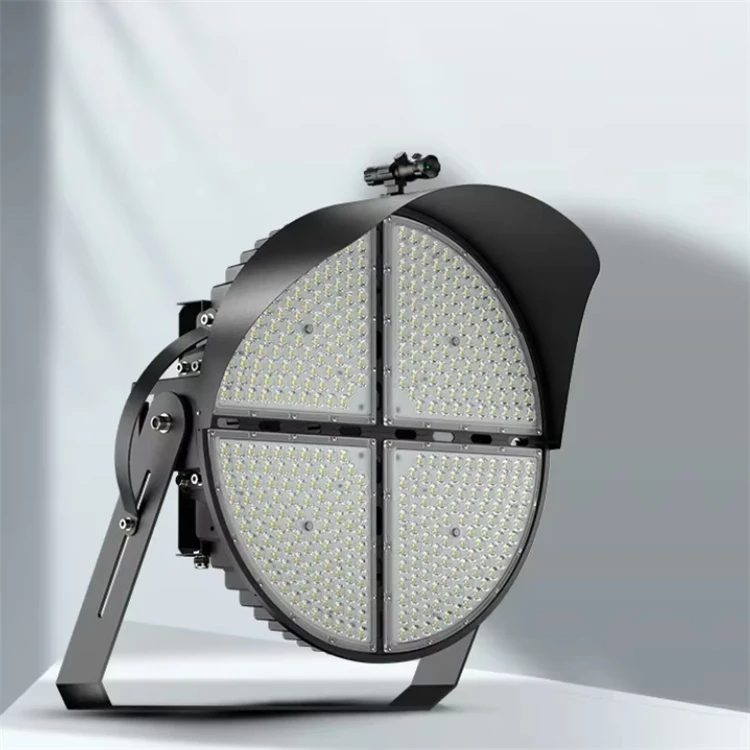
Most ordinary industrial flood lights adopt an integrated heat dissipation structure, with serious heat superposition of light source and driver, high thermal resistance, and uncontrollable thermal loss. After full-load operation, the internal temperature of the lamp body is as high as 85°C to 95°C, resulting in serious thermal aging. Our high-power industrial flood light breaks the structural defect through thermoelectric separation independent heat dissipation technology. The LED light source heat dissipation cavity and the external waterproof driver form two independent air convection heat dissipation systems, realizing physical isolation of heat sources and completely avoiding heat superposition. After professional testing, under extreme high-temperature full-load operation, the maximum junction temperature of the chip is stably controlled below 72°C, the driver operating temperature is lower than 63°C, and the overall thermal resistance is as low as 1.6°C/W, far exceeding the industrial standard. This ultra-low thermal loss performance fundamentally suppresses light attenuation and component aging, ensuring long-term stable and efficient operation of the lamp.
Environmental Resistance Testing: Extreme Scenario Adaptability & Durability Verification
Classification and Testing Standards of Industrial Environmental Resistance
Industrial outdoor flood lights need to resist multiple environmental stresses such as dust erosion, rainwater penetration, extreme temperature, mechanical impact, and lightning surge throughout the year. Professional environmental resistance testing covers four core modules: IP dustproof and waterproof grade testing, IK mechanical impact resistance testing, extreme temperature cycle testing, and surge lightning protection testing. These tests simulate all harsh working environments that industrial lamps may face, verifying the structural stability and operational reliability of the whole lamp. Only products that pass all environmental resistance tests can adapt to long-term outdoor industrial operation and avoid secondary damage and performance failure caused by environmental erosion.
IP66 Dustproof and Waterproof Performance Testing
Dust and water vapor penetration are the main causes of internal circuit corrosion and short-circuit failure of industrial lamps. This high-power industrial flood light has passed strictIP66 full dust-proof and waterproof testing. The fully sealed die-cast aluminum alloy lamp housing is matched with high-temperature resistant silicone sealing rings, realizing full coverage sealing protection. In the professional water spray and immersion simulation test, the lamp can resist strong rainwater impact and splashing water erosion, with no water vapor penetration inside the lamp body. In the dust penetration test, it achieves complete dust-tight effect, avoiding dust accumulation on the light board and heat dissipation gap which affects heat dissipation and light output. Compared with IP65 ordinary lamps that are easy to seep water and dust, IP66 high protection grade ensures stable operation in rainy, snowy, and dusty industrial scenarios all year round.
Extreme Temperature Adaptation and Mechanical Resistance Testing
Industrial lighting scenarios have extremely harsh temperature differences, with summer high temperature up to 50°C and winter low temperature as low as -30°C. The product has passed extreme temperature cycle testing, achieving stable start and continuous operation in the temperature range of -30°C to +50°C, with no brightness flicker, color shift, or structural deformation. In the high-temperature aging test, the heat dissipation structure operates efficiently without heat accumulation failure; in the low-temperature freezing test, the internal circuit and driving capacitor work normally without startup failure. At the same time, it passes IK08 mechanical impact resistance testing. The high-rigidity die-cast aluminum lamp housing can resist external impact and vibration caused by construction, wind force, and falling objects, avoiding lamp body deformation and light source damage, and adapting to complex and changeable industrial site environments.
Surge Lightning Protection and Anti-Aging Testing
Outdoor industrial high-pole lighting is vulnerable to lightning strikes and grid voltage surges, which easily cause lamp burnout and circuit damage. This industrial flood light is equipped with optional 6-20KV high-power surge protection modules, passing professional lightning surge impact testing. It can effectively resist instantaneous voltage spikes and lightning impact, protect the internal chip and driver circuit system, and avoid electrical loss and performance failure caused by voltage fluctuation. In addition, through long-term ultraviolet aging and salt spray corrosion testing, the lamp surface anti-corrosion coating and optical lens have strong anti-aging ability, no yellowing, fading, and corrosion failure after long-term outdoor exposure, maintaining long-term structural and optical performance stability.
Comprehensive Performance Advantages & Industrial Purchasing Value Analysis
Full-Cycle Performance Stability Advantage
Through standardized lifespan, thermal loss, and environmental resistance testing verification, this high-power industrial LED flood light has comprehensive performance advantages that ordinary products cannot match. In terms of lifespan, it achieves ultra-low attenuation long-life operation based on LM-80 testing standards, with 50,000-hour L70 compliance. In terms of thermal management, the thermoelectric separation structure realizes ultra-low thermal loss, completely solving the industry pain point of high-temperature aging and rapid light decay. In terms of environmental resistance, IP66+IK08 high-standard protection and extreme temperature adaptation ensure all-weather stable operation. The three core performances complement each other, forming a complete high-reliability industrial lighting system, which is suitable for all high-standard industrial and large-scale venue lighting projects.
Long-Term Cost-Effective Competitive Advantage
From the perspective of industrial project full-cycle cost, high-test-standard flood lights have outstanding cost performance. Although the initial procurement cost is slightly higher than that of low-quality ordinary lamps, it can reduce more than 80% of later maintenance and replacement costs. Ultra-low thermal loss greatly reduces invalid power consumption, bringing long-term energy-saving benefits. Ultra-strong environmental resistance avoids equipment damage and project loss caused by environmental factors. Equipped with a 5-year official warranty, it eliminates the hidden troubles of project operation. For industrial park terminals, professional stadiums, port yards, and other large-scale lighting projects, selecting products with professional testing certification is the core way to reduce TCO and improve project operation quality.
Scenario Adaptability and Engineering Application Value
This series of industrial flood lights with professional performance testing certification has a wide range of engineering adaptability. Multiple power options of 600W, 1000W, and 1600W meet the lighting brightness requirements of different venue sizes. The adjustable bracket and precision aiming structure facilitate high-pole installation and accurate light distribution. The anti-glare and anti-light-pollution optical design meets professional sports venue lighting standards, while the industrial-grade durable structure adapts to harsh industrial site environments. It can completely replace traditional high-energy-consumption metal halide lamps, realizing energy saving, high efficiency, and long-term stable operation, and is the preferred high-performance solution for modern industrial and commercial large-scale lighting projects.
Conclusion
The performance of industrial LED flood lights is not determined by nominal parameters, but verified by professional standardized testing of lifespan, thermal loss, and environmental resistance. Lifespan testing based on IES LM-80 and TM-21 standards reflects the true long-term luminous stability of lamps; thermal loss testing determines the anti-aging ability and full-cycle service life of lamps; environmental resistance testing verifies the all-weather operational reliability of lamps in harsh industrial scenarios. Ordinary low-cost industrial flood lights have widespread defects such as rapid light attenuation, excessive thermal loss, and insufficient environmental resistance, which cannot meet the long-term operation needs of engineering projects. In contrast, our high-power thermoelectric separation industrial LED flood lights pass strict professional tests in all dimensions, with ultra-long effective lifespan, ultra-low thermal loss, and high-standard environmental protection performance. It effectively solves various failure pain points of traditional industrial lighting, reduces comprehensive project operating costs, and provides stable, efficient, and durable high-quality lighting solutions for global industrial lighting and large-scale venue engineering projects.
How To Cooperate With Us?
We are happy to have total control over the manufacturing process and the calibre of our products since we have our own facilities. Since we are producers rather than just brokers, we are dedicated to providing our customers with the best pricing. Since we are certain that the price and quality of our products are clear, we invite customers to see our samples first. Our commitment to quality and customer satisfaction drives us to continuously provide top-notch goods.
Our address
3rd Floor, 5th Building, Hebei Industrial Park, Hualian Community, Longhua District, Shenzhen, China