Introduction: The Hidden Crisis of Early Light Attenuation
The Misunderstanding of LED Flood Light Service Life
Most buyers and engineering practitioners focus excessively on core parameters such as power, luminous flux, and IP protection grade when purchasing LED flood lights, while ignoring the key indicator of lumen attenuation rate. Many manufacturers mark a theoretical service life of 50,000 to 100,000 hours on product specifications, but most ordinary flood lights experience severe brightness attenuation within 6 to 12 months of actual outdoor operation. This phenomenon is defined as early light attenuation in the lighting industry. The theoretical lifespan of LED lamps is calculated under laboratory constant temperature, constant voltage, and ideal heat dissipation conditions, which is completely different from complex outdoor working environments with high temperature, high humidity, lightning surges, and continuous full-load operation. Early light attenuation is the primary reason why most LED flood lights fail to meet engineering design expectations and become high-consumption, low-durability lighting products.
Practical Losses Caused by Premature Light Decay
Early light attenuation does not cause immediate lamp failure, but it brings continuous and cumulative economic and operational losses to outdoor lighting projects. First, continuous brightness reduction leads to substandard lighting illumination, failing to meet the illumination standards of sports venues, industrial terminals, and municipal plazas, which may trigger project acceptance failures and operational safety hazards. Second, uneven light decay causes local dark areas and color deviation in the lighting field, destroying the uniformity of overall light distribution and affecting the visual experience and functional applicability of the lighting space. Third, attenuated LED lamps cannot exert original energy-saving effects. To compensate for insufficient brightness, users often need to increase lighting power or add auxiliary lamps, resulting in increased power consumption. Most importantly, early light attenuation accelerates the aging of internal lamp components, triggers driver failure and chip damage in advance, greatly shortens the actual service life of lamps, and increases the frequency of replacement and maintenance, bringing huge hidden costs for later-stage project operation.
Core Mechanism: Why Early Light Attenuation Occurs in LED Flood Lights
Thermal Aging: The Primary Cause of Light Decay
According to LED photoelectric conversion principles, only 10% to 20% of electric energy is converted into visible light during the operation of LED flood lights, while the remaining 80% to 90% of electric energy is converted into heat energy. Long-term accumulation of heat is the fundamental inducement of early light attenuation. Industry research data shows that the junction temperature of LED chips is negatively correlated with luminous stability and service life. For every 10°C increase in chip junction temperature exceeding the stable operating threshold, the lumen attenuation rate increases exponentially, and the overall service life of the lamp is directly reduced by 50%. Most ordinary LED flood lights adopt an integrated heat dissipation structure, where the LED light board, driving power supply, and lamp housing are tightly attached. The heat generated by the chip and the driver overlaps and accumulates, failing to dissipate in time. Long-term high-temperature operation causes thermal aging of the chip phosphor layer, substrate aging, and reduced photoelectric conversion efficiency, ultimately leading to continuous brightness decline and irreversible early light decay.
Inferior Component Matching Accelerates Attenuation
The light attenuation degree of LED flood lights is determined by the overall matching performance of chips, drivers, and optical accessories, rather than a single component. Low-cost flood lights on the market generally use low-grade LED chips with uneven wafer quality and poor thermal stability. Such chips have low luminous consistency, and their light-emitting efficiency drops rapidly under long-term full-load operation. In addition, inferior constant-current drivers cannot achieve stable voltage and current output. Frequent current fluctuations cause pulse impact on LED chips, resulting in frequent light and dark changes, increased chip fatigue loss, and accelerated light decay speed. Moreover, low-quality optical lenses and sealing materials are prone to yellowing and aging under long-term ultraviolet radiation and high-temperature baking. Lens yellowing reduces light transmittance by 10% to 30% in a short period, which is visually manifested as lamp brightness attenuation, further aggravating the early light decay problem of flood lights.
Environmental Stress Induces Secondary Light Attenuation
Outdoor LED flood lights face harsh and changeable working environments throughout the year, and environmental stress will induce secondary light attenuation on the basis of structural and component defects. In high-temperature summer environments, the ambient temperature is as high as 50°C, and the internal temperature of the lamp body rises sharply after continuous operation, exacerbating thermal aging of chips and components. In rainy and humid seasons, lamps with low protection grades are prone to moisture and water vapor penetration, causing electrochemical corrosion of chip pins and circuit boards, reducing luminous efficiency, and forming hidden dangers of light decay. In addition, outdoor lightning surges and voltage fluctuations will cause instantaneous impact on the driving power supply, damage the stable working state of LED chips, and lead to uneven light attenuation of individual lamp beads, affecting the overall lighting effect and service life of the lamps.
Performance Contrast: The Gap Between Ordinary Flood Lights and High-Performance Anti-Attenuation Lamps
Light Attenuation Data Comparison of Ordinary Integrated Lamps
Traditional integrated LED flood lights adopt an integrated heat dissipation and power supply structure, which has inherent structural defects. After 1,000 hours of continuous operation, the lumen attenuation rate of ordinary low-cost flood lights can reach 15% to 25%; after 3,000 hours of operation, the brightness attenuation exceeds 35%, and obvious color shift and dark areas appear. After 10,000 hours of use, the effective luminous maintenance rate is less than 50%, which completely fails to meet the long-term use requirements of engineering projects. Most ordinary lamps can only maintain stable brightness for 3 to 6 months, and then enter a rapid attenuation cycle, requiring frequent maintenance and replacement, which is extremely uneconomical for large-area outdoor lighting projects such as stadiums and industrial parks.
Anti-Attenuation Technical Advantages of Thermoelectric Separation Flood Lights
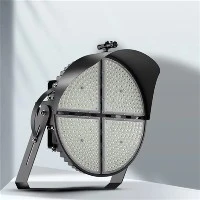
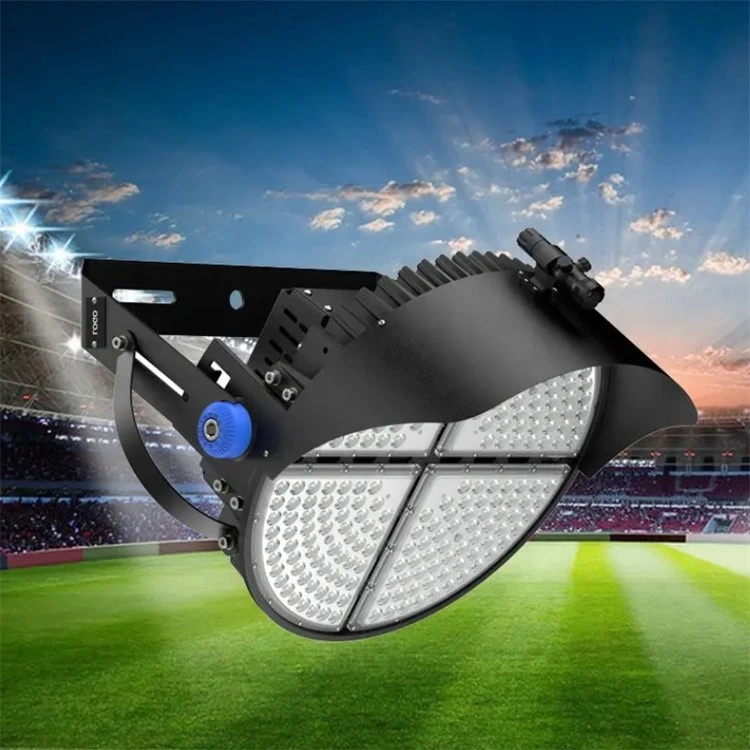
Different from traditional integrated structural defects, our high-power LED stadium flood light (600W/1000W/1600W) adopts a core thermoelectric separation design, which fundamentally solves the heat accumulation problem that causes early light attenuation. The lamp body realizes physical isolation between the LED light source board and the external waterproof driver. The light source heat dissipation cavity and the power supply heat dissipation structure are independent of each other, forming a double natural convection heat dissipation system. This structure completely avoids heat superposition, effectively controls the LED chip junction temperature within a stable and safe range, and inhibits thermal aging of chips and phosphor layers. After professional testing, the lumen maintenance rate of this series of flood lights remains above 92% after 10,000 hours of continuous operation, and the luminous retention rate is still higher than 70% after 50,000 hours of long-term operation, completely eliminating the problem of early light attenuation.
Optical System Optimization to Avoid Visual Attenuation
In terms of optical performance, the product is equipped with high-grade anti-yellowing PC optical lenses, which have strong resistance to high-temperature aging and ultraviolet radiation. Compared with ordinary low-cost lenses that are prone to yellowing and fogging, this professional lens maintains stable light transmittance for a long time and will not cause visual brightness attenuation due to lens aging. At the same time, the equipped metal anti-glare light shield optimizes the light distribution angle, eliminates stray light and light pollution, ensures uniform light output, avoids local light decay and dark areas, and maintains consistent high-quality lighting effects throughout the whole service cycle of the lamp. The high CRI configuration and stable luminous color temperature further avoid color shift attenuation caused by long-term use, meeting the high-standard lighting needs of professional sports venues and high-end engineering projects.
Auxiliary Performance Support for Long-Term Anti-Attenuation Operation
High-Grade Protection Grade Resists Environmental Aging
Environmental erosion is an important inducement for secondary light attenuation of outdoor lamps. This high-performance flood light is rated withIP66 full dust-proof and waterproof grade and IK08 mechanical impact resistance. The fully sealed die-cast aluminum alloy lamp housing and high-quality silicone sealing ring completely isolate dust, rainwater, and humid air, preventing internal circuit corrosion and chip damage caused by moisture penetration. It can operate stably in an extreme temperature environment of -30°C to +50°C, adapting to high-temperature heat accumulation in summer and low-temperature frost erosion in winter. In addition, the optional 6-20KV lightning surge protection device effectively resists outdoor voltage fluctuations and lightning impact, ensures stable working current and voltage of the lamp for a long time, avoids chip loss and light attenuation caused by electrical impact, and lays a foundation for long-term anti-attenuation operation.
High-Quality Component Matching Reduces Operating Loss
The anti-attenuation performance of lamps depends on high-quality full-component matching. This product adopts high-brightness, high-thermal-stability original LED chips with uniform wafer quality and strong anti-aging ability, which fundamentally reduce the chip light decay rate. The external independent waterproof driver has overvoltage, overcurrent, overheating, and short-circuit protection functions, realizing constant voltage and constant current stable output, avoiding chip fatigue loss caused by current fluctuation, and greatly delaying the light attenuation cycle. The fin-type high-density heat dissipation structure of the die-cast aluminum lamp housing maximizes the heat dissipation area, accelerates air convection heat dissipation, ensures that the internal temperature of the lamp body is always within the safe operating range, and effectively suppresses all kinds of light attenuation induced by high temperature.
Long Service Life Reduces Comprehensive Attenuation Loss
Benefiting from thermoelectric separation heat dissipation, high-quality component matching, and high-standard environmental protection performance, this series of flood lights achieve ultra-low light attenuation and ultra-long service life. Compared with ordinary flood lights that need to be replaced frequently due to early light decay, this product maintains stable luminous performance for a long time, with no obvious brightness attenuation within 3 years of use and meeting engineering lighting standards for more than 8 years. It greatly reduces the maintenance frequency and replacement cost of lamps, avoids project operational losses caused by light decay and substandard lighting, and maximizes the long-term economic benefits of outdoor lighting projects. The official 5-year warranty further guarantees the product's anti-attenuation performance and operational stability, providing reliable quality assurance for engineering users.
Professional Selection Tips to Avoid Early Light Attenuation
Prioritize Thermal Structural Design Over Single Parameters
When purchasing outdoor LED flood lights, users should abandon the wrong selection logic of only paying attention to power and luminous flux. The core of anti-attenuation performance lies in the thermal management structure. It is necessary to prioritize products with thermoelectric separation independent heat dissipation structures and avoid ordinary integrated heat dissipation lamps with serious heat accumulation. Excellent heat dissipation design is the most fundamental guarantee to suppress early light attenuation and extend the service life of lamps.
Focus on Long-Term Lumen Maintenance Rate Instead of Nominal Lifespan
The theoretical lifespan marked by manufacturers has no practical reference value. Users must focus on the L70 lumen maintenance rate data, that is, the working hours when the lamp brightness decays to 70% of the initial value. High-quality anti-attenuation flood lights should maintain a lumen retention rate of more than 90% after 10,000 hours of operation, while products with substandard attenuation performance will be eliminated in the early stage of use due to rapid light decay.
Verify Environmental Protection and Component Quality
For outdoor long-term lighting projects, it is necessary to select flood lights with IP66 and above high protection grades and IK08 impact resistance to resist environmental erosion and avoid secondary light attenuation caused by environmental damage. At the same time, check the chip grade, driver protection function, and lens anti-aging performance of the product to ensure that the overall matching performance of the lamp is excellent, so as to achieve long-term stable operation without early attenuation.
Conclusion
Early light attenuation is the biggest hidden danger that plagues the service life and operational value of outdoor LED flood lights. It is not a trivial brightness problem, but a comprehensive performance failure caused by structural defects, inferior components, and environmental stress. It brings multiple losses such as substandard lighting effects, increased energy consumption, and high maintenance costs to engineering projects. The core solution to avoid early light attenuation is to optimize the thermal management structure, adopt thermoelectric separation independent heat dissipation technology, and match high-quality components and high-standard environmental protection performance. Our high-power LED stadium flood lights fundamentally solve the industry pain point of early light attenuation through professional structural design and strict quality control, with ultra-low light decay rate, ultra-long service life, and strong environmental adaptability. For stadium lighting, industrial lighting, municipal engineering, and other long-term outdoor lighting projects, selecting this anti-attenuation high-performance flood light is the key to reducing comprehensive operating costs, improving lighting quality, and realizing long-term stable lighting operation.

How To Cooperate With Us?
We are happy to have total control over the manufacturing process and the calibre of our products since we have our own facilities. Since we are producers rather than just brokers, we are dedicated to providing our customers with the best pricing. Since we are certain that the price and quality of our products are clear, we invite customers to see our samples first. Our commitment to quality and customer satisfaction drives us to continuously provide top-notch goods.
Our address
3rd Floor, 5th Building, Hebei Industrial Park, Hualian Community, Longhua District, Shenzhen, China