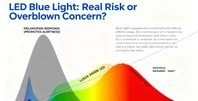
Is LED light source harmful to people?
Because of the narrow spectrum and high brightness of the LED solid-state light source, the biological safety of the lighting even made some people "worry". In the "Yuba's eye injury" incident reported by the media some time ago, the innocent blue light was regarded as the "culprit." ——If this is a "misreading" made by the public because they are not familiar with LEDs, how to scientifically define the impact of LED light sources on the human eye, and how to determine LEDs in different use cases Safety? Especially, for LEDs that are being mass-produced and entering the market, is there a recognized scientific and quantifiable standard for "healthy lighting"? Obviously the latter is of great significance to the overall industry development and many manufacturers . Lighting is facing people, we must emphasize light efficiency, but we must first talk about the quality of light, especially the safety of people. —— "In the future, with the improvement of LED light efficiency and brightness, especially as the application of LED becomes more and more widespread, once LED enters indoor lighting on a large scale, its safety becomes more important." Perhaps because of this, The safety of LED light sources to human eyes and organisms is attracting international and domestic attention.
Regarding the standardization and measurement of optical safety, a lot of research work has been done at home and abroad. IEC TC-76 and CIE D6 are revising IEC62471/CIE S009, and IEC TC-76 is also drafting two of the IEC62471 series of standards. An attachment, including guidance on measurement methods in Part IV. On November 20, 2012, at the standard review and standardization work report meeting of the National Semiconductor Lighting Engineering R&D and Industry Alliance Standardization Committee ("CSA Standards Committee"), the review of 5 industry standards was in progress, "CSA 019-LED Lighting "General Specification for Product Inspection and Testing" also introduces the inspection and test methods of electrical and electronic products for the first time to evaluate the quality of LED lighting products and standardize the quality evaluation system of LED lighting products, which also includes the content of "photobiological safety".
Professor Zhou Taiming of Fudan University stated that LED products below 4000K can be used with confidence. He mentioned to reporters: At present, the public is worried that LED will harm human eyes out of ignorance, and even some experts dare not use it. The former chairman of the International Commission on Illumination also had a process of using LEDs. At the beginning, he also had doubts about LEDs. But now his attitude is very positive and he has done a lot of research work. He has an article called "The quality of lighting and energy efficiency are inconsistent", this document focuses on the analysis of the impact of LEDs on human injuries. After doing calculations at the same time, the conclusion is that we can use white LEDs with a color temperature of 2700K-3000K and a color rendering index above 80. 6000K will hurt when used at home. Lin Yandan, associate professor of the Department of Light Source and Lighting Engineering of Fudan University, believes that in the era of new LED light sources, we can only grasp what people really need, and grasp the characteristics of the spectrum and the adjustment of the spectrum. The need for vision and safety can achieve a better and healthier lighting. She also reminded that not only the lighting, but also the flashes such as Ipad mobile phones are basically high-power white LEDs with a large amount of blue light. When the intensity and fixation time are sufficient, they may damage the retina. A blue and white LED luminous toy to avoid high blue light transmittance of the lens.
Designers who have always been paying attention have also expressed their opinions. Xu Qinghui, the design director of Guangzhou Kebo Lighting Design Company and a member of the Board of Chinese Lighting Designers Association, recently put forward his own views on classroom lighting in primary and secondary schools on his Weibo: It is recommended that the lighting in classrooms in primary and secondary schools should not be eagerly replaced with LEDs; Even if you use LEDs in schools, it is recommended to use 4000K, do not use too high color temperature; and it is recommended that households use LEDs and also do not choose too white light colors, you should use warm white light of about 3000K; in addition, it is recommended that children’s reading and writing desks should not be used LED desk lamp, it is recommended to use 3300K halogen tungsten light source to protect the eyes of desk lamp. At the same time, Xu Qinghui revealed on his Weibo that the Chinese Academy of Building Research is preparing to issue GB50034-2013 next year, which will make strict regulations on the indoor use of LED light sources, one of which is that the color temperature must be lower than 4000K; He also pointed out that the "Civil Building Electrical Design Code" JGJ 16-2008, Section 10.9, architectural landscape lighting issued and implemented this year also clearly stipulates that "be careful not to use light sources with a color temperature higher than 6000K".
Osram senior engineer, Dr. Chen, said that there is no need to talk about blue light and color change. The appropriate blue light component has great positive significance for the regulation of the body's biological clock. He believes that as far as blue light hazard is concerned, what people need to pay attention to is that it is not the blue light itself that causes the damage, but the energy it contains. You stare at the blue sky without any problems, but even if you stare directly at the sun for a short while, it may cause retinal damage. The energy absorbed by the retina mainly depends on the intensity of light and the time spent staring at it, and also has a certain relationship with the color temperature.
On the whole, it is certain that as long as the correct indicators, reasonable design, and suitable application are followed, LED light sources are safe. For enterprises, the development of products should pay attention to optical design, attention to indicators such as glare, color temperature, color rendering index, etc., in terms of light efficiency and light comfort, different choices should be made according to the different use environments. Another point of view is that for manufacturers of finished lamps, they can achieve the purpose of changing the physiological radiance through design, by appropriately changing the distance between the LEDs, and replacing a single high-power LED with more low-power LEDs.