Is Your Photolithography Workshop Still Using Old-Fashioned Yellow Light Tubes? How Does T8 LED Achieve "Zero Blue Light" While Saving Electricity?
In semiconductor and PCB photolithography, yellow lighting is the "first line of defense" to prevent photoresist from being pre-exposed. However, many factories are still using fluorescent yellow light tubes or low-end LED yellow tubes – either the spectral filtering is incomplete, or the lumen depreciation is severe, requiring frequent replacements. How does a true T8 LED yellow light tube actually work? And why has it become the standard for modern yellow light areas? This article explains from three core technical dimensions.
1. The Most Critical Indicator for Photolithography Lighting: Not Brightness, But "Spectral Purity"
Many users mistakenly believe that as long as a tube emits yellow light, it is sufficient – this is a major misunderstanding. Photoresist is extremely sensitive to blue light, violet light, and ultraviolet light below 500nm. Even if the light appears yellow to the naked eye, if the spectrum contains a small amount of short-wavelength components, it can still cause "ghost exposure", ruining entire batches of wafers.
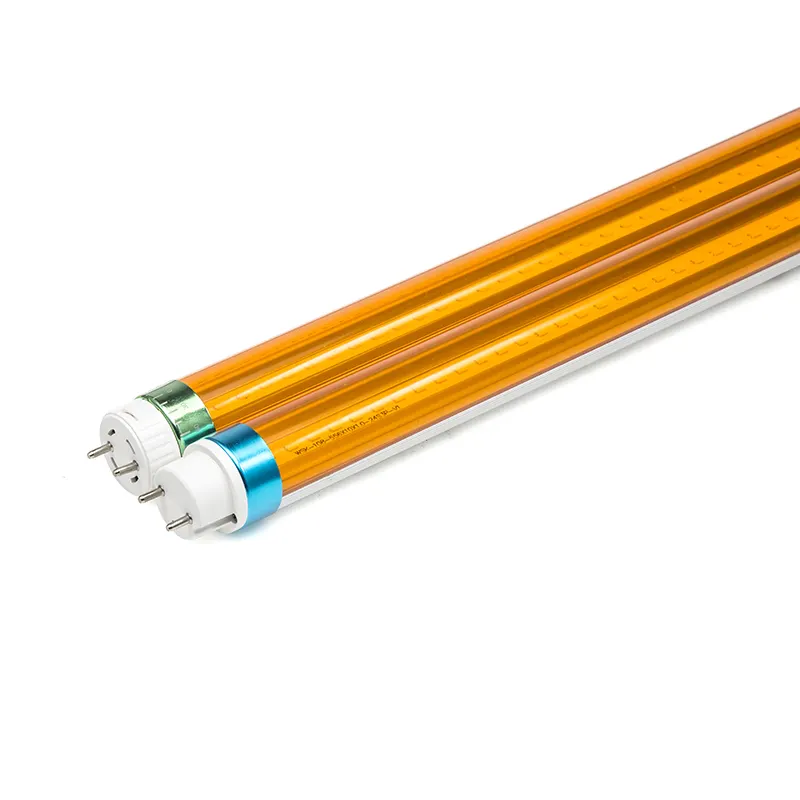
The core of the Benwei T8 LED yellow light tube lies in dual blocking through a specially formulated yellow phosphor + optical-grade PC filter cover, ensuring that the output spectrum falls entirely within the 570nm–590nm range, with near-zero transmittance for wavelengths below 500nm. This is far more reliable than ordinary painted glass tubes or inferior yellow LED chips.
To verify this, professional users use a spectroradiometer. A qualified yellow light tube should have an irradiance below 0.1μW/cm²/nm at 450nm. Benwei's measured data is far better than this standard.

2. From "Bright" to "Stable": How LED Chips and Power Supplies Determine Uniformity?
Non-uniform brightness on the photolithography work surface leads to inconsistent line widths on different parts of the same wafer. The industry requires uniformity ≥95% (i.e., the ratio of maximum brightness to minimum brightness ≤1.05). This depends on two factors:
- Consistency of LED chips: Benwei uses high-brightness yellow-dedicated chips from Taiwan Epistar, with wavelength binning strictly controlled within ±2.5nm, ensuring no stray colors.
- Constant current precision of the power supply: Built-in isolated power supply with Rubycon capacitors, output current ripple <3%, eliminating flicker and brightness fluctuations at the source.
In contrast, cheap LED yellow tubes often use resistor-capacitor dropper power supplies, which not only have a short lifespan but also suffer from severe brightness drift with temperature, making them completely unsuitable for precision processes.
3. Data Comparison: Why You Must Look at L90 Lifespan to "Save Money"
Many procurement personnel only care about the initial price, ignoring the total lifecycle cost. The table below directly compares the real performance of three types of yellow light tubes (using 4-foot T8 tubes as an example):
| Comparison Item | Traditional Fluorescent Yellow Tube | Low-End LED Yellow Tube | Benwei T8 LED Yellow Tube |
| Blue/violet light (<500nm) filtration rate | ~90% (degrades over time) | ~95% (LED chip drift common) | >99.9% (stable for life) |
| Typical power | 36W | 18W | 18W |
| Luminous flux | 2400lm | 2000lm (often exaggerated) | 2200lm (measured, accurate) |
| L70 lifespan | 8,000h | 15,000h | >50,000h |
| L90 lifespan | Not applicable | No data | >50,000h (LM-80 certified) |
| Total 3-year cost (electricity + replacement labor) | 100% | ~65% | ~35% |
| Contains mercury | Yes | No | No |
As shown in the table: although the initial purchase cost of the Benwei T8 LED yellow light tube is slightly higher than low-end LED tubes, its L90 lifespan of over 50,000 hours means it can run for nearly 6 years without replacement under normal production conditions (24 hours/day). In contrast, low-end LED tubes will have lost more than 30% of their luminous flux after about 2 years, causing exposure uniformity to exceed specifications.
4. Beyond Photolithography: "Hidden Functions" of Yellow Light Tubes You May Not Know
The value of T8 LED yellow light tubes extends far beyond semiconductor fabs. They are equally indispensable in the following scenarios:
- PCB solder mask (green oil) process – also requires UV-free lighting.
- Museums / archives – prevents fading of artifacts and ancient books caused by lighting.
- Cleanrooms – yellow light reduces mosquito attraction (longer wavelength, less attractive to insects).
- Night shift work areas – yellow light suppresses melatonin less than blue/white light, helping protect workers' sleep cycles.
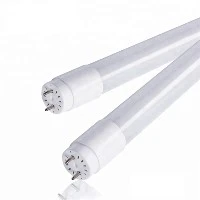
Benwei products are available in transparent yellow (higher brightness) and frosted yellow (more uniform light) covers, suitable for different cleanliness levels and anti-glare requirements. They also feature V2 flame retardant rating and IP20 protection, directly replacing traditional T8 holders.
5. Selection Reminder: How to Identify Genuine "Photolithography-Grade" Yellow Light Tubes?
Many so-called "yellow light tubes" on the market are just ordinary LEDs with a yellow diffuser cover – blue light still passes through. Be sure to ask the supplier for a spectrum graph and confirm the following two points:
- Relative intensity at 450nm <0.5% (relative to peak wavelength).
- The product has passed LM-80 lifetime testing and has an L90 report.
Benwei can provide batch-specific spectrum test reports and original LM-80 data for every T8 LED yellow light tube, ensuring that each tube meets photolithography process requirements.
Conclusion: Lighting in the photolithography area is by no means "just any yellow light". It requires strict control over three dimensions: spectral purity, brightness uniformity, and lifetime reliability. With hardcore features such as German imported materials, Taiwan Epistar chips, and Rubycon capacitor power supplies, the Benwei T8 LED yellow light tube truly achieves "zero blue light, long life, low total cost". Replace once, benefit for six years.