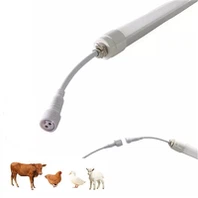
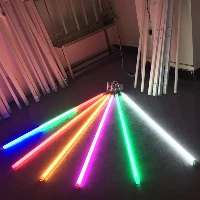
Is Your Vessel Still Using Fluorescent Tubes for Lighting? Switch to LED Tubes and Save Tens of Thousands Annually!
Walk into the engine rooms, decks or living quarters of most ships and you'll find a "legacy issue": rows of fluorescent tubes, humming away, dimly lit and flickering on and off. Why are we still using this century-old technology on modern vessels? The reason is simple: retrofitting is seen as a hassle and sheer inertia prevails.
But today we want to tell you a fact. Replacing fluorescent tubes with LED tubes on a vessel is not only a technological update, it is a solid financial investment that you can feel.

1. The "Four Major Flaws" of Fluorescent Tubes on Vessels
In the demanding marine environment, standard fluorescent tubes present four issues that are simply too significant to ignore:
| issues | Specific Manifestations | Impact of the Marine Environment |
| High energy consumption | The actual power consumption of a traditional 40W fluorescent tube is approximately 45–50W (including ballast losses). | The ship's power system operates under sustained high loads, resulting in increased fuel consumption. |
| Low brightness and rapid decay | The initial illuminance was approximately 2000 lm, decaying to below 1500 lm after six months. | Insufficient illumination in critical areas-such as the engine room and deck-increases safety hazards. |
| The waste is toxic. | Fluorescent tubes contain mercury and are classified as hazardous waste. | Ship waste disposal entails high costs and significant environmental compliance risks. |
| Short lifespan | Average lifespan: approximately 6,000 to 8,000 hours. | Replacement is difficult while the vessel is underway, and maintenance costs are high. |
The Unique Environmental Challenges of Ships: Vibration, humidity, salt spray, and voltage fluctuations-these factors accelerate the degradation of fluorescent tubes, thereby exacerbating the aforementioned issues.
2.LED Tubes: A Tailor-Made Solution for Maritime Applications
The fundamental distinction between LED tubes and fluorescent tubes lies in a generational leap in light source technology. The following is a key comparison of these two light sources in the context of maritime applications:
| Comparison Dimensions | Traditional Fluorescent Tubes | LED Tube Light | Advantages for Marine Applications |
| power | 40W (Actual 45–50W, including ballast) | 18-22W | Saves over 50% on electricity |
| Luminous Efficiency | 50-70 lm/W | 130-160 lm/W | Same Brightness, Half the Power Consumption |
| Average life expectancy | 6000–8000 hours | 5000 hours | 6–8 Years of Maintenance-Free Service |
| Startup Method | Requires a ballast; features a delay | Instant Start, Flicker-Free | Adapted to frequent vessel starts and stops |
| Seismic Resistance | The filament is fragile; the glass is brittle | Solid-state light source, vibration-resistant | Adapted to the vibration environment of cabins and decks |
| Hazardous Substances | Contains Mercury | Mercury-free, RoHS compliant | Avoid Environmental Penalties for Vessels |
| Optical attenuation | Degradation of 20–30% within six months | Lumen depreciation <30% after 50,000 hours | Maintain high illuminance over the long term |
Supported by Authoritative Data: Research conducted by Mokpo National Maritime University in South Korea demonstrates that replacing 40W fluorescent tubes with 22W LED tubes in ship cabins results in a 45% reduction in power consumption and an increase in illuminance of over 20%. Furthermore, retrofit trials conducted on naval vessels under the U.S. National Shipbuilding Research Program (NSRP) have confirmed that the lifespan of LED fixtures can exceed that of fluorescent lights by more than five times.
3.Retrofit Solution: Direct Replacement Without Fixture Exchange
The existing fluorescent fixtures on ships are typically hardwired installations; traditional retrofit methods require replacing the entire fixture assembly-a process that is both time-consuming and labor-intensive. However, a more economical approach is now available: direct-replacement LED tubes.
3.1 Two Mainstream Retrofit Methods
| Renovation Method | Instructions | advantage | shortcoming |
| Direct Replacement (Ballast Compatible) | Remove the fluorescent tube and install the LED tube-no wiring modifications required. | Simple installation-5 minutes per fixture for an electrician. | Due to variations in ballast quality, some ballasts are incompatible. |
| Modify Wiring (Remove Ballast) | Remove the ballast and connect the power supply directly to both ends of the tube. | Fully harnesses the energy-saving potential of LEDs and completely eliminates ballast losses. | An electrician is required to perform the work and modify the wiring. |
3.2 Recommended Solution: Dual-End Powered LED Tubes
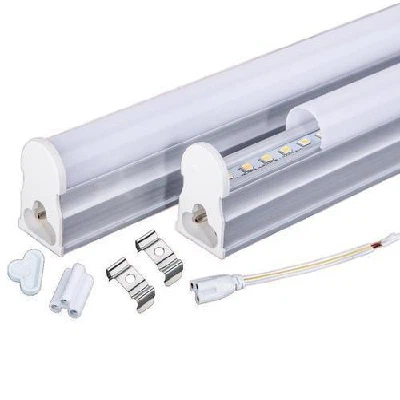
Currently, the mainstream choice for vessel retrofitting is the dual-end powered LED tube:
Ballast-Free Operation: Connects directly to the vessel's 220V or 110V power supply.
Dual-End Power Supply: Fully compatible with traditional fluorescent light fixtures.
Installation Steps: ① Remove the original fluorescent tube; ② Remove or bypass the ballast; ③ Install the LED tube.
Key Reminder: Vessel power grids are subject to significant voltage fluctuations; therefore, it is essential to select LED tubes with a wide voltage input range (AC 100–277V) to ensure stable operation during voltage variations.
4.Economic Benefit Analysis: How Much Can a Vessel Save?
Taking a medium-sized cargo vessel as an example, the total number of lighting tubes throughout the ship is approximately 200 (50 in the engine room, 30 on the deck, and 120 in the living quarters).
4.1 Retrofitting Costs
| Item | Unit Price | Quantity | Subtotal |
| LED Tube Lights (18W) | Approx $4.34/unit | 200 units | $868.07 |
| Labor Costs | Approx $2.17/unit | 200 units | $434.04 |
| One-time Investment | Approx $1302.11 |
4.2 Annual Electricity Savings
| Item | Fluorescent Tube (40W) | LED Tube (18W) |
|---|---|---|
| Single-Lamp Power | 45W (including ballast) | 18W |
| Daily Operating Hours | 12 hours | 12 hours |
| Annual Operating Days | 300 days | 300 days |
| Annual Power Consumption per Fixture | 162 kWh | 64.8 kWh |
| Annual Total Power Consumption (200 Units) | 32,400 kWh | 12,960 kWh |
| Annual Electricity Consumption: | 19,440 kWh | |
| Based on a vessel electricity rate of 1.5 RMB/kWh, the annual electricity cost savings amount to | Approximately $4218.84 |
4.3 Maintenance Cost Savings
| Item | Fluorescent Tube | LED Tube |
|---|---|---|
| Tube Lifespan | 6,000 hours (approx. 1.5 years) | 50,000 hours (approx. 10+ years) |
| Annual Replacement Frequency | 0.7 times per tube | 0 times |
| Annual Replacement Cost (incl. labor) | Approx. $578.72 | $0 |
4.4 Comprehensive Income
| Item | Amount |
|---|---|
| Annual Electricity Savings | Approximately $4195.69 |
| Annual Maintenance Cost Savings | Approximately $578.72 |
| Total Annual Revenue | Approximately $4774.41 |
| Renovation Costs | $1302.11 |
| Payback Period | Approximately 3.5 months |
Note: If the vessel's operating hours are longer (e.g., 18 hours of daily lighting for ocean-going vessels) or electricity rates are higher, the payback period will be shorter.

5.Additional Benefits of Vessel LED Retrofitting
In addition to direct economic benefits, retrofitting with LED tubes also yields several "hidden benefits":
5.1 Enhancing the Vessel's Environmental Rating
- Mercury-free design, eliminating issues associated with the disposal of mercury-containing waste.
- Complies with MARPOL Convention requirements regarding the control of ship-generated pollutants.
- Certain port states offer fee reductions or incentives for environmentally friendly vessels.
5.2 Enhancing Vessel Safety
- Instant-on operation with no flickering, thereby reducing visual fatigue.
- Cold light source; the low surface temperature of the tube minimizes fire risks.
- Vibration-resistant design, reducing the likelihood of power outages caused by tube damage during navigation.
5.3 Improving Crew Quality of Life
- High Color Rendering Index (Ra > 80) lighting, accurately reproducing true colors.
- Buzz-free operation, improving the living environment on board.
- Selectable color temperatures (3000K–6500K) to meet the specific requirements of different areas on the vessel.
6. Key Considerations for Selecting Marine LED Tubes
If you decide to proceed with a retrofit, please be sure to pay close attention to the following selection criteria:
| Key Selection Points | Recommendation Requirements | reason |
| Voltage Range | AC 100–277V (Wide Voltage) | Marine power grids experience significant fluctuations; wide-voltage capability ensures stability. |
| Protection Class | IP65 or higher (Cabins, Decks) | Moisture-proof, Salt-mist-proof, Dust-proof |
| Tube Material | PC Plastic (Polycarbonate) | Shock-resistant and shatterproof, eliminating the risk of glass tube breakage. |
| Luminous Efficiency | ≥130 lm/W | Ensure energy-saving results. |
| Color Rendering Index | Ra ≥ 80 | Meets the visual requirements for critical areas such as cabins and cockpits. |
| Certification | CE, RoHS, and Classification Society Certification (if applicable) | Satisfies ship inspection requirements. |
7.Summary of the story
A ship lighting retrofit may be perceived as a small undertaking, but is in fact a high-value investment of "low initial outlay and high returns." The replacement of traditional fluorescent tubes with LED tubes pays back the initial investment within 3 to 4 months and generates net annual savings of more than $4340.37 thereafter, whilst at the same time improving the environmental compliance rating of the vessel and upgrading the working and living conditions for the crew.
For shipowners and vessel management companies, the transition to LED lighting is one of the most mature, simple, high-ROI retrofit projects in terms of energy savings available under the current state of technology. The alternative is to continue to pay the high cost of electricity and maintenance to keep ageing fluorescent systems running. One up-front investment offers the potential for long-lasting and permanent benefits.
We are ready to provide you with personalised one-on-one technical support for your ship lighting retrofit project, with detailed specifications for marine grade LED tubes, custom retrofit proposals and classification society certification documentation available on request.