With the increasing popularity of indoor cultivation and commercial seedling production, the choice of light source directly determines the growth rate and final quality of plants. Many growers still use traditional T8 fluorescent lamps, but in recent years, T8 LED grow lights have been rapidly replacing them, becoming the mainstream choice in seedbeds, vertical planting racks, tissue culture rooms, and small greenhouses. This article will discuss the advantages of T8 LED grow lights from several aspects, including structure, spectrum, energy consumption, usage scenarios, and key selection points, hoping to provide practical reference for those who are currently selecting lighting fixtures.
What is a T8 LED Grow Light?
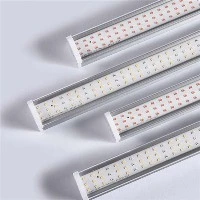
T8 refers to the standard specification of a 1-inch (approximately 2.54 cm) diameter lamp tube. This size was originally the industry standard for fluorescent lamps, leaving a large number of readily available lamp holders and mounting locations. T8 LED grow lights retain this physical size, but the internal light source has been replaced with LED chips, specifically spectrally calibrated for the needs of plant photosynthesis, rather than simply replacing fluorescent tubes with ordinary lighting LEDs. Because the external dimensions remain unchanged, many growers can directly reuse their existing T8 lamp holders and brackets when upgrading their lighting fixtures, without needing to significantly modify the wiring.
How Spectral Design Affects Plant Growth
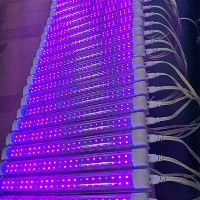
Plants have different spectral requirements at different growth stages. During the seedling stage, blue light is preferred to promote compact and robust plant growth, while during flowering and fruiting, more red light is needed to promote flower bud differentiation and fruit development. Ordinary fluorescent lamps have a fixed spectrum with a broad coverage, and many wavelengths contribute little to photosynthesis. T8 LED supplemental lights, however, can be precisely designed to match the plant's absorption curve, minimizing the waste of ineffective spectrum and ensuring that every unit of electricity is converted into usable light energy for the plant.
Core Advantages Compared to Traditional T8 Fluorescent Lamps
This is a key concern for many customers, summarized as follows:
More Energy Efficient: For the same lamp length, T8 LED supplemental lights typically have significantly better luminous efficacy than fluorescent lamps, consuming less power at the same brightness, resulting in significantly lower electricity bills over the long term.
Longer lifespan: Fluorescent tubes, limited by their filament and mercury vapor operating principle, generally have a lifespan of around 8,000-10,000 hours, and their brightness decays relatively quickly. T8 LED supplemental lights can achieve a lifespan of over 30,000 hours, significantly reducing the frequency of replacement.
Lower heat generation: Fluorescent tubes themselves get very hot during operation, easily causing burns when close to plants, especially in scenarios like vertical planting racks where the light fixture is close to the leaves. LED heat generation is relatively controllable, making it more suitable for close-range supplemental lighting.
Flicker-free and slower light decay: Fluorescent lamps rely on ballasts for ignition, making them prone to flicker and light decay issues; LEDs, with their different driving method, offer more stable light output.
Good installation compatibility: Maintaining the T8 specification, it's easy to directly replace existing lamp holders, making modification costs relatively controllable.
Common Application Scenarios
T8 LED grow lights, due to their slim and elongated shape and uniform illumination, are particularly suitable for scenarios requiring linear lighting:
Seedling racks and seedbeds
Vertical farming
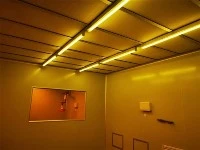
Tissue culture rooms and laboratory breeding
Auxiliary light source for small commercial greenhouses
Home indoor vegetable and flower racks
These scenarios share common characteristics: relatively compact spaces, close distance between the light fixture and the plants, and a need for uniform and controllable linear light sources. This is precisely where T8 LED grow lights have an advantage over panel lights or pendant lights.
Key Parameters to Consider When Purchasing
If you are planning to purchase T8 LED grow lights, it is recommended to focus on the following:
Luminous efficacy (μmol/J): A higher value indicates more effective photosynthetic photons converted per unit of electrical energy, a core indicator of energy efficiency.
Spectral ratio: Based on the type of plant and its growth stage, confirm whether the red and blue light ratio matches the actual needs.
Waterproof and moisture-proof rating (IP rating): Greenhouses and tissue culture rooms have high humidity levels; insufficient protection rating of the light fixture can shorten its lifespan.
Certifications: Certifications such as CE, UL, and RoHS are relevant to electrical safety and export compliance.
After-sales Service and Warranty: The warranty period and response speed of LED driver components directly impact long-term operating costs if problems arise.
Summary
The core reason T8 LED grow lights are gradually replacing traditional fluorescent lamps is that they overcome the shortcomings of fluorescent lamps in efficiency and precise lighting by offering lower energy consumption, longer lifespan, and a spectrum more suited to plant needs, while retaining the installation convenience of the T8 standard. Whether in seedling racks, vertical farming, or tissue culture laboratories, this linear light source provides relatively stable and uniform lighting. When selecting a grow light, it is recommended to consider your planting categories, space structure, and budget, focusing on comparing luminous efficacy, spectrum, and certifications; this is more reliable than simply looking at price.
If you are selecting suitable T8 LED grow lights for your greenhouse, seedling rack, or vertical farming project, please feel free to contact our team. We can provide suitable spectral solutions and product selection advice based on your planting categories, space dimensions, and budget, and can also provide sample testing. We look forward to receiving your inquiry and discussing your specific needs.
https://www.benweilight.com/professional-lighting/led-grow-light/led-grow-light-for-plants-ip67.html