Landscape Lighting Perfected: Creating Drama with Outdoor Spot Lights

As daylight recedes, your garden's character need not disappear with it. Envision softly illuminated trees, intriguing shadows playing across textured walls, and gently lit pathways guiding evening strolls. This transformation isn't accidental-it's orchestrated with light. LED spotlights are the essential tools that bring this nocturnal magic to life.
Unlike broad floodlights that wash areas with uniform brightness, spotlights deliver precision. They accentuate the height of a tree, add depth to a wall, and keep your garden vibrant long after sunset. When strategically deployed, outdoor LED spotlights convert ordinary spaces into captivating focal points. With adjustable models and dedicated landscape designs, complete creative control rests in your hands.
The Practical Advantages of Outdoor LED Spotlights
Exterior lighting must fulfil roles beyond mere illumination. It needs to be energy-efficient, durable, and resilient-qualities where LED spotlights excel.
Energy Efficiency: They consume significantly less power than traditional halogen or incandescent bulbs, leading to substantial savings on electricity bills.
Longevity: With lifespans often exceeding decades of normal use, they eliminate the frequent replacement cycles of older technologies.
Cool Operation: LEDs emit very little heat, making them safe near foliage, wooden structures, and other sensitive materials.
Precision Optics: They produce a controlled, sharp beam, ensuring light falls exactly where intended, minimising spill and glare.
These attributes have firmly established LED spotlights as the modern successor to outdated outdoor lighting.
Crafting Atmosphere with Strategic Lighting
Lighting profoundly influences mood and perception. An upward light at the base of a mature tree can make its canopy glow against the night sky. A carefully angled beam can reveal the intricate texture of a stone wall, hidden in plain sight during the day. Even a modest shrub border gains importance when grazed by a focused spotlight.
Outdoor LED spotlights provide this precise control, making spaces more inviting and giving large landscapes a clear visual structure. The flexibility of adjustable spotlights means your lighting scheme can evolve-shift the focus with the seasons or adapt the ambiance for a special occasion.

Selecting the Right Fixture for the Task
Different landscape features call for different lighting approaches. LED landscape spotlights are designed for varied applications:
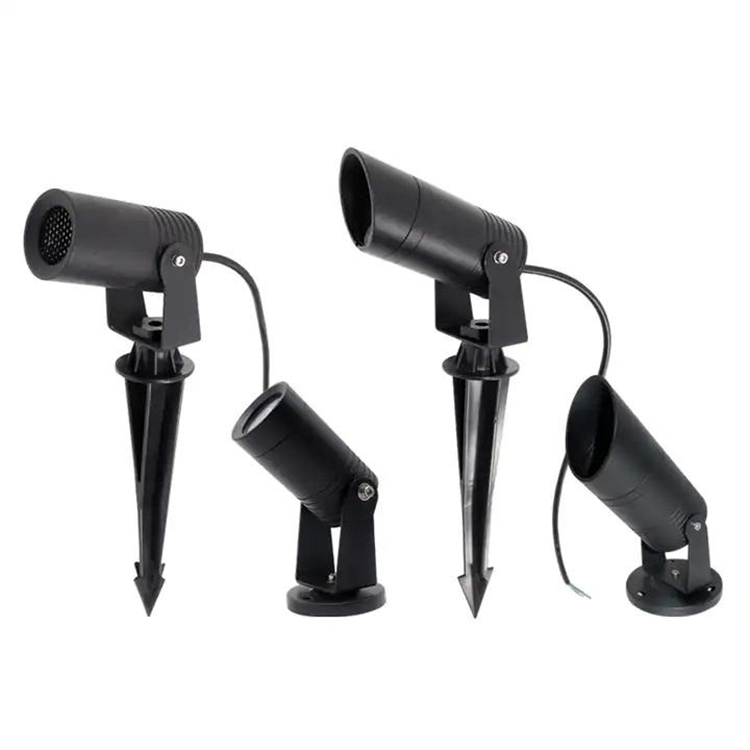
In-Ground/Uplights: Placed at the base of trees, sculptures, or walls to create dramatic upward illumination.
Wall-Mounted: Fixed on structures to cast light downwards across façades or pathways.
Stake Lights: Pushed directly into soil or soft ground for flexible positioning in garden beds.
Adjustable Heads: Feature movable elements to fine-tune the beam's direction and angle for perfect alignment.
A layered lighting plan, often combining several types, achieves the most dynamic and cohesive result.
Principles for Effective Spotlight Placement
Highlight Key Features: Avoid visual clutter by focusing on two or three standout elements-a specimen tree, a water feature, or an
architectural detail.
Build Layers: Use spotlights for accentuation and complement them with path lights, step lights, or ambient wash lighting to add depth and ensure safety.
Manage Brightness: Opt for dimmable adjustable LED spotlights to modulate intensity, softening the scene for quiet evenings or amplifying it for gatherings.
Test After Dark: Finalise angles and positions during nighttime. A slight adjustment can dramatically alter the effect.
The Versatility of Adjustable LED Spotlights
While a fixed beam suffices for static features, gardens are living, changing spaces. Adjustable spotlights offer essential versatility:
Redirect focus to a flowering shrub in spring.
Illuminate a different tree as the landscape matures.
Adjust downward for pathway safety in winter.
Soften angles to prevent glare into windows.
This capacity for adaptation makes them a favoured choice for homeowners seeking a dynamic, long-term lighting solution.
Enhancing Safety and Security
A well-lit exterior is inherently safer and more secure. Spotlights contribute significantly by:
Illuminating entryways for clear visibility.
Defining steps and paths to prevent trips and falls.
Lighting driveways to assist vehicle navigation.
Eliminating dark corners where shadows could gather.
LED spotlights provide this crucial security lighting without the harsh, over-lit feel of traditional floodlights. Their low power consumption allows for extended operation without concern for energy waste.
A Practical Guide to Installation
Plan on Paper: Sketch your garden layout and identify the features you wish to highlight before purchasing any equipment.
Match the Beam: Use narrow-beam spotlights for tall, slender objects like trees, and wider beams for broad walls or large shrub groupings.
Choose a Power System: Decide between low-voltage (requires a transformer and cabling) or solar-powered options based on your site's characteristics and desired light output.
Prioritise Weather Resistance: Select fixtures with an IP (Ingress Protection) rating of IP65 or higher to ensure they withstand rain, dust, and temperature extremes.
Test Before Finalising: Temporarily position lights and evaluate their effect after dark. Make all necessary adjustments before permanently securing them in place.
Common Pitfalls to Avoid
Even quality lighting can be undermined by poor design:
Over-lighting: Using too many fixtures creates a flat, washed-out scene devoid of drama.
Creating Glare: Aiming beams directly into sightlines causes discomfort and ruins the ambiance.
Poor Distribution: Concentrating light in one area while leaving others in darkness creates an unbalanced landscape.
Choosing Inferior Products: Cheap fixtures may fail prematurely, lacking the durability and optical quality required for reliable performance.
Spotlights in Context: Comparing Outdoor Fixtures
How do spotlights differ from other common outdoor lights?
Floodlights: Provide a very wide, diffuse light suitable for large-area security but lack the precision for artistic landscaping.
String Lights: Offer a festive, ambient glow perfect for patios but do not provide focused accent lighting.
Lanterns: Deliver decorative charm and general area lighting but are not designed to highlight specific landscape features.
LED spotlights uniquely provide focus, drama, and detail. Adjustable models add flexibility, while specialised landscape variants offer installation options. Together, they deliver style and control while maintaining high efficiency.
Conclusion
Your landscape should not become a flat, dark void after nightfall. A few well-chosen LED spotlights can make architectural features stand out, guide movement, and create an enchanting outdoor environment. The most successful schemes often use restraint, focusing on a few key elements rather than illuminating everything. With the added flexibility of adjustable models, your lighting can evolve with your garden, ensuring it remains captivating year-round.
A thoughtfully placed lighting scheme enhances safety, extends the usability of your outdoor spaces, and presents your property in its best light, day and night.
FAQ
Q: How many spotlights do I need for my garden?
A: Focus on quality over quantity. Often, just a few well-placed lights to illuminate key features and ensure safe passage on paths and steps are sufficient. Over-lighting should be avoided.
Q: Are spotlights brighter than floodlights?
A: Not necessarily. Floodlights are designed to cover a large area with a wide, intense beam. Spotlights concentrate their output into a more directed, focused beam, making the illuminated object appear brighter, but over a smaller area.
Q: Can LED spotlights truly withstand outdoor conditions?
A: Yes, high-quality LED spotlights are engineered for exterior use. Look for robust construction and appropriate IP ratings (e.g., IP65 for general weather resistance, IP68 for submersion, as needed). They are highly resilient to rain, temperature fluctuations, and UV exposure.
Q: What is a suitable lumen output for garden spotlights?
A: For subtle path or accent lighting, 100-200 lumens may suffice. For highlighting medium-sized trees or architectural features, 300-600 lumens is often adequate. Larger, taller structures might require 700-1200 lumens for a dramatic effect.
Q: What wattage is typical for outdoor LED spotlights?
A: Modern LED spotlights are highly efficient. For most garden applications, spotlights between 5W and 15W are perfectly suitable. Higher-wattage models (20W-30W) are available for illuminating very large trees or buildings.