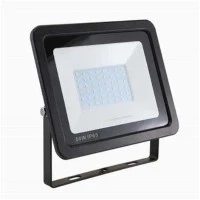
"Light Technology, the Key to Brightness" – A Comprehensive Analysis of LED Structure and Lighting Principles
Specifications:
LEDs (light-emitting diodes) are the mainstream of modern lighting technology. Due to their high efficiency, energy efficiency, long lifespan, and compact size, they are widely used in various fields, including home, industrial, automotive, and outdoor lighting. This article will guide you through the structure and principles of LEDs, providing a deep understanding of how they work, and explore their advantages over traditional light sources and their evolution.
The secret of the lamp's glow lies in this tiny lamp bead!
You probably use LED lights every day, but do you really know what they are?
You've probably grown accustomed to them. From home bulbs to outdoor streetlights, from TV backlights to car headlights, LEDs are ubiquitous and used every day. But have you ever truly understood the inner workings of these tiny bulbs?
LEDs, integrating numerous advances in electronics, materials, optics, and other technologies, are one of the most core components in modern lighting technology. So, how do they actually emit light? And how are they designed internally? Let's start with their structure and principles and gradually understand the true power of LEDs.

What is an LED? A Brief Introduction to Light-Emitting Diodes
LED, short for Light Emitting Diode, is a semiconductor device that converts electrical energy into light. When current flows through it, electrons and holes within it recombine at the p-n junction, releasing energy and emitting photons. This is the fundamental principle of LED light.
Differences from Traditional Light Sources:
🔹Traditional incandescent lamps: They produce incandescent light by heating a tungsten filament, resulting in high energy consumption and a short lifespan.
🔹Fluorescent lamps: They utilise gas discharge and phosphors for light production, resulting in a complex structure and a limited lifespan.
🔹LEDs: They produce light directly through semiconductors, offering low energy consumption, long lifespan, compact size, fast response, and dimmable lighting.

🔍 Quick Facts: Who invented the LED? The concept of the LED was first proposed by British engineer H.J. Round in 1907, who observed that silicon carbide glowed when electricity was applied. It wasn't until 1962 that American engineer Nick Holonyak Jr. invented the first red LED, earning him the title of "Father of the LED". Later, Japanese scientist Shuji Nakamura successfully developed the blue LED, which led to the birth of the white LED, officially entering the lighting market. For this, he was awarded the 2014 Nobel Prize in Physics.
How do LEDs emit light? A complete explanation of the principles of light emission.
Why do LEDs emit light? It can be simply thought of as "electricity passing through a semiconductor generates energy, which is then converted into light".
To simplify the principle, here's how it works:
LEDs are made of a special semiconductor with two layers of different materials, called P-type and N-type, forming a PN junction. When current flows through it, electrons flow from one side to the other and combine with holes, releasing energy. This released energy manifests as light.
You can imagine the LED's light-emitting process as an "energy ladder". When voltage is applied, electrons are pushed across this ladder, jumping from a high energy level to a lower energy level. At this point, they release a photon, the light we see. The height of this "jump" also determines the colour of the light: a higher energy difference corresponds to a shorter wavelength and a bluer colour; a lower energy difference results in a redder colour.

So how is the colour of light determined?
It's determined by the properties of semiconductor materials. Each material has a different "band gap". The larger the band gap, the shorter the wavelength of light produced (for example, blue light).
Blue light material: Gallium nitride (GaN)
Red light material: Aluminum gallium phosphide (AlGaP)
To produce white light, a layer of yellow phosphor is added to a blue LED. This mixture creates the white light we're familiar with.
LED Structure: Every Layer is Complicated
An LED may appear small, but its internal structure is intricate. Its main components include:
✔️Light-emitting chip: The core component responsible for emitting light, determining the wavelength and efficiency of the light.
✔️Electrodes and wires: These carry current to and from the chip, typically packaged with gold or copper wire.
✔️Phosphor layer: Adjusts the colour of light, converting monochromatic light to white or other colour temperatures.
✔️Lens and encapsulant: Protect the chip, guide light, and control the angle of light distribution.
✔️Heat dissipation substrate: helps LEDs quickly transfer heat away to avoid light decay or damage.

Why is heat dissipation so important? While LEDs are highly efficient, they still generate heat. If this heat can't be effectively dissipated, it can affect lifespan and luminous efficiency. Therefore, high-quality LEDs are often paired with aluminium substrates or ceramic heat sinks to improve performance.
🔦 What major breakthroughs has the advent of LEDs brought?
1. Rewriting lighting energy efficiency standards
The high luminous efficiency of LEDs significantly reduces energy consumption for the same brightness, directly rewriting the definition of "energy conservation" in lighting. Compared to incandescent bulbs, they consume approximately 80% less electricity, significantly reducing energy costs for buildings, cities, and industries.
2. Extending lifespan and reducing maintenance costs
LEDs have a lifespan far exceeding that of traditional bulbs, extending their lifespan from 1,000 hours to over 25,000–50,000 hours. This saves significant labour on replacement and maintenance for public facilities, commercial spaces, and homes.
3. Lighting is no longer just about brightness; it's also "controllable".
LEDs can be rapidly dimmed, adjusted to a colour temperature, and integrated with sensors and smart systems, bringing lighting into the "smart" era. This plays a key role in smart cities, the IoT, and energy-efficient buildings.
4. Greater lighting design freedom and more diverse product forms
LED's compact size, high heat dissipation efficiency, and modular design allow lamps to break away from traditional design frameworks and better integrate into architecture, furniture, automotive, and electronic products.
5. Towards a new era of full-spectrum and human-centric lighting
With advances in full-spectrum and high-colour rendering LED technology, lighting is no longer just about "visibility" but is now focused on light that is "comfortable and healthy to look at". LEDs pave the way for human-centric lighting and are driving a revolution in the quality of indoor spaces.
LED is a continuously evolving technology that has not only transformed our conception of lighting but also continues to advance towards energy conservation, intelligence, and high performance. By gaining a deeper understanding of LED structure and light-emitting principles, we can more accurately select appropriate products and understand the future direction of lighting technology.

Xuanfeng specialises in providing high-quality, high-protection lighting fixtures suitable for a variety of scenarios, including indoor, outdoor, and special environments. Our lamps not only meet strict IP standards but also offer energy saving and durability, helping you achieve efficient lighting and sustainable development.
Choose Xuanfeng and ensure that every lamp you use is both reliable and environmentally friendly.
🔗 Learn more about our products and services ➡️http://bwzm15@benweilighting.com
Shenzhen Benwei Lighting Technology Co.,Ltd
Telephone: +86 0755 27186329
Mobile(+86)18673599565
Whatsapp :19113306783
Email:bwzm15@benweilighting.com
Skype: benweilight88
Web: www.benweilight.com
https://www.benweilight.com/lighting-tube-bulb/full-spectrum-grow-lights.html