LED sports lighting vs. LED flood lighting comparison
The development of lighting solutions with differing performance characteristics from those of light fixtures meant for typical outdoor settings has been prompted by the lighting requirements of outdoor sports grounds and facilities (such as parking lots and building exteriors). The lighting needs for sports grounds have gotten so particular that lighting supplies have been made just for lighting athletic playing fields and facilities.
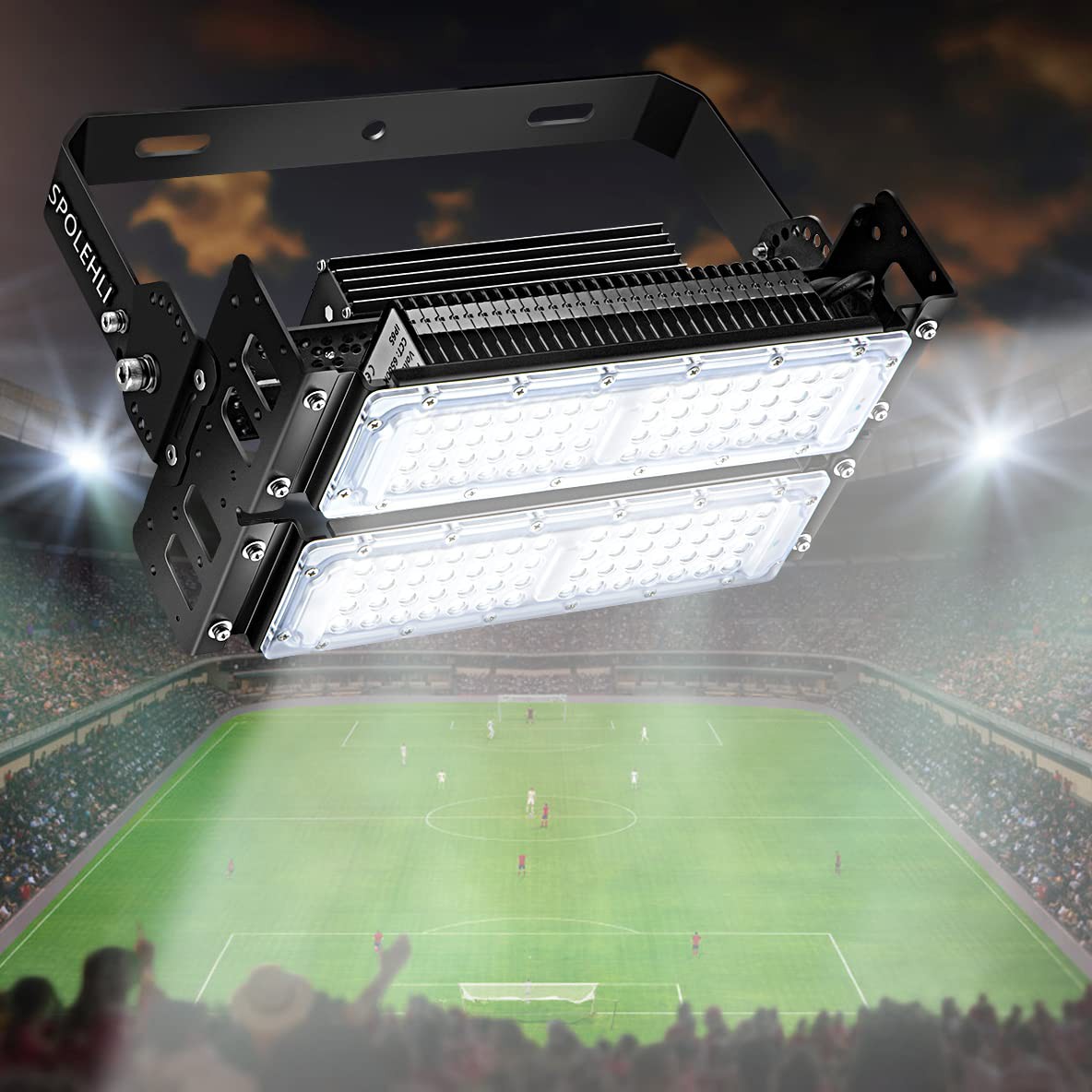
Stadium Lighting Sized for Blog Post for a Football Field
Projects involving sports lighting demand highly particular lighting options. Sports lights are well worth the initial investment for many reasons, despite the fact that it may be tempting to buy less expensive "traditional" flood lights to illuminate your sports field, courts, and facilities. While traditional flood light systems are frequently adequate to handle the lighting demands of outdoor sports venues, general flood lighting is fantastic for some applications.
Sports Lighting Comparison Field lights and ordinary flood lights both provide enough outdoor illumination. Beam spreads, lumen output, light quality and level, mounting height, impact ratings, surge protection, warranties, and wireless control capability, on the other hand, varies significantly from one another.
The major notable distinctions are covered in greater detail below. But first, let's define outdoor sports field lighting and traditional flood lighting because these terms are sometimes used in conjunction with one another or as synonyms when, in fact, they refer to two very different types of LED light fixtures that offer answers to distinct issues.
Definitions for flood lighting and sports lighting
Sports Lighting: What is it?
Large areas used for competitive or leisure sports like baseball, football, soccer, tennis, basketball, etc. frequently employ outdoor LED sports lighting fixtures, a form of outside LED lighting fixture.
The normal height of sports lighting poles is 40 to 100 feet, with 1 to 12 lamps set on each pole.
Schools, colleges and universities, towns, amateur sports organizations, and professional sports teams frequently employ this form of outdoor lighting. These field lights are created with light distribution in mind.
effectively and evenly throughout a playing field over wide areas and distances to enable players and spectators with good vision while significantly reducing operating and maintenance expenses.
Where to use sports lighting:
- Football Fields and Stadiums
- Basketball and Tennis courts
- Race courses & tracks
- Baseball and Softball Fields
- Soccer Fields
- Recreation Fields
- Skate Parks
- Driving Ranges
- & More!
Flood Lighting: What Is It?
Picture of a Flood Light for Blog Posts Flood lighting, which is often installed on poles or buildings to give directed illumination to a range of places, is also utilized for external lighting. Typical flood lights may be installed at different angles, which will alter how the light is distributed.
High intensity discharge (HID) lamps like metal halide, high pressure sodium, and, if they are extremely powerful, mercury vapor lamps are used in the majority of current commercial outdoor flood light applications. Compact fluorescent lights (CFLs) are also used in floodlight setups that don't use LEDs.
LED floodlights versus LED sports lights
The most economical, effective, and ideal method of illuminating outdoor sporting fields, courts, and venues at this time is using LED sports lights.
LEDs can produce between 50,000 and 200,000 lumens at wattages between 300 and 2000, however these numbers are insufficient on their own. Sports lights for fields and stadiums have a number of additional performance attributes that cater to the unique lighting requirements for fields, courts, and stadiums.
The distinguishing performance characteristics that set LED Sports Lighting products apart from LED Flood Lighting products are as follows:
- Beam Spread Variations
- Light Levels and Light Quality
- Lumen Production
- Installing Height
- Surge Defense
- Ability to Control Wirelessly
Beam Spread Variations
Sports Beam Spreads Lights
Several lights, frequently with distinct NEMA beam patterns, are installed on separate poles in LED sports lighting setups. Instead of the patches of brilliant light surrounded by dark regions that arise from employing traditional flood light fixtures, fixtures with several NEMA beam patterns on individual poles may disperse light uniformly throughout a playing surface.
The number of fixtures per pole and the pole height will affect the individual fixture beam angles. The proper mix of beam angles can provide even illumination throughout your area, but the incorrect beam angle can result in cross-beams that can blind players, interfere with play, and create discomfort for both players and spectators.
Because outdoor field lights are mounted at different angles, the way those beams spreads project light at a surface depends on the mounting angle. Two integers that represent the horizontal and vertical light spread of a fixture and the two planes of light where the intensity is at least 10% of the fixture's maximum light intensity are used to identify a NEMA light distribution pattern.
Broadening of floodlighting beams
Commercial LED flood lights are frequently the least expensive alternative for outdoor lighting applications, however the fixtures' design does not produce the illumination outcomes required for sports fields and facilities. One of the greatest problems is that there would be a serious lack of homogeneity in the illumination. It would be challenging for players and observers to see because of the intense shadows and glare that would be present between brilliant areas.
In order to illuminate huge areas and provide light levels for safety and security, flood lights are often produced with "wide" or "extremely wide" beam spreads. The light levels required for ensuring the safety and security of pedestrians and vehicles are substantially different from those required for sporting and recreational activities (you would have a hard time having a catch in a parking lot at night).
The light is dispersed (and less strong) the farther it goes from its source since a broad beam spread indicates that the light emanates from a smaller angle. Beam spreads of more than 70 degrees and up to 130 degrees are most typical for flood lights. When considering light patterns, it's critical to consider the mounting angles, especially with flood lights.
By using flood lights, the ground-level light patterns might alter due to the flexible installation of the flood lights. For instance, if the fixture is inclined "up," a broad beam spread indicates that light will disperse more as it travels farther. Light disperses and loses intensity as it goes away from a focused surface.
Lumen Production
There will be various lighting needs for each field or venue. For bigger and/or more fields, for instance, more lumens will be required. Nonetheless, LED sports lights often provide more lumens than industrial floodlights.
Lumen Output For Sports Lights
Traditional LED sports field lights start at 65,000 lumens and may reach 162,000 lumens. Tennis courts and basketball courts commonly utilize lights with lumen outputs between 36,000 and 85,000. For players and spectators, the ideal lighting and homogeneity are provided by lumen output in conjunction with suitable beam patterns.
Output of Flood Lighting Lumens
The typical lumen outputs of commercial flood lights range from 3,000 to 60,000, which is much less than the typical lumen outputs for sports lights.
Installing Height
Mounting Heights for Sports Lights
Depending on the location, lighting for sports fields and courts can be put at different heights. Certain sports lights must be installed as low as 25 feet since beam angles change depending on height (in tennis and basketball courts, for example), although the typical height is between 40 and 75 feet. Pole heights beyond 75 feet are frequently needed in bigger professional arenas, venues, and fields (where the level of competitive play is considerably higher and the space for spectators and players is much larger).
Mounting Heights for Flood Lights
In contrast, since it is what is required for car and pedestrian safety, most flood lights are set 20 to 30 feet away, with a noticeably broader beam angle that produces far fewer footcandles on the ground.
Final Reflections
In conclusion, for outdoor sports lighting applications, led sport lights offer a much better value than commercial flood lighting. A more economical method of supplying the right foot-candle and light levels that guarantee a safe and competitive playing field is through LED sports lighting. We can assist you in determining if LED sport lights are cost-effective for your company if you're trying to select between normal or LED flood lights and LED sport lights.
Sports lighting is complicated, and various mixes of wattage, lumen output, and beam angle result in wildly dissimilar results. Because each sports project is different, choosing the correct lighting solution is important. Stouch Lighting considers every aspect of your environment to deliver the best possible lighting.
It's crucial to make sure you're looking for the appropriate solutions while updating the lighting in your stadium, court, or playing field. Stouch Lighting can assist you in selecting the appropriate lighting for your project and guiding you through the whole refit and conversion process. For product-only projects, our lighting professionals can assist you in making the best product selections. Alternatively, we can assist you in creating a complete strategy with Specialist Photometrics and implementation plans.
Ready to upgrade to LED sports lights? Tell us more about your project by clicking below:
LED Stadium Light 300-2000w BENWEI INT’L LIGHTING GROUP LIMITED