High mast lighting vs. flood lighting comparison

For significant outdoor lighting installations, selecting the best sort of LED light fixture can be challenging. High Mast Lighting and Flood Lighting are two popular choices for outdoor lighting applications. While these two terms are frequently used interchangeably, they really provide different characteristics, requirements, and solutions.
What is the primary distinction between flood lighting and high mast lighting?
In that both flood lights and high-mast lights are capable of lighting huge regions, they are comparable. The patterns of light distribution, mounting, vibration resistance, surge protection, Darky Sky Compliance, and other factors are very different, though.
The poles for high mast lights are frequently significantly higher than flood lights, which is one of the most obvious contrasts. Your lights will need to be positioned higher if the area you want to illuminate is greater (if you want to keep the total amount of poles to a minimum). Thus, when illuminating broad regions, high tower lights are frequently the preferred choice.
The major notable distinctions are covered in greater detail below. But first, let's define high mast lighting and flood lighting because they are sometimes used interchangeably or simultaneously when, in fact, they are two distinct applications that address separate issues.
Exterior Lighting Definitions
High Mast Lighting
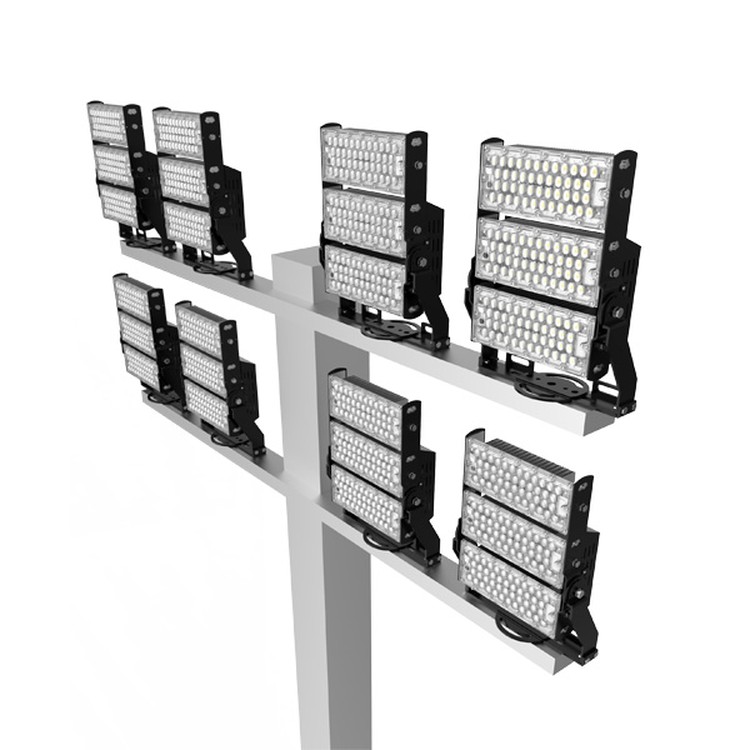
Large-area illumination from extremely high mounting heights is a popular usage for high mast lighting, which is often put on poles that are 50 to 150 feet tall and attached to them by fixed rings or lowering devices. On each pole, there are normally 3 to 12 fixtures. When you wish to illuminate a vast area with fewer poles, high mast lights are the best choice.
Uses for High Mast Lighting: To mention a few, industrial, commercial, and municipal entities frequently employ this style of outdoor lighting in big parking lots, train yards, ports, roads, and airports.
Flood Lighting
Flood lighting, which is often installed on poles or buildings to give directed illumination to a range of places, is also utilized for external lighting. Flood lights' fixtures may be set at different angles, which will alter how the light is distributed.
Uses for Flood Lighting: This sort of outdoor lighting is frequently used to provide light to areas for security, car and pedestrian usage, as well as for sporting events and other major outdoor gatherings.
Flood lights vs. high mast lights
Due to the high mounting height and numerous luminaire arrangement, LED high mast lights are presently the most economical and efficient option to provide even and controlled lighting of sizable outdoor areas.
Additional distinguishing characteristics of LED High Mast products that set them apart from LED Flood Lighting goods include:
- Patterns of Light Distribution
- Mounting
- Dark Sky Conformity with IDA
- Rating for Vibration Resistance
- Surge Defense
Patterns of Light Distribution
Lights on a High Mast
The majority of High Mast Lights are equipped with IESNA Light Distribution Patterns (see image below). Large outdoor spaces benefit from superior visibility thanks to IESNA distribution patterns' overlapping light pattern, high application efficacy, superb homogeneity, and glare reduction. The use of light distribution patterns by high mast lights creates illumination EXACTLY WHERE IT IS NEEDED. High mast illumination is frequently used over floodlights at construction sites when functional visibility is a top concern.
Flood lights
Flood lights are directed fixtures with different beam spreads and projection distances that are manufactured. The spread of light (beam width) from a reflected light source is measured by the beam angle, which is large for flood lights. When light emanates from a lower angle with a broad beam spread, it diffuses more as it travels farther. As a result, light diffuses and loses intensity as it travels away from a light source that reflects light. Beam widths greater than 45 degrees and up to 120 degrees are most typical for floodlights. When considering light patterns, it's critical to consider the mounting angles, especially with flood lights.
As most flood lights have adjustable angle mounting and use NEMA Beam Spreads instead of IESNA Light Distribution Patterns, the angle of the mounting determines how the NEMA Beam Spreads project light onto a surface. Technical information is about to be released. Two values that represent the horizontal and vertical light spread of a fixture and the two planes of light where the intensity is at least 10% of the fixture's maximum light intensity are used to represent a NEMA light distribution.
The distances between the location where the light is installed and the area being lighted define the best Benwei light distribution for your project. At shorter distances, a larger beam is ideal, while for longer ones, a narrower beam. In contrast to even lighting across vast regions, flood lights and, by extension, NEMA Bead spreads are designed to produce focussed illuminations in confined areas.
Benwei's classification system describes distribution of light within the beam produced by the fixture:

In contrast to even lighting across vast regions, flood lights and, by extension, NEMA Bead spreads are designed to produce focussed illuminations in confined areas. You must be aware of the distance between the location of the light's mounting and the area it will illuminate in order to determine the appropriate beam angle for your fixture. You may acquire the proper type of light distribution for your project by selecting the correct NEMA classification type.
Mounting
The types of mounting are another distinction between high mast and flood lights. High mast lights will always be placed using a RIGID Horizontal Tenon, however flood lights can be put on a number of adjustable mount-types (seen below) to modify the angles of illumination.
Mounting Types
High Mast Lighting
This mount, the RIGID Horizontal Tenon, makes sure the fittings are pointed downward (which is IDA compliant). High Mast Lights are attached using a 4-bolt mounting technique in addition to a horizontal tenon to guarantee the security of the lights.
Flood Lights mounted to horizontal tenons often employ "Slipfitter" mounts, which are more vulnerable to vibration issues since they fasten using SET SCREWS.
Flood Lights
Knuckle Mount: This mount uses a 12" Thread to attach to structures and allows the fixture to be pointed in one of many fixed directions.
The most popular because of its adaptability is the adjustable slip fitter. This attachment permits directed lighting by allowing the fixture's angle to be changed from 90 to 180 degrees.
Trunnion Mount - This handy attachment allows for the directionally targeting of the fixture to one of many preset angles and is simple to connect to flat objects (such as buildings or poles).
By using flood lights, the ground-level light patterns might alter due to the flexible installation of the flood lights. For instance, if the fixture is inclined "up," a broad beam spread indicates that light will disperse more as it travels farther. Light disperses and loses intensity as it goes away from a focused surface. Suppose that you are directly directing a flash light at the ground. Then, see (or recall) how that light beam changes as you turn on the flash light until it is aimed directly forward.
Mounting Height
A light's efficiency in reaching its intended target areas is significantly influenced by its mounting height. Knowing the distance between the location of the light's mounting and the area you want to illuminate is necessary to choose the best light distribution pattern for your fixture. To most efficiently illuminate a certain region, you must take into account the distance between the poles when using numerous fixtures per pole.
Lights on a High Mast
High mast lighting poles can be flexible and sensitive to wind loading because of the heights of high mast lighting poles, which are often greater compared to their cross-sectional dimensions (50ft+). High mast lights typically have higher mounting heights (50ft+). The enhanced light coverage from higher mounting heights also makes it possible to use fewer poles.
Flood lights
Flood lights normally have a mounting height of between 15 and 35 feet, although in some circumstances, they can have a higher pole height (although rarely reaching the height of high mast lighting). A broader flood beam will be preferable at smaller ranges since a long-range narrow beam won't be necessary. A highly focused, far-reaching beam is required to illuminate a space at a greater distance.
It's vital to keep in mind that in order to prevent substantial overlapping of lighting (or a total lack of overlapping, which is also undesirable), you will need to take into account the distance between light sources and the beam's radius when erecting light poles for a new project.
IDA Dark Sky Compliance and BUG Rating
Requirements for Dark Sky Compliance provide protection against light pollution. Dark Sky Compliant outdoor lighting fixtures cover the light source to reduce glare and promote better eyesight at night.
- A few characteristics of Dark Sky Compliance are as follows:
- Just turn on the lights when necessary (with dimmers, timers or photo-controls)
- Only regions that require illumination are lit by lights.
- Lighting is only as bright as is required or safe.
- Most crucially, lights must utilize optics or shielding to stop "uplight" in this context.
To retain any IDA compliance rating, high mast lighting will always be positioned using a horizontal tenon (such that the lights' optics are looking downward). Remember that while photos of extremely tall poles may resemble high mast lights, most of the light is lost when the optics of high mast fixtures are not aimed downward and they are improperly placed.
Flood lights, in contrast, lose any IDA compliance rating when they are not orientated 90 degrees to the pole since they employ changeable angles with mounting brackets. The ability of flood lights to produce uniform lighting on the ground is diminished once they are slanted.
As a result, only a select group of flood lights will be deemed IDA Compliant. Even though it might be typical to see "IDA Complaint" listed on an LED Flood Light specification sheet, if you read the fine print, you'll discover that as soon as the light fixture changes its mounting angle (which is why you would use a flood light in the first place), it will no longer be IDA Compliant. Nevertheless, this mounting orientation is not typical for flood lights, and a 90 degree angle actually negates the purpose of choosing flood lights in the first place. In principle, flood lights that point straight downward (placed at a 90 degree angle) are IDA compatible.
Bug Rating
BUG stands for Backlight (light coming from behind a fixture), Uplight (light coming from above the luminaire's horizontal plane), and Glare (amount of light coming from high angles). Fixtures that minimize all three of these enhance light quality, lessen harshness, and are frequently Dark Sky Compliant.
The Dark Sky Compliant light zones, which are the accepted light levels in particular outdoor places, work in conjunction with the Bug Rating system, which was developed by the International Dark Sky Association and IES. A fixture with a U0 BUG rating sends no light upward; the lower the number, the better and the more probable it is that the fixture complies with IDA standards.
Conclusion
In summary, there are a lot of distinctions between flood lights and high mast lights, and there are a lot of things to consider when deciding which product type is best for your project. In order to establish if a fixture will satisfy the lighting requirements for your planned application, it is frequently desirable to have a photometric evaluation.
Do you need help choosing fixtures or performing a retrofit? You have our support! You may pick the appropriate lighting, fixtures, controls, and equipment for your area with the assistance of Benwei Lighting as you move through this process (s).
click here for more information about LED Stadium Light 300-2000w